

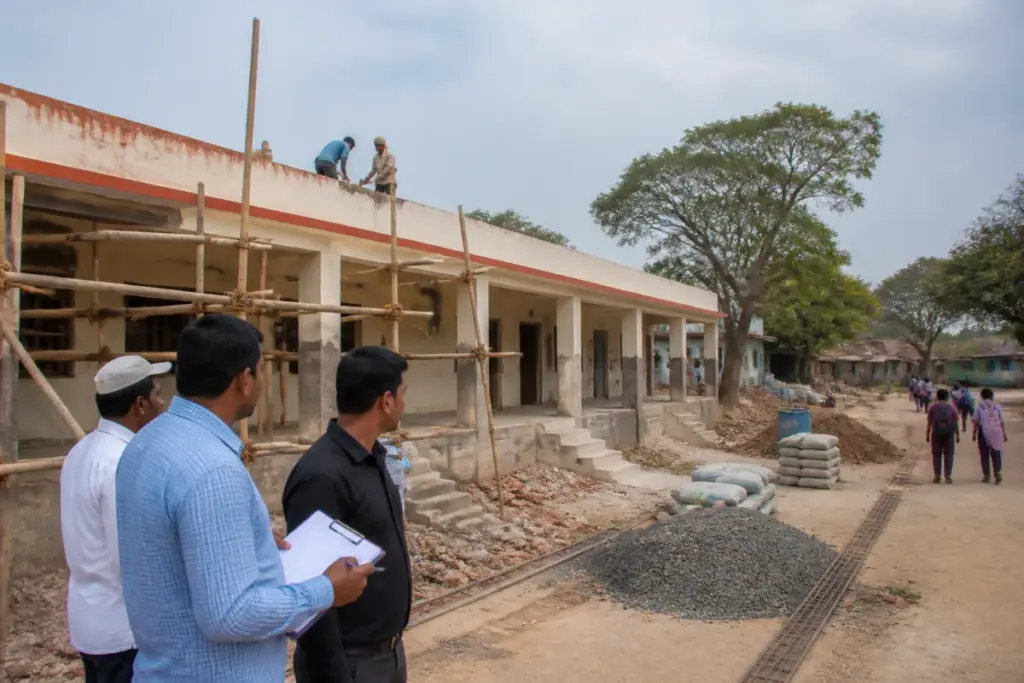
Questions over Pune Zilla Parishad’s model school programme have moved beyond the value of individual contracts. The reported dispute concerns an estimated Rs 180 crore in tenders covering 303 schools, but its deeper significance lies in how public construction projects are planned, bundled, awarded, supervised and audited. Allegations raised by political group leaders point to possible weaknesses in each of those stages, while the Zilla Parishad president has said that complaints will be formally examined if they identify breaches of prescribed criteria.
The allegations do not establish that financial loss or procedural violations occurred. They do, however, identify a set of records and decisions that would need to be examined before the programme can be judged on value for money. These include the basis for selecting schools, the preparation of estimates, the structure of the tendering process, the qualification of contractors, the appointment of project consultants and the certification of completed work.
The immediate dispute began with questions about the tender rates. BJP group leader Shivajirao Buchade-Patil and Shiv Sena (Uddhav Balasaheb Thackeray) group leader Vijay Shinde said that none of the tenders received bids at rates 20 to 25 per cent below the estimates. They claimed that this raised the possibility of a loss of Rs 40 crore to Rs 50 crore to the Zilla Parishad. That figure remains an allegation, not an established audit finding. Determining whether the estimates were reasonable would require comparison with the approved designs, quantities, schedule of rates, market conditions and the actual scope of work.
The tender structure itself is another central issue. According to the report, the first phase of the model school programme selected 303 schools. Estimates were prepared by engineers and staff in the construction division of the education department’s Sarva Shiksha Abhiyan machinery. The tendering process was then conducted through the north and south construction divisions. The group leaders have asked why the estimating and tendering responsibilities were arranged in this manner and whether the institutional separation was adequate to prevent conflicts or weak scrutiny.
This question matters because public procurement is not limited to the final bid price. The way works are grouped can affect the number of firms able to participate, the scale of financial and technical capacity required, and the possibility of competition. The leaders objected to the alleged “clubbing” of tenders, arguing that combining works may have benefited particular contractors. They also asked whether the contractors’ financial capacity, technical qualifications and required documents were properly checked.
The report does not provide the tender documents, the number of bids received, the approved estimates, the lowest quoted rates or the qualification records of the successful contractors. Without those documents, it is not possible to determine whether the tender design reduced competition or whether the quoted rates represented a procurement failure. Those are precisely the records that a formal inquiry would have to place in the public domain or submit to an authorised audit process.
The allegations also extend to implementation. The group leaders claimed that some contractors may have executed the works through subcontractors rather than directly, and asked who actually carried out the construction, how quality was inspected and whether contractual conditions were followed. Subcontracting, where permitted by a contract, is not by itself proof of wrongdoing. The relevant questions are whether it was disclosed, whether approval was required, whether the subcontractor met the specified requirements and whether the principal contractor remained responsible for quality and delivery.
Quality concerns had reportedly been raised in meetings of the standing committee, general body and construction committee. The political representatives alleged that these complaints were not investigated. The report does not establish whether site inspections were conducted, whether defect registers were maintained, or whether payments were linked to measurable completion and quality certification. These gaps are significant because the value of a school infrastructure programme depends not only on the number of sanctioned works, but also on whether the assets remain usable after completion.
The appointment of 13 architects or project consultants has become a separate point of contention. Buchade-Patil said the consultants were appointed after estimates had been prepared and after some part of the tender process had been completed. A fee of one per cent was also cited. The issue is not simply the fee amount. It is whether the consultants were appointed through a transparent process, what responsibilities they were given, whether their appointment preceded the work they were expected to supervise, and whether their payments were connected to defined deliverables.
One school in Sonori, Purandar taluka, illustrates why project-level verification is necessary. The report says the school’s work had been completed in 2022 and 2023 using corporate social responsibility funds from Bharat Forge and Indian Oil. Despite this, the school was allegedly included in the model school programme with a provision of Rs 102.60 lakh. The group leaders further claimed that Rs 27 lakh in repair bills were paid and that a bill of Rs 63.29 lakh was released even though required photographs and videos were not available. They also questioned a fresh provision for waterproofing despite earlier waterproofing work.
These claims require examination against the school’s asset history. The key records would include the CSR agreements, completion certificates, earlier bills, the model school estimate, work orders, measurement books, inspection reports, photographs, videos and payment approvals. Inclusion in a later scheme could have a legitimate explanation if the new work differed from the CSR-funded work, but the supplied report does not establish whether the scopes overlapped. Nor does it establish whether the alleged payments were irregular. That distinction is essential before the claims can be treated as findings.
The dispute also raises the less visible question of how old materials are accounted for during school renovation. The group leaders asked whether old doors, windows, grills and granite flooring removed during the work were auctioned, how they were disposed of and whether records were maintained. In a large programme spread across hundreds of schools, material disposal can affect both financial accountability and the reliability of completion records. The supplied report does not state whether inventories or auction records exist.
The Zilla Parishad’s response provides an important institutional qualification. President Veerdhaval Jagdale said that the clubbed tenders and estimates were processed before the current office-bearers assumed their positions. He also said that complaints had been discussed in the Zilla Parishad general body and that one complaint had not found factual substance. At the same time, he asked the group leaders to submit their complaints formally and said that the claims would be verified and investigated if prescribed criteria had not been followed.
That response places the next step within an administrative process rather than a political exchange. A credible examination would need to distinguish between three different questions: whether the procedure complied with applicable rules, whether the work delivered matched the sanctioned scope and quality, and whether public funds were paid for duplicated, incomplete or inadequately documented work. Each question requires different evidence and should not be collapsed into a single estimate of alleged loss.
The case also demonstrates the governance challenge created when a public education programme combines many sites, multiple construction divisions, external consultants and several funding streams. The report identifies the model school programme, the model PSC scheme and CSR-funded works as connected areas of concern, but does not establish whether they share the same contracts or administrative controls. That relationship would need to be mapped before conclusions are drawn about the wider programme.
For residents, teachers and students, the most important outcome is not only whether an allegation becomes a formal finding. It is whether the schools selected for improvement receive durable, documented and usable infrastructure. For the Zilla Parishad, the immediate accountability test is whether it can provide a clear record of selection criteria, tender competition, contractor eligibility, consultant appointments, site inspections, payments and material disposal.
The evidence currently confirms that named representatives have raised detailed allegations about a major school infrastructure programme and that the Zilla Parishad leadership has indicated that formal complaints can be investigated. It does not yet confirm the alleged Rs 40 crore to Rs 50 crore loss, tender manipulation, substandard work or duplicate payments. The next material developments will be the submission of formal complaints, the administration’s verification process and the release of documentary findings on the 303-school programme.


