

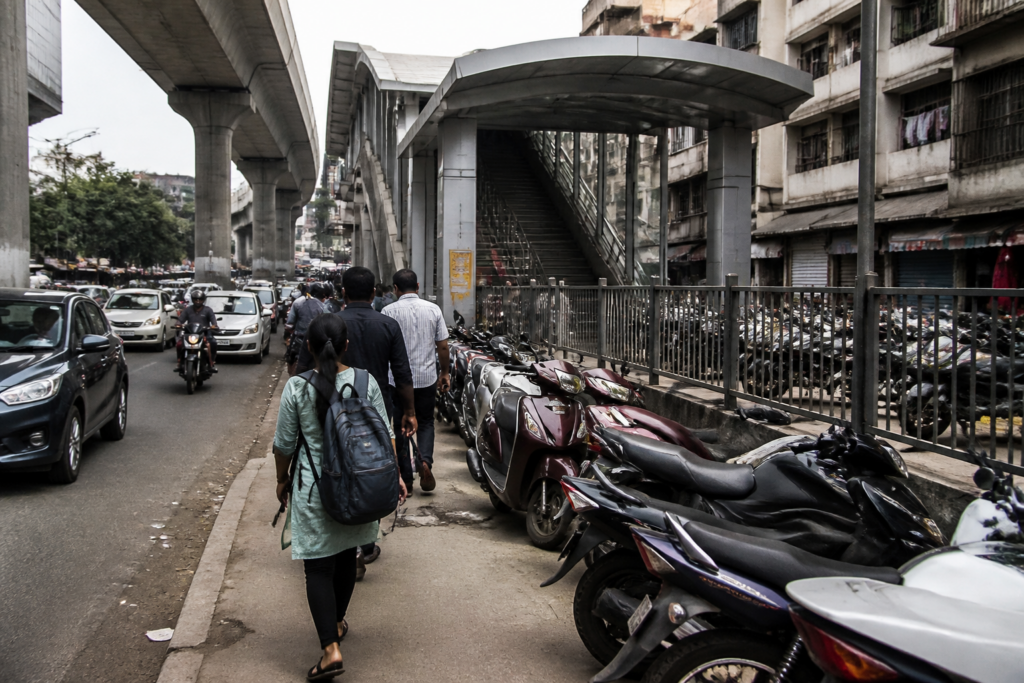
Pune Metro was intended to make public transport more accessible, but along the Deccan Gymkhana–Vanaz corridor, the journey to several stations can still force pedestrians into the road. A Civic Mirror inspection and interviews with commuters and sustainable-transport advocates point to a recurring problem: station entry and exit gates, parked vehicles, narrow footpaths, missing cycle infrastructure and unresolved drainage issues are competing for the same limited public space.
The problem is most visible between Garware College and Vanaz, where pedestrian movement around stations is reported to become particularly difficult during peak hours. People walking to the metro have to negotiate motorcycles and other vehicles parked on footpaths, while station access structures occupy portions of the space meant for walking. When the remaining passage is too narrow, pedestrians are pushed towards moving traffic.
This is not simply a question of whether metro stations have been built. It is a question of whether the surrounding street network allows people to reach them safely. Public transport depends on the complete journey from home, school or workplace to the station. A train may reduce travel time on the main corridor, but that benefit is weakened when the final approach involves obstructed footpaths, unsafe crossings or a lack of space for cycling.
Pranjali Deshpande, who works independently in the sustainable-transport sector, identified station entry and exit gates and footpath parking as the two main problems on the corridor. She said the gates occupy pedestrian space and that extensive parking on footpaths adds to the difficulty. During busy periods, rising passenger movement makes the available walking space even harder to use.
Deshpande said station entrances and exits should open into safer, protected areas wherever possible, rather than creating obstructions on footpaths or forcing passengers to walk along busy roads. She cited the exit arrangement at the Zashi Rani Chowk–Balgandharva metro station as an example of a passage opening into a protected space, and said similar arrangements could reduce safety risks at other stations during peak hours.
The situation around the SNDT Metro station illustrates how older street-safety problems can remain after a new transport system is introduced. According to Deshpande, narrow footpaths and disorderly parking have continued in the area since the station began operating. The report also raises questions about how much space was reserved for other modes while the metro infrastructure was being planned.
Cycling is a particular gap. Deshpande said there is no fully separated cycle route along the corridor, despite the presence of several schools. Her example was a student travelling by metro from Vanaz to SNDT and then cycling to a nearby school. Without a protected cycle connection, the combination of metro and cycling becomes difficult and potentially unsafe, reducing the practical value of both modes when used together.
The report also records concerns from social worker Prashant Kanojia about restricted road space near the bridge and BSNL area in Kothrud. He alleged that the planning of metro piers and associated infrastructure did not adequately account for future traffic requirements. He also questioned whether the current pier arrangement would support a future metro extension towards Chandni Chowk and whether the possible need for a flyover should have been considered during the planning stage. These claims have not been independently confirmed through an engineering assessment.
Kanojia said the road near the Motiwala shops, particularly close to BSNL, has become extremely narrow, creating difficulties for both drivers and pedestrians. He also pointed to traffic-management concerns near the bridge, including restrictions on right turns from the Kalmadi and Garware sides. According to his account, these restrictions push motorists towards alternative routes, while some avoid the bridge because of the inconvenience and add pressure to the lower road.
He further raised concerns about a signal on the steep approach after the bridge and the movement of large dumpers on the route. The report does not provide accident data or an official traffic-engineering assessment to establish the scale of the alleged risk. It does, however, identify the need to examine traffic flows, turning arrangements and pedestrian movement on both sides of the bridge as one connected problem rather than as separate complaints.
Station access is also linked to parking. Commuters arriving by two-wheeler reportedly struggle to find suitable parking near stations. If organised parking is unavailable, vehicles may be left in unauthorised locations, potentially exposing users to penalties and adding to footpath obstruction. Kanojia proposed using an unused floor at Vanaz station for parking, estimating that it could hold between 700 and 800 vehicles. The report makes clear that the actual capacity would require a technical assessment before any implementation.
The drainage and sanitation concerns mentioned in the report widen the issue beyond transport design. Kanojia alleged that leaking septic tanks in Vanaz, Anandnagar and the SNDT area allow wastewater to flow onto roads, creating odour and unhygienic conditions for pedestrians. He also said water accumulates during the monsoon near the waste depot beyond Vanaz station because the necessary drainage connections are absent. These claims, like the other local infrastructure complaints, require confirmation by the responsible civic agencies.
For daily passengers, the consequences are immediate. Commuter Nikunj Kulkarni said people use the metro to save time, but reachability becomes difficult when vehicles are parked on footpaths. Another commuter, Adwait Shastri, said sufficient space is needed to walk safely near stations, especially during peak hours, and that pedestrians should not have to enter the road to get around parked vehicles.
The corridor demonstrates a recurring institutional challenge in Indian cities: transport projects are often assessed through their major infrastructure, while the public realm around that infrastructure is treated as a secondary matter. A metro station has a formal operator, but the surrounding footpath, parking enforcement, drainage, road geometry and cycling network may fall under different authorities. Unless these responsibilities are coordinated, each agency can complete its own component while the passenger experiences the gaps between them.
The evidence supplied in the report does not establish whether the station gates were designed after a comprehensive pedestrian-capacity assessment, whether footpath parking enforcement has been systematically reviewed, or whether a corridor-wide accessibility audit has been conducted. It also does not provide official data on pedestrian injuries, traffic volumes, parking demand, drainage capacity or the number of passengers affected. Those missing measures matter because isolated fixes may not resolve a problem that shifts between adjacent streets and station approaches.
A useful assessment would therefore need to examine the corridor at walking speed and during peak hours. It would map the clear width of every footpath, identify where station structures interrupt movement, record illegal parking, review crossings and turning movements, and test whether drainage and sanitation systems function during the monsoon. It would also need to include school routes, cycle access and the availability of formal two-wheeler parking. The report’s accounts indicate the subjects of such an audit, but do not themselves constitute one.
The larger urban question is whether Pune’s metro expansion can deliver a genuinely multimodal network without protecting the space between the station and the street. The report shows that the metro’s usefulness is being judged not only inside trains and stations, but also on footpaths, at bridges, beside shops and near school routes. For passengers, those spaces are not peripheral infrastructure. They are the first and last part of the public transport system.
Civic Mirror reported that Maha-Metro Additional General Manager for Public Relations and Administration Chandrashekhar Tambwekar did not respond to telephone calls and messages. The next important step is therefore an official response addressing station access design, footpath parking, cycling provision, drainage, parking capacity and traffic management along the Deccan Gymkhana–Vanaz corridor. Until those questions are answered with corridor-level evidence, Pune’s metro access problem remains documented primarily through the daily experience of pedestrians.


