

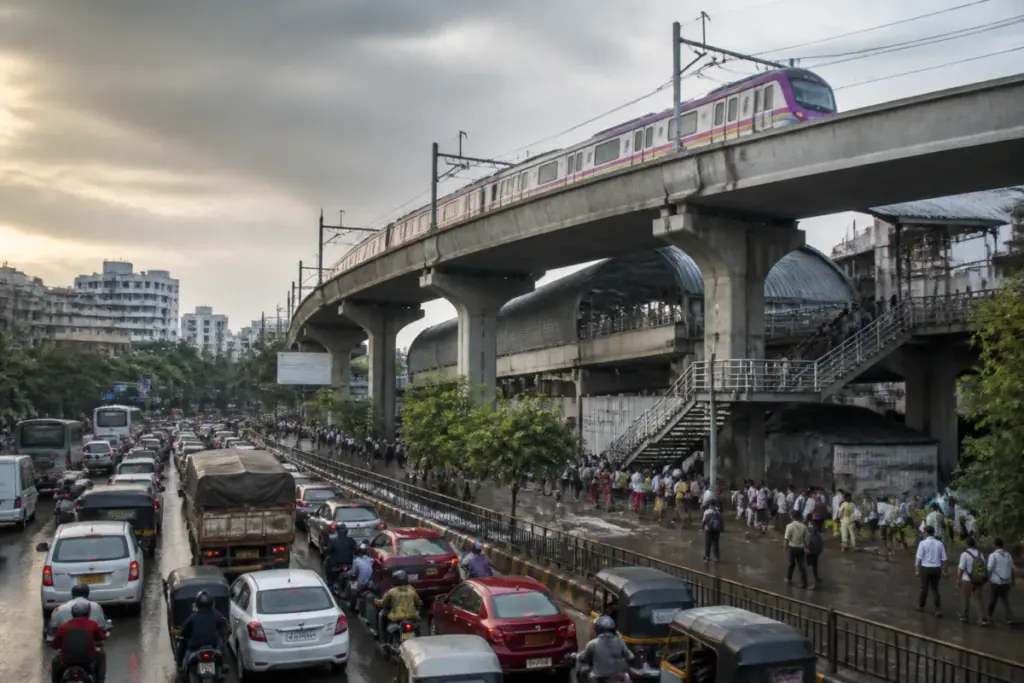
Pune Metro has given the city a larger public transport option, but its growing passenger base has not translated into an end to road congestion. The gap is not simply a question of how many kilometres of metro track Pune has built. It is a question of whether the city’s transport system is being planned as one network, connecting expanding suburbs, buses, walking routes, cycling infrastructure and major road projects.
The first phase of Pune Metro covers 33.28 kilometres and has 29 stations. It carries approximately 235,000 passengers a day, according to the figures cited in a Maharashtra Metro Rail Corporation presentation reported by Lokmat. That ridership indicates that the system is being used at a meaningful scale. Yet the persistence of congestion shows that metro ridership and citywide traffic reduction are not interchangeable outcomes.
This distinction matters because Pune and Pimpri-Chinchwad are growing as one increasingly connected urban region. Population growth, the rapid expansion of suburbs and rising private vehicle ownership are increasing travel demand across municipal boundaries. A metro line can move large numbers of passengers along its own corridor, but it cannot by itself serve trips that begin far from stations, end beyond the network or require multiple transfers without reliable connections.
The current expansion pipeline illustrates the administrative distance between a proposed corridor and a functioning transport service. The detailed project reports for the Hadapsar–Loni Kalbhor and Hadapsar–Saswad Road corridors have been sent to the Union government after approval by the state government, while inter-ministerial consultation is under way, the MahaMetro presentation says. These projects therefore remain subject to processes beyond the preparation of a plan or the announcement of an alignment.
In Pimpri-Chinchwad, proposals under consideration include links from Bhakti-Shakti Chowk to Mukai Chowk and corridors connecting Baner, Nashik Phata, Vallabhnagar and Chakan. The report says these proposals are being discussed at the Pimpri-Chinchwad Municipal Corporation level. Discussion, however, is only one stage in a longer sequence involving route finalisation, detailed planning, approvals, financing, land acquisition and construction.
Several other extensions are also at different stages. A roughly three-kilometre connection to Pune airport is being planned. The expansion planning also includes routes involving Pune district court, Pune Gate, Kondhwa, Yewalewadi, Katraj, Khadi Machine Chowk and Baner. A Pune–Purandar airport connection is under consideration, with preliminary work on its detailed project report under way. The Vanaz–Chandani Chowk extension is awaiting Union government approval, while the Ramwadi–Wagholi corridor awaits approvals from the state and Union governments. The Khadakwasla–Kharadi and SNDT–Manikbaug corridors are also awaiting Union government approval, according to the reported project status.
The range of proposals creates an important planning challenge. A city can appear to have an extensive future metro network on paper while commuters continue to experience limited access on the ground. The practical value of each corridor depends on when it receives final approval, whether funding is secured, how land and construction issues are handled, and when passenger service actually begins. Until those milestones are completed, a proposed route remains a planning commitment rather than available transport capacity.
The most important issue is therefore not only network expansion, but network access. Many passengers need a reliable way to reach a metro station before the system can replace a private vehicle for the full journey. The report identifies bus services, safe pedestrian routes, cycling facilities and organised parking as necessary parts of that connection. It also stresses coordination with Pune Mahanagar Parivahan Mahamandal Limited bus services and other public transport modes.
This is where the difference between a metro project and a metropolitan transport system becomes visible. A station may be close on a map but difficult to reach if the surrounding road has no continuous footpath, if crossings are unsafe, if buses do not connect with train timings or if parking arrangements push more vehicles into already crowded streets. In such conditions, metro services can attract passengers along selected corridors without substantially reducing the number of private vehicles approaching the wider transport network.
The reported ridership figure of approximately 235,000 daily passengers is significant as a measure of use, but it does not establish how many car or two-wheeler trips have been replaced. Nor does it show whether passengers are arriving by bus, walking, cycling, two-wheelers or cars. That information is not provided in the supplied material. Without such evidence, the effect of metro operations on total road traffic cannot be assumed from passenger numbers alone.
The same caution applies to the proposed second phase. The critical question is not simply how many new routes are added, but which high-demand areas they connect and how easily passengers can transfer between services. A corridor that terminates without strong interchange facilities may provide a useful ride while leaving the beginning and end of the journey dependent on private vehicles. The report accordingly places emphasis on connecting crowded areas, improving access to stations and reducing dependence on private transport through coordinated services.
The proposed interaction between the High Capacity Mass Transit Route, or HCMTR, and metro lines adds another layer of complexity. Where the two projects intersect, their designs need to be coordinated from the beginning. Flyovers, metro pillars, ramps, connecting roads and station structures can compete for the same limited urban space. If the projects are designed separately, changes during construction may affect cost, timelines and traffic management.
This is not merely an engineering coordination problem. It is an institutional one. Metro planning, municipal road construction, bus operations, pedestrian infrastructure and traffic management often involve different agencies, budgets and approval chains. The usefulness of the final network depends on whether these institutions make decisions around shared movement patterns rather than completing isolated projects. The HCMTR–metro intersections therefore test whether Pune’s transport planning is integrated or merely concurrent.
The approval status of the proposed corridors also points to the importance of governance in infrastructure delivery. The reported obstacles include waiting for Union government approvals, delays in implementation and administrative processes at different stages. These are not secondary details. They determine when a corridor can move from a concept to a detailed project report, from a report to approval, from approval to funding and from funding to construction.
A detailed project report can define an alignment and establish a project framework, but it does not by itself create a usable transport service. The next stages involve institutional decisions, financial commitments, land requirements and construction management. The report’s distinction between routes awaiting approval, routes under consultation and routes still undergoing route determination shows that the proposed expansion is not at one uniform stage of readiness.
Pune’s transport challenge is consequently a capacity problem as much as a congestion problem. The city needs more public transport capacity because its urban footprint and travel demand are expanding. But capacity must be distributed across the journey, not only concentrated on the metro track. Station access, bus connectivity, transfers and safe movement around stations determine whether the network can attract trips that would otherwise be made by private vehicle.
The evidence supplied in the report confirms three things. Pune Metro’s first phase is operating and carrying approximately 235,000 passengers daily. The city and its neighbouring urban areas have a substantial pipeline of proposed extensions at different administrative stages. And road congestion has not disappeared simply because metro services have started. What the material does not establish is the exact reduction in private vehicle use attributable to the existing metro system, or a confirmed completion date for each proposed corridor.
That uncertainty makes implementation milestones more important than the size of the planned network. The next meaningful indicators will be approvals for pending corridors, progress on detailed project reports, clarity on funding and land processes, and the design of bus, walking, cycling and interchange connections. Pune’s metro expansion can improve regional mobility, but its effect on congestion will depend on whether the city builds an integrated transport system around the railway rather than treating each project as a separate line.


