

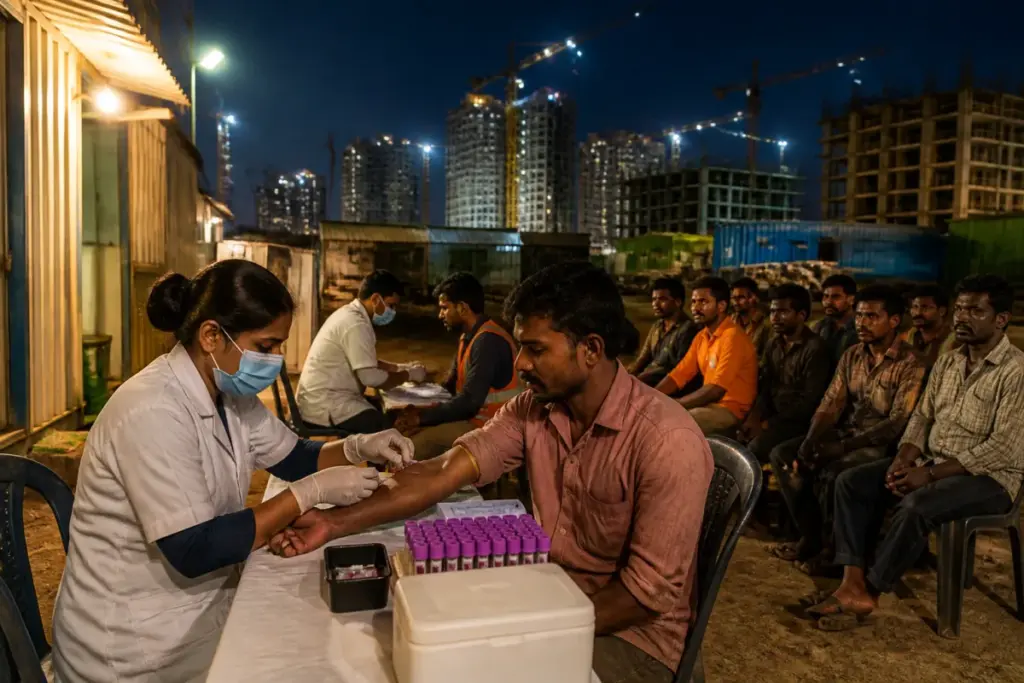
Pune’s decision to conduct night blood tests for lymphatic filariasis among construction and migrant workers highlights a public-health challenge that is easy to miss in a rapidly expanding city: people, mosquitoes and disease risks move across administrative boundaries. The Pune Municipal Corporation and Maharashtra’s state health department have begun a two-month survey at construction sites where workers also live, collecting samples between 9pm and midnight.
The timing is not incidental. According to PMC assistant health officer Dr Rajesh Dighe, the microscopic parasites associated with filariasis are most likely to be detected in the bloodstream at night. The survey began on October 14 and is scheduled to continue for two months. PMC ward offices have been instructed to deploy six staff members each for sample collection.
The campaign places construction sites at the centre of a disease-surveillance exercise because they combine several urban conditions in one location. They are workplaces, temporary settlements and often high-turnover communities. Workers may arrive from different states, stay for limited periods and live close to areas where water can accumulate. For civic health officials, this makes the worksite an important point for identifying infection and understanding whether transmission could continue locally.
Lymphatic filariasis, commonly known as elephantiasis, is a mosquito-borne parasitic infection. The report identifies Wuchereria bancrofti as the principal parasite involved and Culex quinquefasciatus as the infected mosquito that transmits it. The disease is not contagious through ordinary person-to-person contact. However, infected mosquitoes can spread the parasite locally after biting an infected person, making early detection relevant even when a city is not considered an endemic area.
That distinction is important for Pune. Health officials said filariasis is not endemic in the city, but Pune receives a large migrant workforce from states where the disease is prevalent. The city’s risk, therefore, is linked not simply to where transmission has historically been concentrated, but also to how workers move between regions and how local mosquito exposure is managed after arrival.
Many infected people may not show immediate symptoms. Over time, however, lymphatic filariasis can cause disabling swelling of the limbs, genitals or breasts, along with severe pain and recurrent bacterial infections. The health consequences can therefore extend well beyond the initial infection. For workers whose income depends on physical labour, prolonged swelling, pain or disability can also affect their ability to work, although the supplied report does not quantify that impact in Pune.
The night survey is an example of a surveillance method designed around the biology of the disease rather than the convenience of daytime administration. Guidelines issued by the National Centre for Vector Borne Diseases Control recommend night blood surveys or filarial antigen tests to determine whether transmission is continuing in areas where the disease may be present. PMC’s decision to collect samples after dark reflects that operational requirement.
It also exposes a recurring administrative problem in growing cities: public-health systems must serve populations that are not always visible in standard residential records. Construction workers may live inside or beside project sites, move between employers and originate outside the city. If health monitoring is organised mainly through permanent neighbourhoods, some of these workers can remain outside routine surveillance. The present campaign attempts to reach them where they work and live rather than waiting for them to visit a civic facility.
The institutional arrangement is similarly significant. The survey is being conducted jointly by the municipal corporation and the state health department. PMC is responsible for deploying staff through its ward offices, while the campaign operates within national vector-borne disease-control guidance. This places the exercise across multiple levels of public administration: national technical guidance, state health oversight and city-level implementation.
The report does not specify the number of construction sites to be covered, the target number of workers, the number of samples already collected or the criteria that will be used to publish the results. It also does not provide previous survey figures against which the campaign can be compared. Those gaps matter because the value of a surveillance programme depends not only on testing, but on whether its findings are recorded, communicated and linked to treatment or further investigation.
For now, the campaign’s stated objective is early detection. Construction-site managers and contractors have been asked to cooperate with health teams and encourage workers to participate in the voluntary screenings. That request places a practical responsibility on private worksites, where access to workers may depend on contractors, supervisors and site management. The report does not indicate how participation will be monitored or how workers who test positive will be followed up.
The voluntary nature of the screening also raises an implementation question without establishing a conclusion: reaching workers may require more than sending health staff to a site. Workers must be present during the late-evening testing window, understand the purpose of the screening and feel able to participate. The source material does not provide information about consent procedures, language support or arrangements for communicating results. These details will determine how fully the survey captures the population it is intended to study.
The campaign’s environmental advice is directed at both homes and worksites. Residents have been urged to prevent water accumulation, use mosquito nets or repellents at night and report persistent limb swelling to the nearest civic health facility. These measures connect individual protection with the management of the urban environment. The report does not identify specific sites of water accumulation or provide evidence linking any particular Pune location to transmission, so the broader environmental risk cannot be quantified from the available information.
Still, the focus on construction sites shows how temporary urban infrastructure can become part of the city’s public-health network. A worksite is usually planned around construction output, worker accommodation and logistics. The health survey adds another requirement: it must also be accessible to surveillance teams and capable of supporting preventive action. That requirement becomes more complex when the workforce is mobile and the disease may have been acquired outside Pune.
The survey also illustrates why disease-control boundaries do not always match municipal boundaries. A worker may carry an infection from a region where filariasis is prevalent into a city where it is not endemic. If local mosquitoes are capable of transmitting the parasite, the question for authorities is no longer limited to the patient’s place of origin. It includes the conditions in the receiving city, the presence of vectors and the speed with which infection is detected.
What the current exercise can establish will depend on its coverage and follow-up. A positive sample could identify an individual requiring medical attention, while a wider pattern of results could help authorities assess whether further surveillance or vector-control measures are necessary. The supplied report does not say how results will be analysed or whether PMC plans to release a public report at the end of the two-month campaign.
The immediate evidence confirms that Pune has begun targeted night-time surveillance among a high-risk population identified by civic officials. It does not establish the prevalence of filariasis in the city, demonstrate ongoing local transmission or indicate how many workers may be affected. Those remain questions for the survey and any subsequent health-department findings.
For Pune, the larger urban issue is the need to design civic services around a changing population rather than a fixed map of permanent residents. The night blood survey brings that challenge into focus: detecting a largely silent infection requires health authorities to follow the city’s workers into construction sites, temporary lodgings and late-evening hours. The next significant markers will be the campaign’s coverage, participation, test results and the follow-up actions announced by the municipal and state health authorities.


