

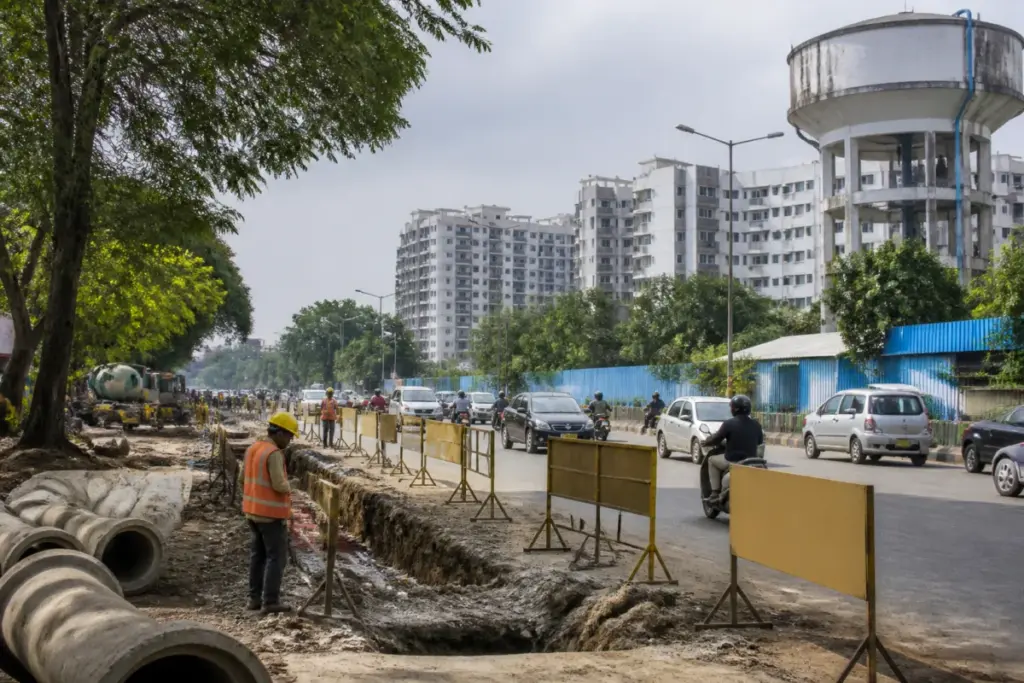
Pune’s equal water supply scheme remains incomplete after repeated extensions, with 87.78% of the work reported as finished even though the project was expected to be completed in 2023. The delay has kept unresolved the central promise of supplying residents with water at more uniform quantities and pressure across the city.
The scheme was approved by the Pune Municipal Corporation’s general body in May 2015 and work began after tenders were issued in 2018. It was designed around a 30-year planning horizon and an estimated future population of 49,21,663. The project was intended to address water distribution losses reported at 40% and improve the reliability of supply to households across Pune.
According to the report by Lokmat – Pune, the project covers 141 distribution zones. Its planned components include 79 water storage tanks, 1,268.97 kilometres of distribution pipelines, 101.54 kilometres of pipelines supplying the storage tanks, 2,32,652 water meters, seven civic facility centres and six new pumping stations. The original completion period was 36 months, placing the expected completion in 2023.
The reported completion figure, however, does not mean that the scheme’s intended service outcomes have been achieved in all areas. Lokmat reported that work had been completed in only 50 of the 141 zones. It also said that complaints about supply timing and water pressure continued in parts of Baner-Balewadi, Pashan, Sus, Warje, Mahammadwadi, Kondhwa-Mahammadwadi and Sinhagad Road, including areas where work in some zones had already been completed.
This distinction between construction progress and service performance is important. A water distribution project can register physical progress through completed tanks, pipelines or meters while residents continue to experience uneven supply. In Pune’s case, the source report indicates that the municipal corporation’s stated objective of delivering water in equal quantities has not yet been realised in the areas covered by the report.
The project’s institutional design relies on dividing the city into zones and regulating distribution through storage infrastructure, pipelines and meters. The planned meter system is intended to support billing based on measured consumption once the scheme is operational. The report states that many installed meters are currently closed and unused because billing by meter has not yet begun.
The meter rollout has also created a separate implementation challenge. According to the report, some residents and political leaders opposed the installation of meters, while several meters that had been installed were damaged. That resistance affects more than the physical installation of equipment. It complicates the transition from a broadly shared municipal water system to one that measures household consumption and links supply to billing.
The report identifies several reasons for the delay. These include difficulties in obtaining permissions from traffic police, the National Highways authority, the Forest Department and defence authorities for pipeline excavation. Work in densely populated areas has also created operational problems, while the shifting of existing utility lines has added another layer of difficulty to road and underground construction.
These constraints show why citywide water infrastructure cannot be evaluated only as a contracting exercise. Pipeline work must take place within roads already occupied by traffic, drains, electricity lines, telecommunications networks and other public utilities. Each excavation requires coordination across agencies, and delays in one permission or utility relocation can affect the sequence of work in an entire zone.
The Pune scheme also illustrates the administrative tension between long-term infrastructure planning and day-to-day service demands. The project was planned for a future population of more than 49 lakh people and for a 30-year period. Residents, however, judge the system through immediate experiences: whether water arrives at the announced time, whether pressure is sufficient and whether one locality receives a more reliable supply than another.
The source report raises a further question about the relationship between physical completion and accountability. If a zone is declared complete but residents continue to report irregular timing or inadequate pressure, the municipal corporation must distinguish between construction completion, commissioning, operational stability and actual service delivery. These are separate milestones, but the supplied material does not provide a zone-wise assessment of them.
The expenditure figure also requires clarification before the project’s financial performance can be assessed. The original headline and summary supplied with the report refer to spending of Rs 2.5 crore. The body of the same report, however, refers to nearly Rs 2,500 crore being spent on the scheme. This is a material difference of scale and changes the interpretation of the project’s cost, progress and public value. The authoritative project cost, expenditure to date, revised cost and payments released are not established in the supplied material.
The same caution applies to the reported claim that the expected water leakage reduction has not been achieved. The article attributes this information to unnamed sources rather than identifying a municipal report, audit, engineering assessment or official statement. The project was originally linked to addressing 40% distribution losses, but the supplied material does not provide a current measured leakage figure or explain how losses were calculated before and after implementation.
The available evidence therefore supports a clear account of delay, incomplete zone coverage and continuing complaints in named parts of Pune. It does not yet establish the final financial position of the project, the precise current level of water losses or whether all completed zones have been formally commissioned. Those distinctions matter because the scheme’s public purpose is not simply to build assets; it is to improve the regularity and fairness of water delivery.
The municipal corporation’s next administrative task is to complete the remaining work and resolve the permissions, utility-shifting and access problems identified in the report. It must also address opposition to meters and explain when installed meters will become operational. The source material does not provide a final completion date after the repeated extensions, a revised zone-wise schedule or a formal response from the civic administration.
For Pune residents, the unresolved issue is whether the scheme will translate into measurable improvements after construction ends. The evidence supplied by Lokmat – Pune shows that the project remains incomplete and that complaints continue even in some areas where work has been reported as finished. Before the scheme’s results can be judged conclusively, the Pune Municipal Corporation’s official expenditure records, revised completion schedule, zone-wise commissioning data and verified leakage assessment need to be established.


