

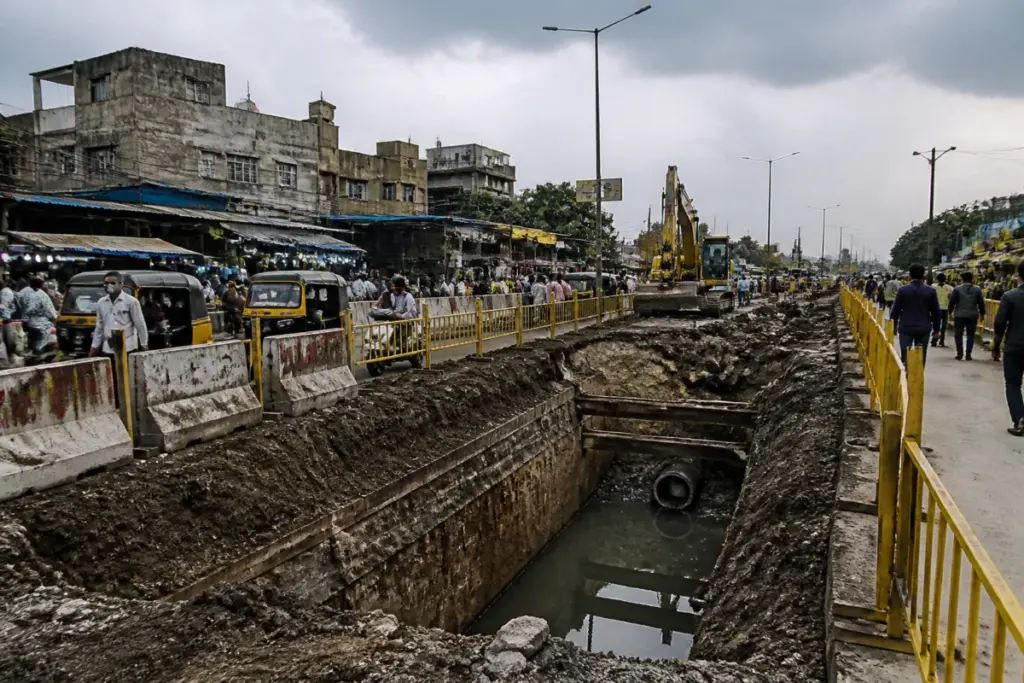
The death of 55-year-old Pradeep Pardeshi after he fell into an open drainage excavation near the fish market in Yerwada has turned a local accident into a wider test of how Pune manages public safety around civic works. The incident, reported to have occurred on Saturday, October 17, raises questions not only about the immediate circumstances of the fall but also about who is responsible for securing a road excavation, warning residents and monitoring contractors while work is under way.
According to Civic Mirror – Pune, Pardeshi was passing through the fish market area when he was reportedly struck lightly by a rickshaw and fell into a pit dug for drainage work. The excavation was estimated to be between 10 and 15 feet deep. He sustained serious injuries and was taken to hospital, where he later died during treatment. The account is based on information provided by eyewitnesses and the report says that police are investigating the case.
The immediate question is whether the excavation had been made safe for people who had to continue using the area. Residents alleged that the pit lacked adequate safety measures. The report specifically raises questions about the presence of secure barricades, warning boards and other arrangements to alert pedestrians and motorists to the danger. These are not secondary details in a roadwork project. They determine whether an excavation remains a controlled work zone or becomes an unmarked hazard in the middle of a functioning neighbourhood.
The location adds an important urban dimension to the incident. A fish market is a public-facing, high-activity area where pedestrians, rickshaws and other vehicles are likely to share limited road space. An excavation in such a setting affects more than the contractor’s work programme. It changes how residents move, where vehicles pass and how people identify safe routes through the area. The report does not establish the exact traffic arrangement or whether an alternative pedestrian path had been provided, but it records the central concern: a deep pit was present in a place used by the public, and residents say the protection around it was insufficient.
The reported rickshaw contact also shows how risk can multiply around poorly managed worksites. A minor collision or momentary loss of balance can have severe consequences when a deep excavation is immediately adjacent to the road. The available account does not determine whether the rickshaw driver, the road layout, the excavation or another factor was legally responsible for the fall. That determination will form part of the police inquiry. It does, however, show why worksite safety cannot be assessed only under ideal conditions. Urban road space is unpredictable, and protection must account for ordinary movement, congestion and small errors by road users.
The responsibility chain in such cases is usually spread across several levels of urban administration. The municipal authority may be responsible for the drainage project or for approving the road opening. A contractor may be executing the work. Site supervisors may be responsible for daily safety arrangements, while officials may be expected to inspect progress and compliance. The supplied report does not identify the contractor, the supervising officer, the work order or the specific safety conditions imposed on the project. Those omissions are significant because accountability cannot be fixed merely by describing the excavation as dangerous. It requires documents and records showing who authorised the work, who controlled the site and whether required safeguards were installed.
The response after the incident will therefore matter as much as the immediate investigation. Pardeshi’s relatives reportedly approached the Laxminagar police station and asked why public safety had been neglected during the drainage work and who should be held responsible for his death. Civic Mirror – Pune reports that residents have demanded strict action against the responsible individuals and agencies. Police are investigating the death, but the supplied report does not state whether a case has been registered, whether municipal officials have inspected the location or whether the excavation has since been closed or secured.
The report also says that local residents believe similar accidents have occurred in Yerwada previously. That claim is attributed to residents and is not independently documented in the supplied material. It should therefore be treated as an allegation requiring verification, not as an established pattern. Even so, the claim points to a recurring governance question: whether road excavation safety is handled as a one-time site responsibility or as a monitored municipal function across the city.
A reference in the report to a fatality in Mumbai involving an open manhole around three months earlier places the Yerwada incident within a broader public debate about exposed civic infrastructure. The comparison does not prove that the two incidents had identical causes, and the report provides no further details about the Mumbai case. Its relevance lies in the common administrative problem: when public infrastructure is opened, damaged or left incomplete, the boundary between a construction site and a public space must be actively managed.
Drainage works can require deep excavations and may disrupt roads for extended periods. That makes safety arrangements a core part of project execution, rather than an optional addition after engineering work is completed. Barricades, visible warnings and safe movement routes are practical controls, but their presence alone is not enough if they are poorly positioned, damaged or ignored. The available report does not establish which safeguards were required at the Yerwada site or whether any inspection had taken place before the incident. Those facts should be central to the investigation and to any municipal review.
The case also exposes the information gap that follows many urban accidents. Residents can see an open pit, but they may not know which agency owns the work, how long it will remain open, whom to contact or whether the site has passed a safety inspection. Contractors and authorities may have technical documentation, but unless basic information is visible at the site, public accountability remains weak. The supplied report does not say whether the Yerwada excavation displayed project details or an emergency contact number.
What is established so far is limited but serious. Pardeshi died after falling into a drainage excavation near the Yerwada fish market; the pit was reported to be 10 to 15 feet deep; eyewitnesses described a preceding rickshaw impact; relatives approached the police; and residents questioned the safety arrangements around the work. What remains to be established includes the exact sequence of events, the condition and placement of barricades or warning signs, the identities of the contractor and supervising officials, and whether any violations occurred.
The next institutional steps are therefore clear from the facts available: the police investigation must determine the circumstances of the death and identify responsibility, while the municipal administration must establish how the excavation was authorised, supervised and secured. Until those questions are answered, the Yerwada incident remains both a death under investigation and a warning about the risks created when essential urban works continue without demonstrably safe public access around them.


