

Pimpri-Chinchwad has a separate collection arrangement for sanitary waste, but the system is being weakened at the point where household waste enters the municipal chain. Used sanitary pads and diapers are often being placed with dry waste, forcing waste pickers to handle material that the municipal system is supposed to keep separate. The problem exposes a wider gap between having a collection compartment on a garbage vehicle and ensuring that sanitary waste is actually segregated, recorded and processed safely.
The issue is significant because sanitary waste forms a notable share of the city’s waste stream according to figures cited in the report published by Sakal – Pune. The Pimpri-Chinchwad Municipal Corporation’s City Climate Action Plan 2026 estimates that sanitary waste accounts for an average 10 per cent of the city’s total waste. The report also cites a 2025 Health Department estimate that the city generates 1,389 tonnes of waste every day. On that basis, sanitary waste is estimated at about 139 tonnes per day.
These figures are estimates, not an independently verified daily measurement of separately collected sanitary waste. However, they indicate the scale of the administrative task. A waste stream of roughly this size cannot be managed only through occasional appeals to households. It requires consistent segregation at source, dependable collection practices, clear instructions, accurate records and a defined processing route.
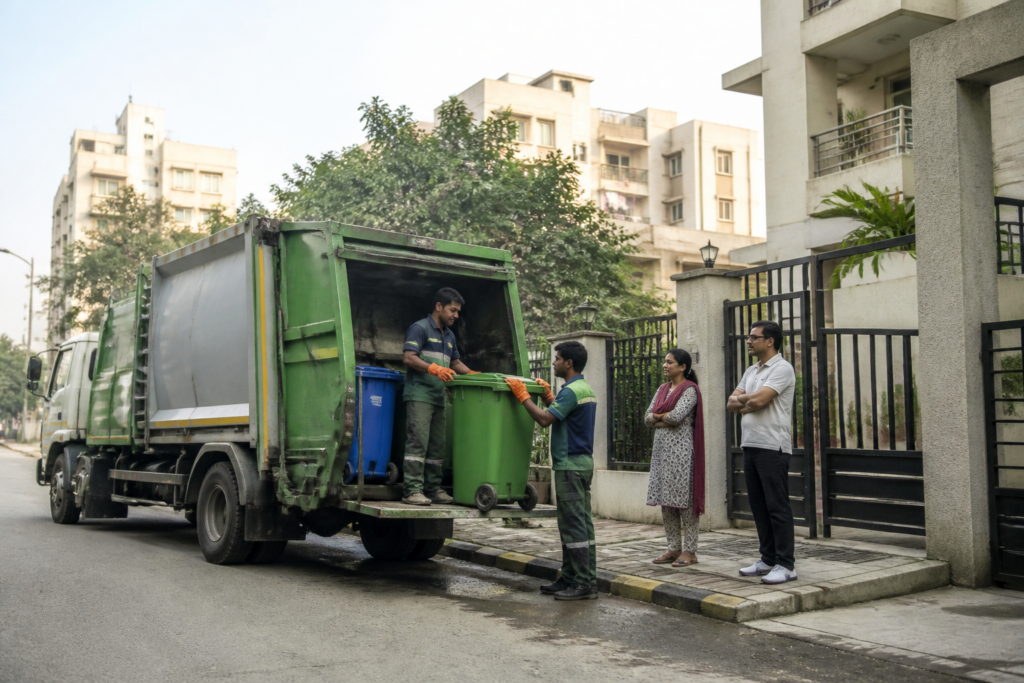
The municipal corporation has already created a basic mechanism for source segregation. Garbage collection vehicles, locally referred to as ghantagadi vehicles, have separate compartments for wet waste, dry waste and sanitary waste. The report says sanitary waste is intended to be placed in a separate compartment so that it can be identified and handled independently during collection and subsequent sorting.
The existence of that compartment is important, but it does not resolve the problem by itself. If pads and diapers are wrapped into paper or mixed with other dry waste, the separation burden shifts to the next stage. The report describes waste pickers encountering sanitary material while separating paper for recycling. This creates a practical and occupational-safety concern: workers who are sorting recyclable material may come into contact with sanitary waste because it was not separated at the household level.
The municipal system therefore depends on a chain of decisions. Residents must identify sanitary waste as a separate category, prepare it appropriately, place it in the designated container or compartment, and hand it over to the collection vehicle without mixing it with wet or dry waste. Collection staff must also communicate the process consistently and ensure that the separate compartment is used as intended. If any link fails, the material can enter the mixed waste stream.
The report indicates that the municipal corporation has repeatedly appealed to residents to separate waste into categories including wet, dry, household, hazardous and sanitary waste. It has also advised residents to use a red container for disposing of sanitary pads and diapers. These instructions establish the intended system, but the continuing mixing of sanitary waste shows that communication has not yet become routine household behaviour across the city.
A resident from Akurdi, cited in the report, said that many people do not know how pads and diapers should be wrapped before being handed over. She suggested that societies display instructions and that collection workers provide guidance. Her observation points to a specific operational gap. Public awareness is often framed as a general need to segregate waste, but residents also need practical information about how to prepare different categories before collection.
For housing societies and apartment buildings, this makes communication a management responsibility as well as a municipal one. The report says the administration has undertaken door-to-door contact, distribution of leaflets and awareness activities in housing societies. Such programmes can help, but their effectiveness depends on whether instructions reach residents repeatedly and whether collection personnel reinforce them during daily operations.
The distinction between a public campaign and a functioning service is central to the Pimpri-Chinchwad case. A campaign can tell residents that sanitary waste must be separated. A functioning service must make the correct action easy, visible and predictable. Residents need to know which container to use, how to wrap the material, when it will be collected and what happens after it leaves the home. The supplied report establishes that some of these arrangements exist, but it also records that confusion and mixing continue.
The downstream process is another unresolved part of the system. The report says the municipal corporation’s environmental report records that sanitary waste is being sent to landfill. It also states that separately collected sanitary waste is currently not being processed independently. This means that segregation at source, even when it occurs, may not yet lead to a complete treatment pathway.
That gap matters administratively. Source segregation is not only a collection exercise. It is meaningful when separate material remains identifiable through transport, storage and processing. If sanitary waste ultimately reaches landfill, the city may be separating it at one stage without establishing a distinct end-to-end management system. The report does not provide details of a dedicated processing facility or a separate treatment capacity for sanitary waste, so the final route for the material remains an important area for municipal clarification.
The absence of updated records also limits the city’s ability to manage the problem. The report says it is important to know how much sanitary waste is received separately and how much enters the mixed waste stream. Without current records, officials cannot clearly measure whether awareness campaigns are improving segregation, whether one neighbourhood performs better than another, or whether collection arrangements are capturing the estimated volume.
The city’s headline waste figure illustrates why this data gap matters. If total daily waste generation is estimated at 1,389 tonnes and sanitary waste is estimated at 10 per cent, the implied sanitary-waste quantity is about 139 tonnes per day. But the report does not state how much of that volume is separately collected. Nor does it establish how much is mixed with dry waste, how much reaches landfill, or whether the estimate is based on a current composition study. These are not minor details; they determine whether the municipality is planning collection and processing capacity against measured conditions or broad estimates.
The institutional responsibility is shared. The municipal corporation must provide the collection infrastructure, issue instructions, train or guide collection staff, maintain records and establish an appropriate processing route. Residents must separate and prepare the waste correctly. Housing societies can support compliance by displaying instructions and coordinating with collection teams. Waste pickers and collection workers, meanwhile, are directly exposed when household segregation fails, making their experience an essential indicator of whether the system works beyond official plans.
The statement from municipal deputy commissioner Dr Pradeep Thengal, cited in the report, asks residents not to mix wet and dry waste and to hand over four separate categories to the municipal corporation’s collection vehicles. The statement confirms the administration’s emphasis on source segregation. It also suggests that the immediate municipal priority remains improving compliance with the existing arrangement rather than announcing a new collection model.
For Pimpri-Chinchwad, the larger urban question is whether waste infrastructure is being treated as a physical asset or as a service chain. The separate compartment on a collection vehicle is a physical intervention. Its success depends on behaviour, instructions, staff practices, data and processing capacity operating together. A city can therefore have visible segregation infrastructure while still producing mixed waste at the point where workers handle it.
The evidence supplied in the report confirms four conditions: sanitary waste is estimated to represent 10 per cent of the city’s waste; daily waste generation is estimated at 1,389 tonnes; separate compartments exist on collection vehicles; and sanitary waste is still entering dry waste, with landfill remaining the recorded destination in the municipal environmental report. What remains unclear is the current quantity separately collected, the proportion that remains mixed, and whether the city has an independent processing system. Those are the figures and institutional steps that will show whether Pimpri-Chinchwad’s sanitary-waste policy is moving from instruction to implementation.


