

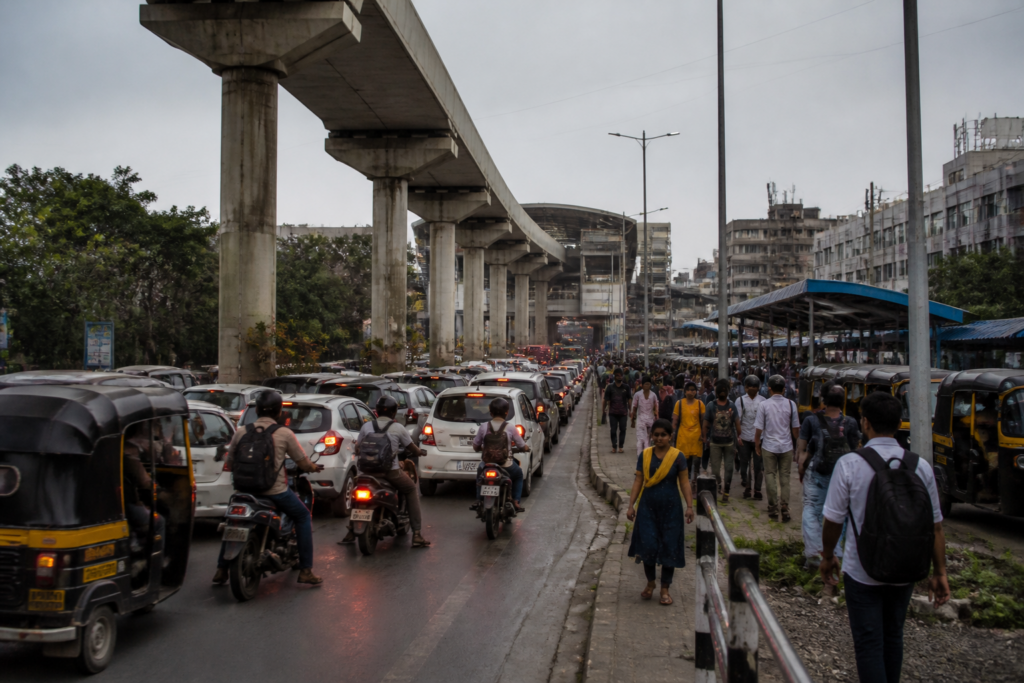
Traffic problems along the Dapodi–Pimpri-Chinchwad metro corridor are being linked not to a single obstruction, but to the way metro pillars, junctions, station access, parking and informal autorickshaw activity now compete for limited road space on the old Mumbai–Pune Highway. A Civic Mirror report published on October 14 said commuters and activists had raised concerns about congestion and road safety between Dapodi, Pimpri and Chinchwad, particularly near metro stations.
The report describes a corridor where the metro largely runs along the centre of the existing highway. That alignment can preserve access to the surrounding road network, but it also leaves the road design dependent on careful coordination between the elevated structure, carriageways, pedestrian movement, parking, junction geometry and station entrances. According to the report, differences in the position of some pillars, barricades at junctions, undisciplined parking and unauthorised autorickshaw stands have narrowed the effective space available for moving traffic.
The issue is therefore larger than whether individual pillars are physically blocking vehicles. It concerns how a major transit project is integrated into a road that was already carrying heavy traffic and serving multiple functions. The same corridor must accommodate through traffic, turning movements, buses and other large vehicles, pedestrians accessing stations, parked vehicles, feeder activity and autorickshaws waiting for passengers. When those uses are not assigned clear and enforceable space, the metro can become the centre of a wider access and traffic-management problem.
The report says some metro pillars in parts of Pimpri-Chinchwad do not appear to form one straight line. Some are described as being further into the road while others are set comparatively back. Between Pimpri and Dapodi, road dividers have been installed around the pillars, creating some separation between the traffic lanes and the structures. However, the report says this has not fully removed congestion at junctions or on routes leading to metro stations.
This distinction matters for road planning. A median structure may not directly prevent movement on every section of a road, but the space around it influences lane width, turning radii and the ability of large vehicles to negotiate intersections. The report cites Nashik Phata–Bhosari as one location where pillars and associated structures may complicate vehicle movement. Road-design specialist Pranjali Deshpande said large vehicles need more space to turn and that narrowing the available road can make those manoeuvres particularly difficult.
The corridor’s most immediate pressure appears to be concentrated around station access points. The report says passengers, autorickshaws and private vehicles waiting to pick up or drop off commuters converge near station entrances and exits. At Morwadi, referred to in the report as the Pimpri station area, local residents alleged that unauthorised autorickshaw stands operate on both sides of the road. They said between 25 and 30 autorickshaws can gather near the station staircase and sloping access routes at the same time.
These figures are claims reported by Civic Mirror and are not presented as an independently audited traffic count. Their importance lies in showing how station-area demand can spill into the main carriageway when designated interchange and waiting spaces are inadequate or poorly enforced. The report says the autorickshaws, combined with nearby traffic signals, leave limited room for through vehicles. It also says that vehicles receive only about 30 to 40 seconds of green time, allowing relatively few to pass and contributing to queues on the main road.
The problem is compounded by the absence of a clear curbside system. The report says vehicles parked between two pillars often extend onto the road, while vehicles entering or leaving parking areas interfere with footpaths and pedestrian movement. At the same time, private cars waiting for passengers reportedly add to the obstruction near stations. This produces a familiar urban-transport conflict: infrastructure intended to increase public transport access creates additional pressure at the point where passengers must transfer between the metro and the street.
For commuters, the result is not simply slower traffic. It can mean difficult pedestrian crossings, blocked footpaths, conflict between autorickshaws and moving vehicles, and greater uncertainty at junctions. The report also refers to congestion during evening peak hours near the Pimpri-Chinchwad Municipal Corporation building, where activist Maruti Bhapkar claimed that delays can last between 30 minutes and an hour. That claim, like other statements in the report, requires assessment against official traffic and enforcement records, but it identifies the time and location of the reported impact.
Enforcement is another part of the institutional gap. The report says the municipal corporation has made around 1,100 traffic wardens available to assist the police, but commuters have questioned whether traffic control is sufficiently effective. Rishi Phadnis, identified as a commuter, said some wardens focus more on catching rule violators than on clearing congestion. The report does not provide deployment data, duty rosters, challan records or an official response from the municipal corporation or traffic police, so it cannot establish how the wardens are being used across the corridor.
The account also raises questions about the division of responsibility between the metro agency, the municipal corporation and traffic authorities. Bhapkar said an agreement between the metro corporation and the Pimpri-Chinchwad Municipal Corporation required the project agency to prevent road damage, traffic obstruction and accidents during construction. He alleged that these responsibilities had not been adequately discharged. The report does not reproduce the agreement or provide a response from the metro corporation, making the specific scope of the obligation and the basis for the allegation unclear.
Bhapkar also questioned the public expenditure on bus infrastructure built for the proposed Bus Rapid Transit System between Nigdi and Pune station, arguing that some facilities became ineffective after metro construction began on the highway. He further criticised the narrowing of roads for footpaths and cycle tracks. These claims point to a broader planning problem: transport investments can underperform when each project is designed in isolation, even when the projects serve the same corridor and the same passengers.
The alternative alignment proposed by Bhapkar—alongside the Lonavala–Pune railway line, with metro stations near existing railway stations—also illustrates the trade-offs involved in corridor planning. He argued that using railway land could have reduced disruption on the highway, while acknowledging that land acquisition and rehabilitation would have had to be considered. The report records this as an activist’s alternative, not as an established or officially evaluated option. It provides no feasibility study, land assessment or government position on the proposal.
What the evidence in the report does establish is a recurring interface problem. The metro structure, road lanes, junctions, station access, parking and informal passenger services are functioning in the same constrained space. The report’s interviews suggest that the resulting congestion is experienced most sharply near stations and intersections, where movement from the elevated system meets street-level activity. It also indicates that traffic signals and enforcement practices may be amplifying the physical constraints.
The institutional question is whether one agency has responsibility for the entire passenger journey and road environment around a station. The metro corporation may control station infrastructure and project structures; the municipal corporation may control roads, parking and footpaths; and the traffic police may regulate movement and illegal stopping. If each authority addresses only its own asset, problems at the boundaries can remain unresolved. The report’s allegation of inadequate coordination between the Pimpri-Chinchwad Municipal Corporation, Pune Municipal Corporation and the metro corporation reflects this fragmented arrangement, although the authorities’ responses are not included.
A useful assessment would require information that is absent from the supplied report: approved junction designs, pillar locations, lane-width measurements, signal-cycle data, official accident records, parking capacity, autorickshaw-stand permissions and the terms of the inter-agency agreement. Without those documents, it is not possible to determine whether the pillars themselves are the principal cause of congestion or whether station operations, parking and enforcement are the dominant factors.
The broader urban lesson is that metro construction does not end when trains begin running. The street-level system around each station determines whether the investment functions as an accessible public transport network or creates new bottlenecks. Safe pedestrian access, organised feeder services, managed pick-up and drop-off areas, clear turning space and coordinated enforcement are part of metro performance, not peripheral additions.
The Civic Mirror report therefore points to a problem of integration rather than a single design defect. It documents complaints and attributed claims about the Dapodi–Pimpri-Chinchwad corridor, but leaves several matters to be verified through official records and site-level data. The next meaningful steps would be a published assessment of the affected junctions, clarification of agency responsibilities, and transparent information on traffic, parking, station access and road-safety conditions along the corridor.


