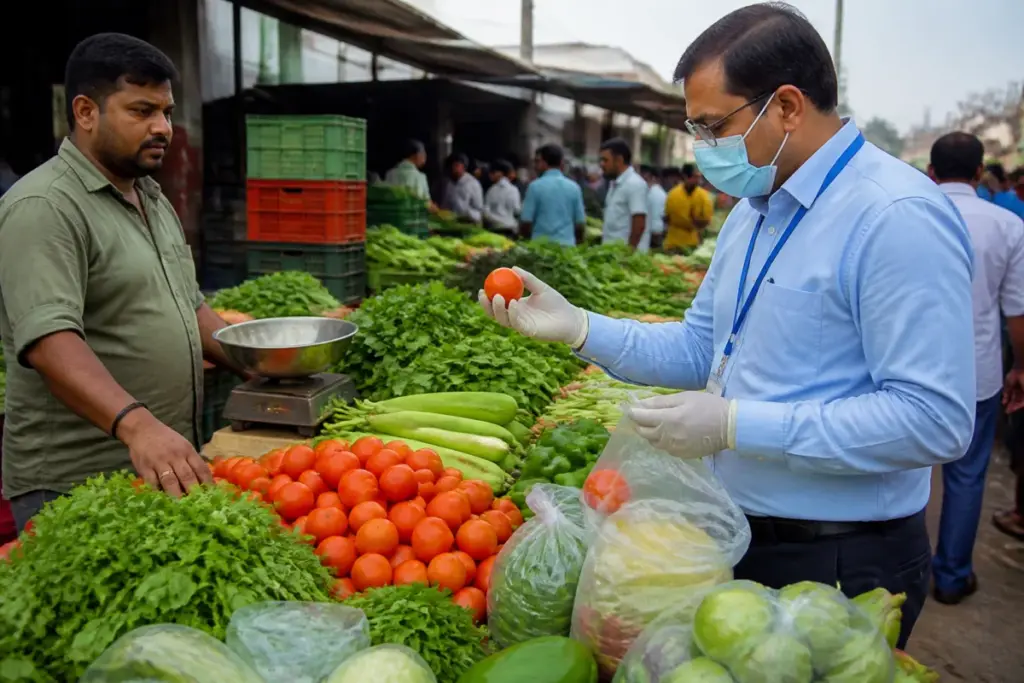
Pesticide residues in vegetables have emerged as a food-safety concern in Gujarat, where 170 of 6,035 vegetable and fruit samples tested between 2023 and 2026 reportedly contained residues above prescribed limits. The figures, cited in a recent report, place Gujarat among 23 states examined nationally and raise a question that extends beyond farming practices: how effectively does India’s food-safety system monitor what moves from fields through markets and into urban kitchens?
The national sample set included 70,652 samples, of which 3.1% reportedly showed pesticide levels above permitted limits. Gujarat accounted for the fourth-highest number of samples collected, after Karnataka, Telangana and Punjab. It also recorded the fourth-highest number of samples with residues above the prescribed threshold, behind Telangana, Karnataka and Maharashtra. Haryana followed Gujarat in the reported ranking with 152 such samples.
These numbers need to be read carefully. The presence of a pesticide residue and the presence of a residue above the legally prescribed maximum limit are not the same thing. Pesticides can remain on or within crops after application, and their detection alone does not establish that a food item will cause a particular illness. The more specific concern is whether the residue exceeds the level considered acceptable for that crop and chemical under the applicable food-safety framework.
That distinction matters because raw sample counts do not by themselves measure the total risk faced by consumers. A state that tests more samples may identify more violations simply because its surveillance is broader. At the same time, a high number of samples above limits can indicate weaknesses in agricultural practice, enforcement, supply-chain oversight or all three. The figures therefore offer a warning signal, but they do not establish the overall safety of every vegetable sold in Gujarat.
The report’s state-level comparison shows both the value and the limitations of food-safety surveillance. Karnataka recorded the highest number of samples collected, at 9,176, followed by Telangana with 8,198 and Punjab with 6,582. Gujarat’s 6,035 samples placed it fourth, while Himachal Pradesh recorded 5,765. Telangana reported the highest number of samples with excessive pesticide residues, at 486, followed by Karnataka with 334 and Maharashtra with 260.
The data does not specify in the supplied material how the samples were distributed between fruits and vegetables, which pesticides were detected, which commodities were involved, or how many samples came from farms, wholesale markets, retail outlets or other points in the supply chain. It also does not state the number of enforcement actions, prosecutions, product withdrawals or repeat violations linked to the findings. Those gaps limit what can be concluded about where the problem is concentrated and whether monitoring is leading to corrective action.
Still, the farm-to-plate chain is central to understanding the issue. Pesticide residues can become a food-safety concern when farmers use a product not approved for a crop, apply more than the recommended quantity, spray too close to harvest, or do not follow the waiting period specified on the product label. The interval between the final application and harvesting is intended to allow residues to decline. If it is ignored, produce may reach markets before residues fall within the permitted limit.
This is not only an individual farmer’s compliance problem. It is also an institutional challenge involving agricultural extension, pesticide regulation, food-safety authorities, market surveillance and consumer awareness. Farmers need reliable information about approved products, dosage and waiting periods. Markets need regular sampling that can identify non-compliant consignments. Laboratories and regulators need the capacity to process results quickly enough for action to matter. Consumers, meanwhile, usually have little visibility into where produce was grown, what was applied to it or whether it was tested.
Urban residents are particularly dependent on this chain. Most city consumers purchase vegetables through wholesale markets, neighbourhood vendors, supermarkets or delivery platforms rather than directly from farms. The distance between production and consumption can make accountability difficult. If a sample fails a test, tracing the produce back to a farm or distributor requires records, coordination and enforcement across multiple administrative jurisdictions.
The report also highlights an important communication challenge. News of pesticide residues can easily be interpreted as a reason to stop eating vegetables, even though the supplied material does not support such a conclusion. Vegetables remain an important part of a regular diet; the public-interest requirement is to improve safety controls rather than create blanket fear. The relevant question is whether regulators and supply-chain actors are preventing excessive residues from reaching consumers and responding when they are detected.
Household practices can reduce some exposure, but they cannot substitute for regulation. Washing vegetables thoroughly under clean, running water can help remove soil, dust and some residues on the surface. Removing damaged outer leaves from leafy vegetables and peeling produce where appropriate may also help. However, residues absorbed into a vegetable or strongly attached to its surface may not be completely removed by washing. Cooking can reduce some biological hazards, but heat does not eliminate every type of pesticide.
The supplied report also cautions against treating salt, vinegar or baking soda as guaranteed solutions. There is no established basis in the material for claiming that these methods completely remove all pesticide residues. Soap, detergent and household cleaning chemicals should not be used on vegetables because they introduce another form of chemical exposure and are not intended for food washing.
Health effects depend on the chemical, the amount and route of exposure, and the duration of contact. The report notes that high exposure to some pesticides can cause nausea, vomiting, stomach pain, dizziness, excessive sweating and nervous-system problems. It also records longer-term concerns associated with excessive or prolonged exposure to certain chemicals, including possible effects on the liver, kidneys and other body systems. These statements do not mean that consuming a vegetable with a detected residue will inevitably cause a specific disease. They do underline why compliance with residue limits and targeted monitoring are necessary.
Children and pregnant women require particular care in food-safety systems because exposure can have different consequences depending on body size, development and vulnerability. The practical implication is not to rely on visual inspection. Produce that looks or smells normal is not necessarily pesticide-free, while unusual appearance or odour may justify avoiding it. Neither appearance nor smell can replace laboratory testing.
For Gujarat, the central governance issue is whether the 6,035 samples represent a consistent monitoring system or a limited examination of selected locations and commodities. The supplied report does not identify the responsible testing programme, the applicable sampling protocol or the follow-up taken on the 170 samples. Those details would determine whether the reported number reflects isolated non-compliance, recurring problems in particular crops or a broader weakness in the food distribution chain.
A stronger food-safety system would need to connect three stages: prevention at the farm, detection in the market and enforcement after a violation. Training and accessible advice can reduce incorrect pesticide use. Market and supply-chain sampling can identify risks before products are widely consumed. Transparent action against violations can establish accountability and provide feedback to farmers, traders and consumers. Without all three, testing risks becoming a record of failure rather than a mechanism for prevention.
The reported figures therefore reveal a measurable concern, but not a complete picture of food safety in Gujarat. They confirm that samples above prescribed pesticide residue limits were detected and that Gujarat was among the states with the highest number of such samples in the reported dataset. They do not establish that all vegetables are unsafe, identify the specific chemicals or commodities involved, or show how authorities responded. The next important evidence will be the underlying government report, sampling methodology, commodity-wise findings and enforcement record. Until those details are available, the most defensible conclusion is that pesticide residue control requires stronger farm-to-market oversight, not a retreat from vegetables in the urban diet.