

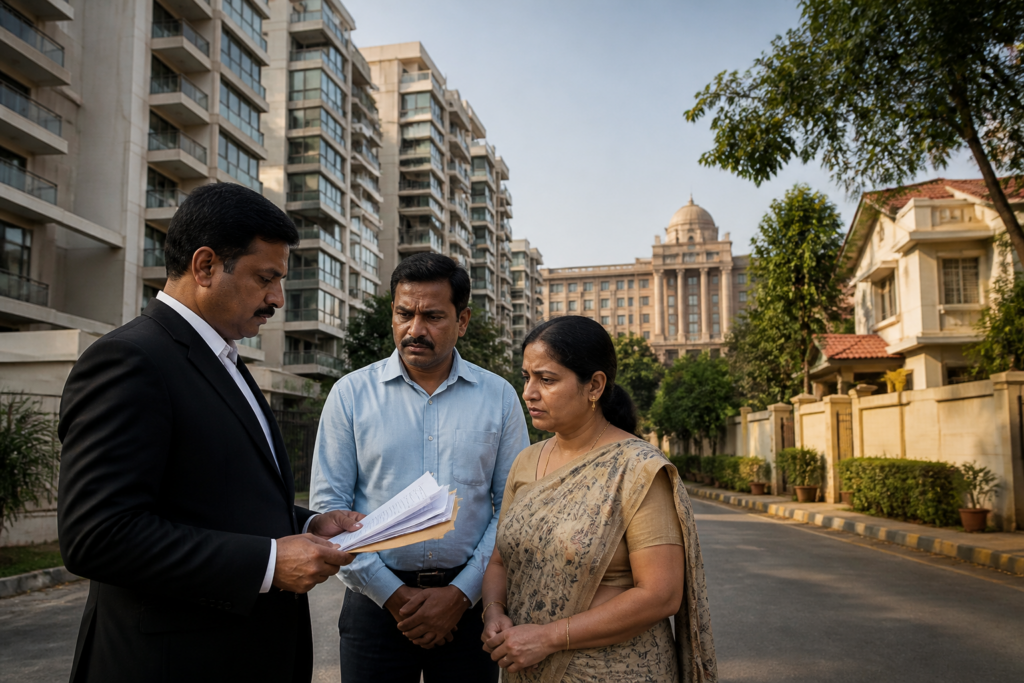
The registration of seven Hyderabad properties auctioned for approximately Rs. 15.03 crore in the Nowhera Shaik case marks a significant transition in a long-running enforcement process: assets attached during a financial investigation have moved into the hands of successful bidders, while the stated objective remains restitution to genuine claimants and victims.
The Directorate of Enforcement’s Hyderabad Zonal Office said the sale deeds were registered on October 6, 2026, in favour of the successful H-1 bidders. The properties include six flats at HS Royal in Shaikpet Village and a house in MLA Colony on Road No. 12, Banjara Hills. The auction was conducted pursuant to directions issued by the Supreme Court.
The development is important because attachment alone does not return value to people who may have lost money. An attached property can remain locked in legal and administrative proceedings until a court permits its sale, a buyer is identified and the transaction is formally completed. In this case, the registration of the sale deeds represents the administrative stage at which those assets become transferable to the successful bidders.
The Supreme Court’s orders set the framework for that process. In an order dated March 5, 2025, the court allowed the Enforcement Directorate to auction immovable properties attached in the case involving Nowhera Shaik, Heera Group of Companies and others. The stated purpose was to maximise realisation from the attached properties for restitution to genuine claimants or victims.
A subsequent order dated July 27, 2026, directed the Registrar General of the High Court for the State of Telangana to depute T. Venkateshwar Rao, Registrar (Protocol), to execute the sale deeds on behalf of the petitioner-accused. The ED said the deeds for all seven properties were subsequently registered in favour of the successful bidders.
This sequence shows the layered institutional structure involved in the recovery of property linked to an alleged financial offence. The ED investigates and attaches assets under the Prevention of Money Laundering Act, 2002. The court determines whether the attached assets can be auctioned and establishes the procedural route for their sale. The High Court’s administrative machinery then facilitates execution and registration of the sale deeds.
The underlying investigation began under the PMLA on the basis of multiple FIRs registered by police authorities in different states. According to the ED, its investigation found that Nowhera Shaik and others had collected more than Rs. 5.978 crore from the public by promising returns of more than 36 per cent a year. The entities later defaulted on repayment of principal amounts and promised returns to a large number of investors, the agency said.
The ED also alleged that part of the proceeds of crime was used to acquire movable and immovable properties in the names of Nowhera Shaik, Heera Group entities, relatives and associates. The properties involved therefore form part of a wider asset trail rather than an isolated real estate transaction. The Hyderabad properties are urban assets, but their significance in the case arises from how ownership, attachment, sale and restitution intersect.
The figures supplied by the agency indicate a substantial gap between the value of the seven properties now registered and the value of the properties attached during the investigation. The seven properties were auctioned for approximately Rs. 15.03 crore, while five Provisional Attachment Orders issued during the investigation covered properties valued at Rs. 428.83 crore. The difference does not by itself establish how much can ultimately be recovered for claimants, because the source does not provide a complete inventory of the attached properties, their legal status, sale values or distribution arrangements.
That limitation is central to understanding the development. Registration confirms that the seven transactions have been completed in favour of the successful bidders. It does not, based on the information available, establish the timing, mechanism or final amount of restitution to individual investors. The Supreme Court’s stated objective provides the institutional direction, but the source does not detail a claimant-wise distribution process.
The case also illustrates why property recovery in financial investigations is administratively complex. Real estate is not a single, easily transferable pool of money. Each flat or house has a location, title record, valuation, buyer and registration process. In this instance, the assets were spread across two prominent Hyderabad locations: HS Royal in Shaikpet Village and MLA Colony in Banjara Hills. Their conversion into realised value required judicial permission and a court-directed execution process.
For urban governance, the episode highlights the role of land and property records in enforcing financial accountability. A property connected to an investigation can remain part of the city’s housing stock while being subject to legal restrictions that affect its transfer and use. The eventual registration of the sale deeds brings the assets back into ordinary property transactions, but only after the enforcement and judicial steps described by the ED have been completed.
It also demonstrates that the recovery of public money can depend on coordination between institutions that have different responsibilities. The ED’s role is investigative and enforcement-oriented. The Supreme Court provided permission and directions. The Registrar General of the Telangana High Court deputed an officer for execution of the deeds. The registration process then gave legal effect to the transfers. The source does not identify the individual buyers or describe any objections raised during the auction, so those aspects remain outside the established facts.
The next question is not whether these seven properties have changed hands; the ED has stated that the sale deeds were registered. The unresolved issue, on the evidence available, is how this realisation fits into the broader restitution process for the affected claimants. The agency has filed a Prosecution Complaint and a Supplementary Prosecution Complaint before the Special Court under the PMLA in Hyderabad. Those proceedings, along with the status of the remaining attached properties, will determine how the wider recovery process develops.
The registration of the seven properties is therefore best understood as one completed stage in a larger chain: alleged collection of investments, investigation, identification and attachment of assets, court permission for auction, sale to successful bidders and formal registration. It confirms progress in converting attached urban property into realised value, but the supplied information does not yet establish the final recovery available to individual victims or the complete outcome of the broader proceedings.


