

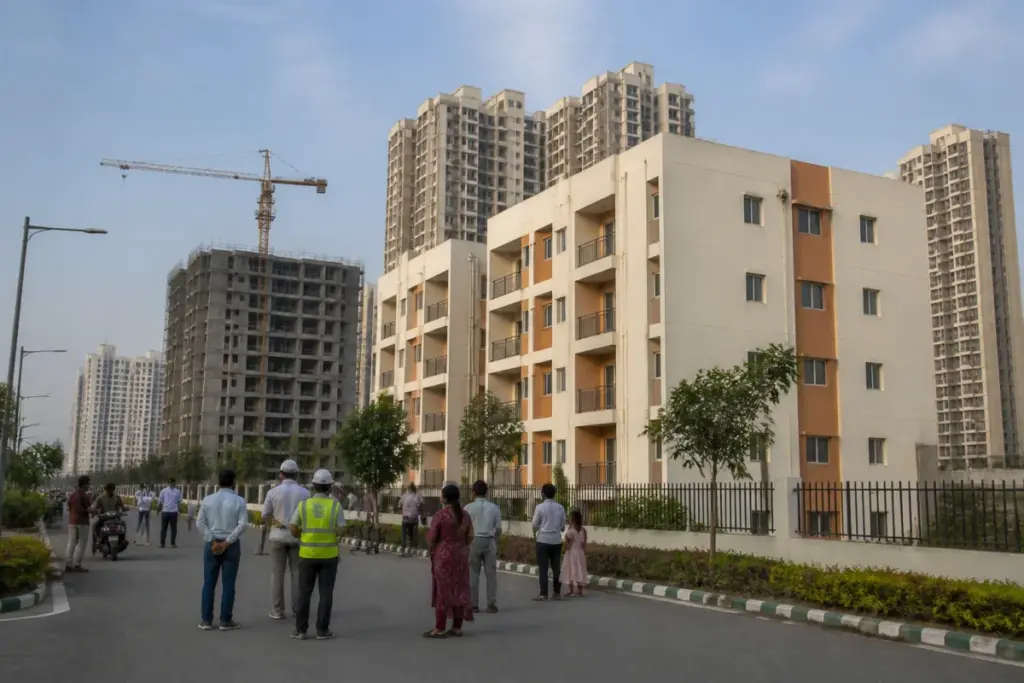
Noida is studying how to bring Uttar Pradesh’s Model Building Regulations-2026 into private group-housing projects, a move that could require 10% of residential units in such developments to be reserved for economically weaker sections (EWS) and lower-income groups (LIG). The policy is significant not simply because it sets aside smaller homes, but because it attempts to place affordable housing inside the same development system that has largely served higher-income buyers.
The Uttar Pradesh Cabinet approved the model regulations on 9 October, according to Navbharat Times. The Noida Authority has begun examining how the rules should be applied locally and is expected to take its proposal to the authority board. Implementation in Noida will therefore depend on the board’s decision after the authority completes its study.
That administrative stage is central to the policy’s outcome. A state-level model regulation establishes the framework, but the local authority must determine how it fits into Noida’s planning, approval and enforcement processes. The authority’s study will decide how the 10% requirement is interpreted for group-housing projects, how eligible units are identified and how the new standards are incorporated into project approvals.
The policy responds to a gap in Noida’s housing supply. The report says that no scheme for lower-income residents has been introduced in the city for around 15 years. During that period, Noida’s private housing market has expanded through group-housing developments, but access to new homes has remained closely tied to household purchasing capacity. The proposed regulation seeks to use those existing private developments to create a defined supply of smaller and lower-cost homes.
Under the reported framework, EWS and LIG units together must account for 10% of the total residential units in a group-housing project. The report places the price range for these homes at approximately ₹9 lakh to ₹45 lakh. The wide band indicates that the policy covers more than one income and housing category, although the supplied material does not specify the precise price allocation between EWS and LIG units or how prices will be calculated for individual projects.
The distinction between the two categories is also reflected in the eligibility rules. The annual family-income ceiling is reported as ₹3 lakh for EWS households and ₹6 lakh for LIG households. These thresholds are intended to connect the reserved homes to households that may be excluded from regular private-market housing, but the supplied report does not detail the application, verification or allotment mechanism that will be used to establish eligibility.
The regulations prescribe unit sizes as well. EWS flats are to have a carpet area of 30 to 35 square metres, while LIG flats are to have a carpet area of 35 to 45 square metres. For plotted development, the prescribed plot sizes are 35 to 40 square metres for EWS housing and 40 to 50 square metres for LIG housing. These standards create a basic physical definition of affordable housing rather than leaving the category entirely to the discretion of developers.
The parking provisions are correspondingly limited. The regulation sets aside two square metres per EWS dwelling and four square metres per LIG dwelling. The supplied report does not explain how these parking areas will function within Noida’s existing parking and circulation standards, but the provision suggests that affordable housing is being planned with a lower parking requirement than larger market-oriented units.
This is an important planning choice. In group-housing projects, parking, road width, building height and plot dimensions affect both project design and development cost. The model regulations reportedly include standards for all these elements, along with construction costs. By specifying them together, the policy treats affordable housing as a development-control issue, not only as a subsidy or allotment programme.
The strongest enforcement mechanism in the reported rules concerns completion and occupancy certification. Developers will be required to obtain completion certificates for the EWS and LIG flats before the process for issuing occupancy certificates for the remaining flats can begin. In practical terms, this links the delivery of affordable units to the approvals needed for the wider project.
That sequencing addresses a recurring implementation problem in housing projects: units intended for lower-income households may be delayed while the commercially valuable parts of a development move ahead. If applied as described, the certification condition gives the authority a formal point at which to check whether the reserved homes have been completed. It also makes affordable housing part of the project’s statutory completion pathway rather than treating it as a separate promise to be fulfilled later.
However, the available information does not establish how the rule will be monitored after completion. It does not specify whether the EWS and LIG homes will be sold directly by the developer, allotted through a public mechanism or transferred through another arrangement. It also does not state whether the units will remain subject to income-based eligibility in subsequent resale or rental transactions. These details will be important in determining whether the reserved supply reaches the households for whom it is intended.
The Noida Authority’s role will extend beyond formally adopting the state model regulations. The authority will have to translate the framework into local approvals, project conditions and inspection procedures. It will also need to reconcile the new standards with existing permissions for group housing, plotted development, building height, access roads, parking and occupancy. The report confirms that this examination has begun, but it does not yet provide the board agenda, draft implementation framework or a project-level timeline.
The policy’s institutional design therefore has two layers. The state government has established the model rules and the broad affordable-housing obligations. The Noida Authority must decide how those rules operate within the city’s development-control system. The authority board is the next formal decision point identified in the report. Until that approval is secured, the regulation remains under consideration for local implementation rather than an operational requirement across Noida’s builder projects.
The numbers in the framework show the intended structure of the intervention. Ten out of every 100 residential units in a qualifying group-housing project would be reserved for EWS and LIG categories. EWS household income would be capped at ₹3 lakh annually, and LIG household income at ₹6 lakh. EWS flat sizes would range from 30 to 35 square metres, and LIG flats from 35 to 45 square metres. The rules also define smaller plotted-development formats and reduced parking provisions.
These figures matter because affordability is shaped by more than the headline sale price. Unit size, parking allocation, construction standards, project location and access to transport and services all influence the real cost of living in a home. The supplied material confirms the regulatory standards for size and parking, but it does not provide information about the locations of future projects, monthly maintenance charges, commuting costs or access to schools, health facilities and public transport.
That missing information will determine how inclusive the policy becomes on the ground. A lower-cost unit within a well-connected project may serve a different household need from an identically priced unit located far from employment areas. The current report does not establish how the Noida Authority or the state government plans to address that question. For now, the regulation’s measurable promise is to create reserved supply within private developments and attach that supply to defined income, size and completion standards.
The model regulations also raise a broader question about the role of private development in meeting urban housing needs. Instead of relying only on separate public housing schemes, the state is seeking to embed affordable homes in group-housing projects. This approach can expand the number of developments contributing to lower-income housing, but its performance will depend on enforcement, eligibility verification and timely certification.
For Noida, the next test is administrative rather than merely legislative. The Noida Authority must complete its study, place the proposal before its board and decide how the state framework will be applied to local projects. The authority’s general manager, Meena Bhargava, said the model regulations had been received from the government and would be examined before a decision on implementation.
The evidence currently confirms a policy framework, not a completed housing programme. The state has prescribed reservation, income thresholds, unit sizes, parking standards and a certification sequence. Noida has begun studying local adoption, but the supplied material does not yet establish the number of projects that will be covered, when the first units will be delivered or how eligible households will receive them. Those decisions will determine whether the new rules become a meaningful source of affordable housing or remain primarily a change in project-approval requirements.


