

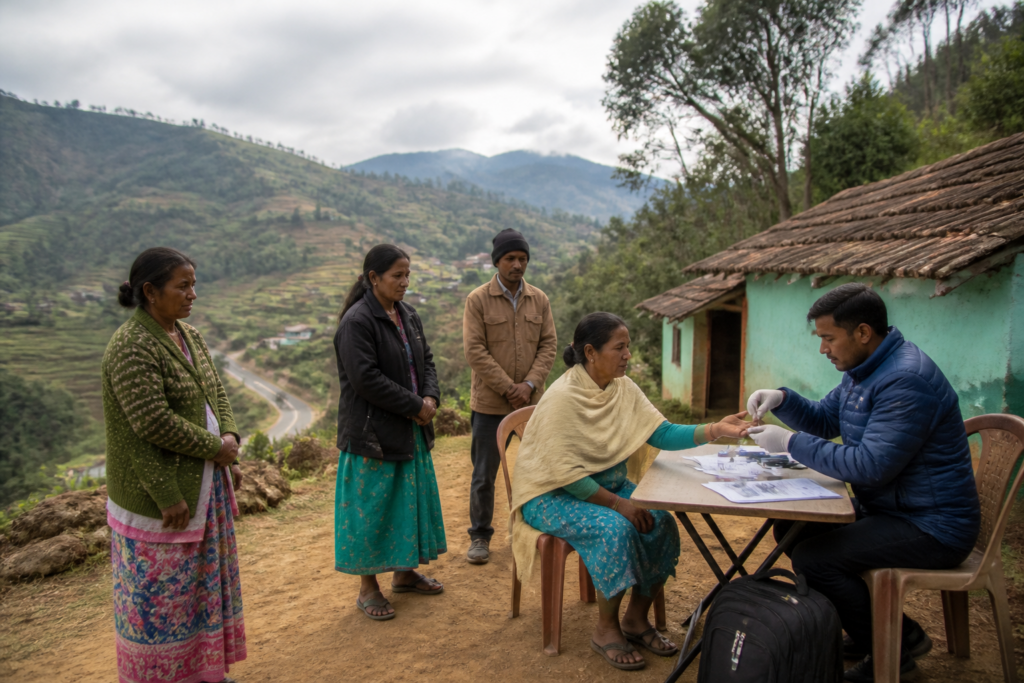
The Nilgiris has been associated with sickle-cell disease for more than seven decades, but the district still cannot say with confidence how widespread the inherited blood disorder is among its communities. Public-health screening has identified 340 people with sickle-cell disease and 1,650 carriers among 61,393 people screened over the past eight years, yet the figures describe programme detection rather than the true burden of disease.
That distinction is central to the Nilgiris’ public-health challenge. Sickle-cell disease is not only a medical condition requiring diagnosis. It is also a test of whether screening reaches representative populations, whether patients can access regular treatment across difficult terrain, whether families receive usable genetic counselling and whether health institutions can maintain follow-up over decades.
The problem is particularly important in the Nilgiris because the disease has long been documented among tribal communities. Researchers recorded the first Indian case in the district in 1952. Today, communities including the Toda, Kota, Kurumba, Irula, Paniya and Kattunayakan remain part of the public-health response, while screening is also being expanded to non-tribal populations, including the Badaga community.
The district’s geography adds an operational layer to the challenge. Health organisations working in Gudalur and Pandalur have served remote settlements spread across hundreds of hamlets. Earlier initiatives used mobile medical vans to provide outpatient care, maternal services, vaccinations and laboratory tests. Such arrangements are important in a hill district where physical distance, terrain and dispersed settlements can determine whether a patient reaches a facility regularly or only during a crisis.
Sickle-cell disease results from abnormal haemoglobin known as haemoglobin S. Red blood cells can become stiff and crescent-shaped, obstructing blood flow and breaking down prematurely. The consequences can include severe pain episodes, chronic anaemia, fatigue, infections and damage to vital organs. Sickle-cell trait is different: people carrying one copy of the gene are typically healthy but can pass it to their children.
This distinction makes the screening numbers more complex than a simple count of patients. Identifying a person with the disease supports treatment and follow-up. Identifying a carrier raises questions about counselling, family planning and whether the person understands the hereditary nature of the condition. In communities where consanguineous marriages occur, the risk of two carriers having a child with the disease becomes a particularly important part of preventive care.
The Nilgiris public-health department’s numbers show both progress and uncertainty. Dr D Somasundaram, deputy director of public health, said 61,393 tribal-community members had been screened under various National Health Mission programmes, with 340 identified as having sickle-cell disease and 1,650 found to have the trait, including non-tribal residents. These figures establish what existing programmes have detected. They do not establish how many people remain undiagnosed, how many screened residents continue treatment or how disease severity varies across the district’s communities.
A 2026 review published in the Journal of Haematology and Allied Science adds to that uncertainty. The paper, authored by Kanjaksha Ghosh, former director of the National Institute of Immunohaematology at KEM Hospital, Mumbai, reported that sickle-cell disease in the Nilgiris and neighbouring Wayanad is generally milder than in several central Indian tribal populations. But it also noted that much of the available research is hospital-based and may not represent the wider population.
That limitation matters because hospital records tend to capture people who have already reached care. They can help describe clinical severity but cannot, by themselves, measure prevalence across remote settlements or communities that face barriers to diagnosis. The review called for larger studies examining the influence of fetal haemoglobin, alpha-thalassaemia, nutrition, infections, climate and occupation on disease severity. It did not establish the district’s overall prevalence.
The available population context further underlines the gap. The 2011 Census recorded about 35,000 tribal people in the district. The screening figure of 61,393 people includes screening conducted over eight years and cannot be directly treated as a one-time survey of the entire population. Nor can detected cases be used to infer the number of undetected cases without knowing how the programme selected people, where screening occurred and how consistently different communities were covered.
Community organisations have therefore become part of the district’s health infrastructure. The Association for Health Welfare in the Nilgiris, known as Ashwini, works across 320 hamlets in eight areas, with many field staff drawn from tribal communities. It has focused on people of reproductive age and is implementing newborn screening. The Nilgiri Adivasi Welfare Association, or Nawa, provides screening, monthly follow-up and treatment support, while Ooty Government Medical College Hospital is also involved in care.
Dr Mridhula of Ashwini has said that health education alone is insufficient. Families need to understand how the disease is inherited and what it could mean for their children. Dr R Laxman Bharathi of Nawa similarly described a gap between awareness of the disease and understanding of it. These comments point to a service-delivery problem that cannot be solved by testing alone: screening produces a public-health benefit only when results are explained, recorded, linked to care and followed up.
The district’s experience also shows how stigma can weaken surveillance. Myths that sickle-cell disease is contagious, a divine curse or the result of black magic, certain foods or abandonment of traditional practices can discourage people from seeking testing or treatment. Some residents may avoid screening because of fear, misunderstanding or concerns about social consequences. The report also noted that some non-tribal residents have declined to participate in screening.
Earlier programmes attempted to combine outreach and treatment. The Tamil Nadu Health System Project provided screening, treatment cards, genetic counselling, hydroxyurea and emergency transfusions, and appointed tribal peer counsellors at several healthcare centres. The significance of that model lies in its integration of diagnosis with treatment and community-based support. A positive test without medication access, emergency care or repeated clinical monitoring leaves the most important part of the health pathway incomplete.
The current public-health response is expanding beyond its earlier focus on tribal settlements. The department is screening new pockets, including the Badaga community and other populations. Nawa has screened about 11,000 Badaga residents since 2021 in the Kotagiri, Coonoor and Ooty blocks, according to Dr Bharathi. He estimated disease prevalence at about 1% among Badagas and 5% among the Thoraiyar community, with trait prevalence estimates varying across groups. These are field estimates reported by the organisation and should not be treated as a district-wide prevalence study.
Technology offers another possible tool, but it does not remove the need for representative screening. A 2025 study by Maria Sheeba and K Sarojini developed an artificial-intelligence system that used red blood cell images and 14 disease-related attributes to classify sickle-cell anaemia among Nilgiris tribal communities. Using records from 300 patients obtained through Nawa, the system achieved 98% accuracy in that study.
That result may support early identification in settings with limited diagnostic capacity. But classification and population measurement are different tasks. An AI system can help identify whether a tested sample resembles a disease pattern; it cannot determine how many people in a district have the disease unless the people being tested represent the population. The technology therefore addresses one part of the diagnostic chain, while access, sampling, records and follow-up remain institutional responsibilities.
The national policy framework has made screening a major priority. The National Sickle Cell Anaemia Elimination Mission, announced in the Union Budget for 2023–24, set a target of screening seven crore people up to the age of 40 across 17 states between 2023 and 2026, with the broader objective of eliminating the disease as a public-health problem by 2047. Thirty tribal blocks in 14 Tamil Nadu districts were identified as vulnerable to sickle-cell anaemia.
Tamil Nadu has reported around 500 cases, with about 70% in the Nilgiris, according to the report. Cases of sickle-cell disease and trait have also been recorded in the hill areas of Salem, Kallakurichi, Dharmapuri and Villupuram. These figures place the Nilgiris within a wider state network rather than treating it as an isolated pocket. They also make district-level systems for referral, data management and continuity of care important to the mission’s implementation.
One missing element is the digital card intended to record whether an individual is unaffected, a carrier or has the disease. Such records could help patients and health workers retain essential information across facilities. But the cards had not yet been issued in the Nilgiris, according to the report. Without reliable records, patients may have to repeat testing, health workers may lack a complete history and officials may find it harder to monitor whether identified cases are receiving care.
The district’s central problem, therefore, is not simply that more people need to be screened. It is that the entire chain—from representative outreach and accurate diagnosis to counselling, records, medication, emergency transfusion and long-term follow-up—must work together. The 340 identified patients are not the endpoint of the programme; they are the beginning of a continuing care obligation. The 1,650 carriers represent a parallel need for clear information and voluntary, informed counselling.
What the evidence confirms is a substantial and persistent health burden concentrated in a district with dispersed settlements and historically underserved communities. What remains uncertain is the disease’s true population prevalence, the comparative burden across communities and the extent to which identified patients receive uninterrupted care. The next important milestones are wider representative studies, delivery of the promised digital records, continued expansion of screening and stronger monitoring of long-term treatment access across the Nilgiris.


