

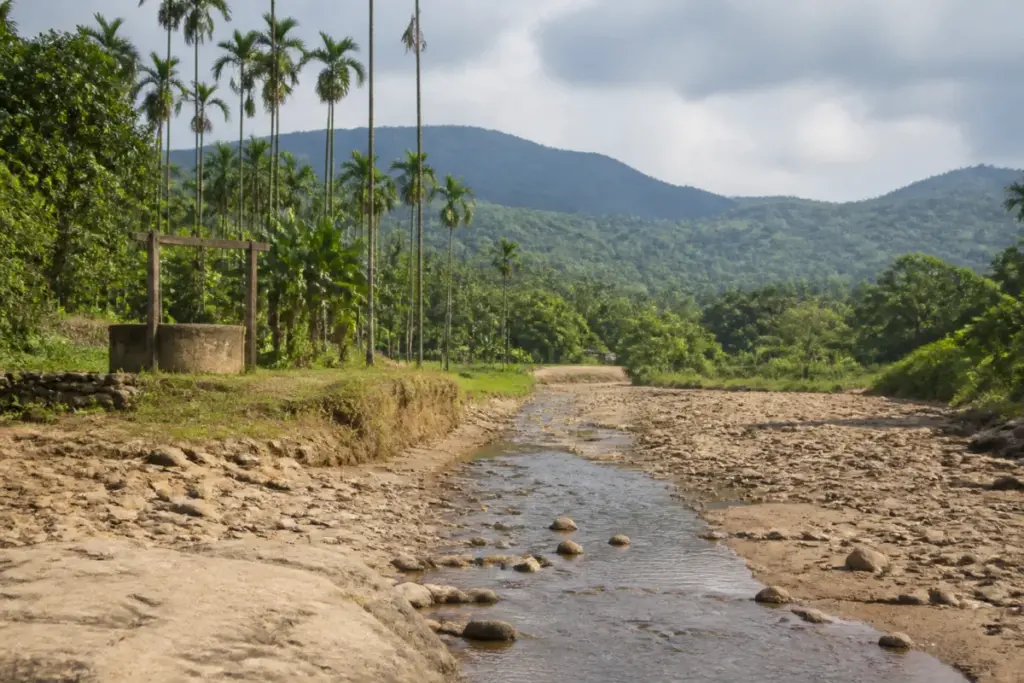
The drying of tributaries of the Netravati river in Dakshina Kannada is bringing a water crisis forward by several months, with farmers in the Western Ghats foothills reporting declining well levels, weak stream flows and growing difficulty in sustaining crops and cattle. The immediate trigger is a sharp shortfall in rainfall in parts of Belthangady taluk, but the effects reveal how closely rural livelihoods remain tied to the seasonal performance of small streams and springs.
The situation has been reported from the foothills of Charmadi Ghat, including Malavantige and Didupe. Belthangady has already been declared a drought-affected taluk by the Karnataka government, according to the report published by Prajavani. Within the taluk, however, the impact has not been uniform. The areas below the ghat received ordinary rainfall, while the foothill settlements received much less rain than usual. That difference has weakened the water sources that feed farms, homes and tributaries of the Netravati.
The distinction matters because the water security of these settlements depends not only on rainfall in the immediate vicinity, but also on sustained rain over the hill slopes and catchments. Local streams and springs filled only a few times during the season, the report said. Without repeated rainfall, the soil and rock formations in the foothills have not generated adequate seepage, leaving streams with little continuing flow after individual showers.
In earlier years, roadside flows along Charmadi Ghat could be seen through September and October. This year, many of those flows have disappeared as rainfall declined. Springs that once cascaded down the slopes are now reduced to dripping water. A stream locally known as Belnore, which had earlier shown a visible flow from the hills, has receded to the point where its bed can be seen.
These changes are also appearing in wells. Farmers in Charmadi Hosagadde told Prajavani that a 20-foot well which would normally be full at this time of year is now less than half full. The nearby Mrityunjaya river, which was previously difficult to cross during this period because of its flow, can now be crossed without even submerging a foot. The farmers said they may have to begin irrigating plantations before November, earlier than they would ordinarily expect.
The pressure is not limited to surface water. Farmers reported that borewell levels have also fallen, while concerns over possible electricity shortages could further complicate irrigation. The combination of lower groundwater availability and uncertain power supply creates a linked risk for plantations: even where water can be accessed below the ground, pumping it may become more difficult or expensive if electricity availability declines.
For households, the change is already visible in everyday water use. A farmer from Didupe told the newspaper that a tributary of the Netravati, which would normally be flowing strongly at this time, now has a visible riverbed. Water accumulated in check dams built in several locations during the previous summer has also not been washed away. According to the farmer, the rainfall has not been heavy enough either to replenish the flows or to remove those temporary structures.
The result is that some domestic wells have dried earlier than expected. The farmer said conditions usually seen in March and April had arrived already, forcing the family to collect water for drinking and cooking from a neighbour’s well. This is an important indicator of the severity of the situation: water stress is no longer confined to irrigation or seasonal farm planning, but is beginning to affect household access to basic water.
Dairy farmers face a separate but connected burden. In the Didupe area, many households depend on cattle rearing and require water not only for animals to drink, but also for washing them. Farmers told Prajavani that the shortage could disrupt dairy activity and reduce income. The impact therefore moves through the local economy in stages: weak rainfall reduces stream flow, declining water availability affects farms and livestock, and lower agricultural or dairy output threatens household earnings.
The tributaries named in the report include the Somavathi near Belthangady town and the Mrityunjaya flowing through Mundaje. Farmers living along these rivers observed that even accumulated waste had not been fully washed away, suggesting that the rivers had not experienced the stronger flows associated with substantial rainfall. A cultivator from Mundaje said that, despite having a plantation beside the river, irrigation may have to begin earlier this year and described the conditions as resembling a severe drought.
The reported weather pattern offers part of the explanation. Weather observers cited in the report said medium-level heavy clouds were obstructed by the Western Ghats, resulting in heavier-than-expected rain in areas below the mountain range. But the foothills did not receive the sustained heavy rainfall required to create reliable water seepage. This produced an uneven outcome: rainfall could be significant in one location while the catchments feeding local streams remained inadequately replenished.
That unevenness is central to understanding the water problem. A broad statement that a district has received rain can conceal severe shortages in particular catchments. For farmers and households dependent on a tributary, the critical question is not simply whether rain fell somewhere in the district, but whether enough rain fell repeatedly over the slopes and recharge areas connected to their wells and streams.
The report also shows why small water sources deserve the same administrative attention as major rivers. The Netravati is a major river system, but the daily water economy of foothill settlements is shaped by minor tributaries, springs, wells and local check dams. When these smaller systems fail, residents experience the crisis before any large river-level measure necessarily communicates the full extent of the problem.
The institutional response is complicated by the fact that water availability is spread across several responsibilities. The state government’s declaration of Belthangady as drought-affected establishes the wider administrative context. At the local level, however, irrigation, drinking water, electricity, livestock support and the management of temporary water structures involve different operational concerns. The supplied report does not specify a new relief package, emergency tanker plan, formal water audit or government assessment focused on the affected tributaries.
That absence of detail is significant because the current accounts are primarily ground-level observations. Farmers describe falling well levels, weakened rivers, earlier irrigation needs and difficulty supplying cattle. These accounts establish how residents are experiencing the shortage, but the report does not provide rainfall totals, groundwater measurements, reservoir data or a comparative assessment of individual catchments. The scale of the problem is therefore clear at the local level, while its precise hydrological extent remains unquantified in the supplied material.
The timing is nevertheless a warning sign. Farmers traditionally associated the most difficult water conditions with the later dry months, particularly March and April. In Didupe, residents say those conditions have arrived much earlier. In Charmadi Hosagadde, plantation irrigation may have to begin before November. The calendar of water stress is shifting for these communities, at least in the locations described by the report.
The broader urban and regional question is how water planning accounts for the rural catchments that support towns, farms and downstream river systems. The Netravati’s tributaries connect the Western Ghats foothills to the wider settlement network of Dakshina Kannada. When springs and streams weaken, the consequences are distributed across domestic water access, agriculture, dairy production and local incomes. Water security here is not only a matter of river volume; it is also a matter of maintaining the small flows that sustain everyday life.
The evidence currently confirms a serious and uneven rainfall-linked water shortage in parts of Belthangady taluk. It shows that tributaries, springs, wells and borewells are carrying less water than farmers expected at this point in the season, while dairy and household needs are already being affected. What remains unclear is the measured extent of groundwater decline, the official response for individual villages and whether rainfall conditions will improve. Those are the developments that will determine whether the present shortage remains a local seasonal crisis or deepens into a wider water emergency.


