

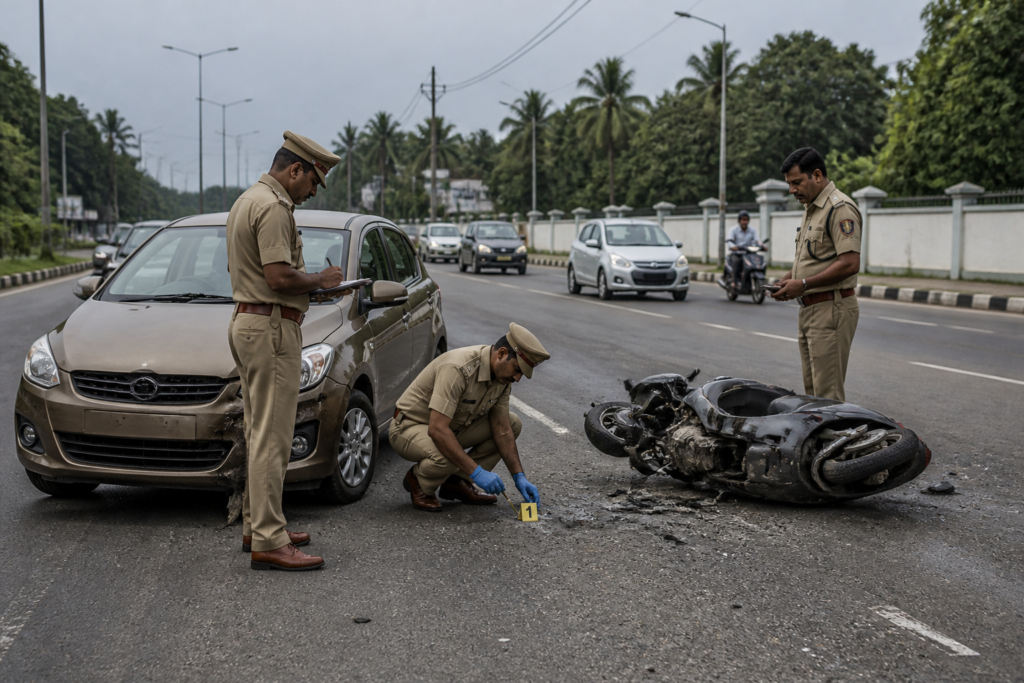
The Nedumbassery crash investigation has moved from an allegation of drunken driving to a case supported by forensic evidence, after a laboratory report recorded 160mg of alcohol per 100ml of blood in the 19-year-old accused who police say was driving the Mini Cooper. The result was more than five times the statutory limit of 30mg and followed a collision near Kochi airport that killed three young people.
According to the Times of India report, the Regional Chemical Examination Laboratory at Kakkanad submitted its findings to the police on Thursday. The report recorded 230mg of alcohol per 100ml of urine for prime accused Suhail Sajeev. Police have submitted the report to the judicial first class magistrate court at Angamaly, and all four accused in the case are in judicial custody.
The forensic finding matters because the central question in the case is not only whether alcohol was consumed, but who was driving and whether intoxication contributed to the collision. Police have said they are collecting multiple forms of evidence to establish that Suhail was behind the wheel when the Mini Cooper hit a scooter in Nedumbassery early on October 11.
The crash killed three youngsters, including two women, all aged around 21. The victims were travelling on a scooter when the car allegedly struck them. The location, near Kochi airport, places the incident within a busy urban movement corridor where airport traffic, local journeys and high-speed vehicle movement converge. The supplied report does not establish the road design, speed limit, lighting conditions or traffic-management arrangements at the exact location, but it places the collision within a setting where road-user safety has consequences beyond the people directly involved.
Police said blood and urine samples from Suhail and the second accused, Ninav, also aged 19, were collected within two hours of the crash. The blood-alcohol test of Ninav was positive, according to a senior police officer associated with the investigation. The other two accused, identified as Ameer and Joel, were arrested later that day. The report does not provide their test results or specify their alleged roles in the incident.
The timing of the sample collection is significant to the investigation because it gives the laboratory evidence a direct connection to the period soon after the crash. However, the forensic result by itself does not resolve every issue before the court. The police still have to establish the identity of the driver, reconstruct the collision and present the evidence through the legal process. The laboratory report has been described as strengthening the police case, not as a final judicial finding of guilt.
Police have also referred to CCTV footage as part of the evidence. Investigators said one set of footage allegedly shows Suhail getting into the driver’s seat before the journey and stepping out of the vehicle after the crash. Another purported recording allegedly shows the accused drinking together before the incident. These claims remain part of the investigation and are attributed to the police in the available report.
Together, the evidence described by investigators illustrates how a fatal road-crash case is built through different sources rather than a single test. The forensic report addresses alcohol levels. CCTV footage is being used to address who occupied the driver’s seat and what happened before and after the journey. The police are attempting to connect those strands to the collision involving the scooter. The court will ultimately determine how that evidence is assessed.
The case also exposes a persistent enforcement problem in urban road safety: the gap between a legal alcohol limit and the actual risk created when people drive after drinking. The report records 30mg of alcohol per 100ml of blood as the statutory limit and a reading of 160mg for the prime accused. That difference is central to the police account of the case. It indicates that the investigation is dealing with an alleged level of intoxication substantially above the permitted threshold, rather than a marginal exceedance.
Yet the available material does not establish how the accused obtained the vehicle, whether the journey was subject to any prior intervention, whether roadside testing took place before the samples were collected, or whether the road had earlier recorded similar crashes. Those unanswered questions are important for understanding the wider prevention system, but they cannot be filled with assumptions from this case. The evidence currently supplied supports a focused conclusion: investigators have a laboratory result, positive testing reported for a second accused and CCTV material that they say links Suhail to the driving and the events before the crash.
The institutional chain in the case is also clear. Police investigators collected biological samples, pursued CCTV footage and submitted the forensic report to the judicial first class magistrate court at Angamaly. The Regional Chemical Examination Laboratory at Kakkanad conducted the examination cited in the report. Four accused remain in judicial custody. These steps show how road-crash investigations move through policing, forensic examination and judicial scrutiny.
For residents and airport-area road users, the immediate public concern is the danger posed when a private vehicle is driven after alcohol consumption. The three people killed were around 21 years old, and the crash demonstrates how a decision made before a journey can affect vulnerable road users who have no connection to the drinking or the vehicle. The supplied account does not say whether the victims were travelling for work, education or another purpose, but it records the basic urban reality: a local scooter journey intersected with a car allegedly travelling at speed.
The case should therefore be read neither only as an individual prosecution nor as proof of a broader pattern that the available evidence does not document. Its public significance lies in the way a single fatal crash brings together road behaviour, alcohol enforcement, forensic capacity, CCTV coverage and the responsibilities of the criminal justice system. Each part answers a different question, and weaknesses in any one part can affect the ability to establish what happened.
The forensic report strengthens the prosecution narrative, but the final legal outcome remains pending. What is established in the supplied material is that the laboratory recorded 160mg of alcohol per 100ml of blood in Suhail Sajeev, that urine testing recorded 230mg per 100ml, that Ninav’s blood-alcohol test was reported positive, and that police have submitted the report to court. The next stage will be the judicial examination of this evidence alongside the CCTV footage, witness accounts and other investigation material.


