

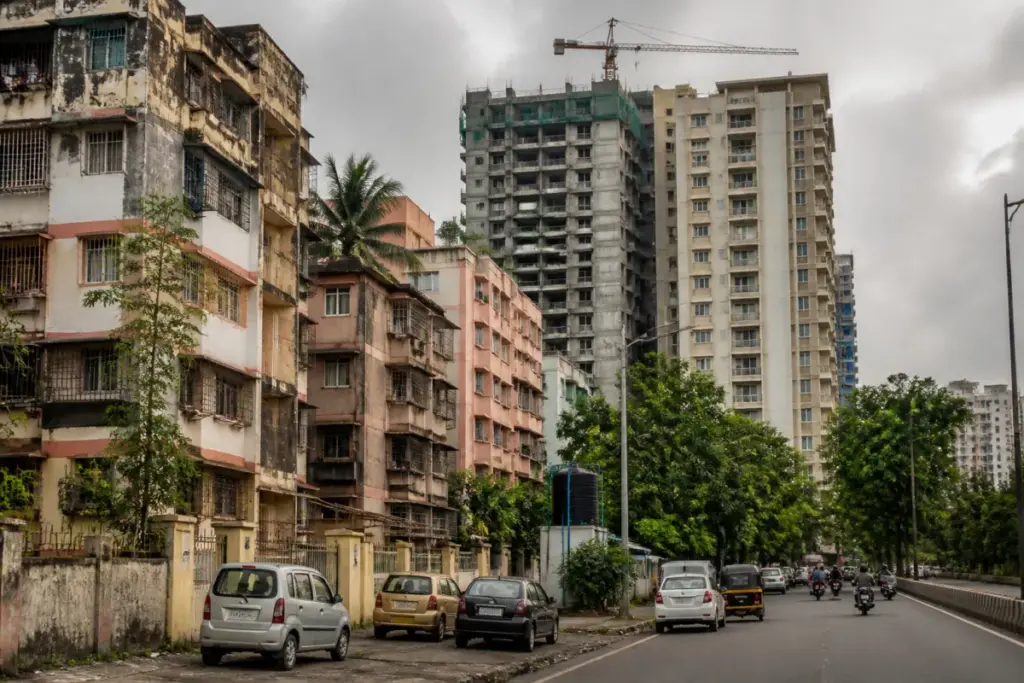
The Maharashtra government’s decision to override Navi Mumbai’s freeze on cluster redevelopment has reopened five proposals in Ghansoli and Vashi, but it has not resolved the planning conflict that produced the freeze in the first place. Navi Mumbai cluster redevelopment is now caught between two legitimate civic concerns: the need to replace ageing and potentially unsafe buildings, and the capacity of roads, water systems, parking and environmental infrastructure to absorb additional density.
The Urban Development Department, headed by Deputy Chief Minister Eknath Shinde, has directed Navi Mumbai Municipal Commissioner Kailash Shinde to process five proposals under the Urban Renewal Scheme. The department’s order says projects already notified in the government gazette, or pending before the civic body’s high-powered committee, cannot be stopped through a general body resolution. The Navi Mumbai Municipal Corporation must process the proposals and forward them to the state for approval.
The order reverses the practical effect of an August decision by the NMMC general body to suspend all projects under the scheme until their impact on civic infrastructure could be scientifically assessed. That resolution had stalled projects that had already cleared scrutiny, including some that had been notified by the state government. The latest direction therefore does more than restart five redevelopment cases. It establishes that a municipal freeze cannot override the state’s position on proposals already in the approval pipeline.
The institutional question is central. Cluster redevelopment is not simply a building-permission mechanism. It brings several buildings or settlements together for reconstruction and permits higher floor space index, or FSI. That can allow residents of cramped or ageing structures to receive larger homes and can make redevelopment financially viable. At the same time, additional built-up area and a higher resident population can increase pressure on local roads, water supply, sewage systems, parking and public spaces.
This tension is visible in the competing positions attributed to the state government and Navi Mumbai’s civic leadership. The Urban Development Department has argued that many buildings in the city are old and dilapidated, and that prolonged delays could put lives at risk. Eknath Shinde has also maintained that residents living in cramped homes deserve larger houses. The opposing concern, voiced by BJP minister Ganesh Naik, is that indiscriminate use of higher FSI could choke roads, water supply and parking.
Neither position, by itself, provides a complete redevelopment framework. Treating building age as the only test can accelerate construction without establishing whether the surrounding urban systems can support it. Treating infrastructure capacity as a reason for a blanket freeze can leave residents in unsafe or inadequate housing while a technical assessment remains pending. The dispute shows why redevelopment decisions need project-level evidence rather than broad political or administrative positions.
The state order appears to recognise this limitation. It does not automatically approve the five proposals. Instead, it requires the projects to continue through committee scrutiny and final approval by the state. It also directs the NMMC to assess infrastructure capacity and environmental impact. Future proposals are to be examined for their effect on civic amenities.
That distinction matters because processing a proposal and approving it are separate stages. The state has required the municipal body to consider the projects, but the reported order does not remove the need for scrutiny. Three of the five proposals had already been approved by the high-powered committee, while the remaining proposals were part of the notified or pending group covered by the department’s direction. The final decision still rests on the applicable scrutiny and approval process.
The five proposals also illustrate why redevelopment policy cannot be understood only through the language of private real estate. They include the Simplex settlement of mathadi workers in Ghansoli and the JN-type colony in Vashi Sector 9. Residents’ associations from these locations had appealed to the Urban Development Department. Their involvement places housing conditions and the rights of existing residents at the centre of the dispute, even as the wider question concerns the city’s ability to accommodate more built density.
The case also exposes a divided governance structure. The NMMC general body imposed the freeze, while the state department has ordered the civic administration to process the affected proposals. The municipal body is therefore responsible for examining infrastructure and environmental impacts but is operating under a state direction that rejects a general halt to projects already notified or under consideration.
This arrangement creates a difficult accountability chain. If a proposal advances, residents and developers may look to the state and the municipality for approval. If infrastructure constraints later become visible, it may be unclear whether responsibility lies with the civic assessment, the high-powered committee, the state approval process or the political decision to resume processing. A technically documented decision at each stage is essential because the dispute has already moved beyond a routine planning disagreement.
The political context has made that institutional conflict more visible. The Indian Express report describes the redevelopment dispute as part of a wider contest between Eknath Shinde and Ganesh Naik, despite both being associated with the Mahayuti alliance. Naik has longstanding political influence in Navi Mumbai, while Shinde is identified as Thane’s guardian minister. The report also notes earlier friction between the two leaders. That context helps explain the intensity of the public disagreement, but it does not substitute for the infrastructure evidence required to determine whether individual projects are appropriate.
The available facts do not establish the actual carrying capacity of the affected roads, water systems or parking supply. They also do not provide the proposed FSI, the number of additional homes, the expected population increase, the project-wise infrastructure assessments or the environmental findings. Without those figures, it is not possible to determine whether the five proposals represent a manageable increase in density or a material risk to civic services.
That evidence gap is the larger urban issue. Navi Mumbai was planned as a city with distinct nodes and organised infrastructure, but redevelopment changes the intensity at which those systems are used. A higher FSI decision is therefore not only a matter of building height or permissible floor area. It changes traffic generation, water demand, waste loads, parking requirements and the pressure on public amenities. The impacts may be distributed across a wider neighbourhood rather than remaining within the redevelopment plot.
The state’s direction has at least kept both sides of the planning problem within the formal process. It rejects an indefinite general freeze while retaining infrastructure and environmental assessment requirements. Whether that balance works will depend on the quality and transparency of the assessments, not merely on the fact that proposals are allowed to move forward.
For residents of old buildings, the immediate question is whether the restart will shorten a process that had become uncertain. For the NMMC, the challenge is to demonstrate that infrastructure concerns are being measured project by project rather than used either to block redevelopment generally or to justify approvals automatically. For the state, the order places responsibility on the approval system to show how housing safety and additional density can be reconciled.
The evidence currently confirms a change in procedure, not final redevelopment approval. Five proposals must be processed, three had already cleared high-powered committee scrutiny, and all still require the prescribed review and final state approval. The next significant developments will be the project-level infrastructure and environmental assessments, the committee’s further scrutiny and the state’s final decisions.


