

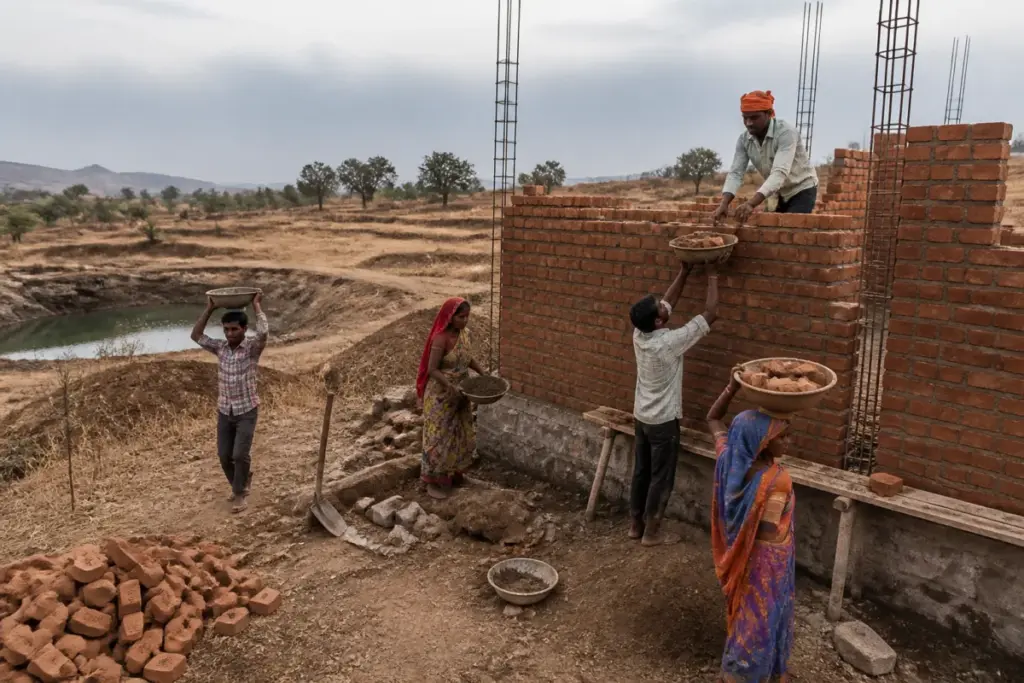
Nandurbar’s rural employment scheme is being used not only to provide wages but also to slow a drought-driven migration cycle before it pushes more families towards cities. With the district recording a 50% rainfall deficit, the administration has activated 25,524 projects across villages, created a work shelf capable of generating more than 101.7 lakh man-days and linked employment to housing, irrigation and water conservation.
The immediate trigger is visible in the experience of families such as that of Shankar Gavit in Akkalkuwa. After his paddy crop failed, Gavit had planned to leave for Surat with his wife and son. His family usually migrated for work in December, but the loss of the crop brought the decision forward. Work under the rural employment programme changed that calculation: the family began constructing its house under the Pradhan Mantri Awas Yojana and planned to take up well-digging after completing it.
That account illustrates the administration’s central strategy. Instead of treating migration as an isolated household decision, officials are responding to the conditions that produce it: failed crops, weak local incomes and a shortage of work at the point when agricultural employment declines. District collector Mittali Sethi said officials had identified early signs of possible migration as rainfall remained weak and asked gram panchayats to prepare individual and community-benefit works. The stated objective is to provide employment to every person demanding it.
The scale of the response is significant within the district’s administrative geography. Officials said 20,500 unskilled workers are currently engaged under the employment guarantee scheme, while 14,761 individual and community works are under way across Akkalkuwa, Akrani, Nandurbar, Navapur, Shahada and Taloda talukas. Employment is available in 621 of Nandurbar’s 643 gram panchayats, giving the programme reported coverage of 97% of the district’s gram panchayats.
The figures also show that the intervention is not limited to short-term wage payments. Around 79,077 houses have been included in the employment shelf, allowing eligible villagers to earn daily wages of Rs 312 while constructing their own homes under PMAY. The district’s deputy collector for the employment guarantee scheme, Usharani Devgune, said the household-level works were designed to combine income support with long-term asset creation and agricultural stability.
The listed assets include 3,901 individual irrigation wells, 6,679 horticulture and fruit orchard plantations, 2,162 cattle sheds and poultry-farming shelters. These categories matter because they connect employment to the productive capacity of rural households. A house addresses shelter; an irrigation well addresses water access for cultivation; an orchard creates a longer-term agricultural asset; and cattle or poultry shelters support livelihood activities beyond a single crop.
This design marks a shift from viewing rural employment only as a response to unemployment. In Nandurbar, the work shelf is being assembled around the specific vulnerabilities created by rainfall failure. The administration has combined household works with community infrastructure, including contour trenches, farm ponds, stream desilting and weirs. It has also included anganwadi buildings, protection walls and village roads.
The reported project mix reveals how drought affects more than farm output. When rainfall is deficient, the immediate loss is agricultural income. But the consequences spread to water availability, livestock, household construction and local infrastructure. By placing these needs within one employment pipeline, the district is attempting to use public works to address both the income shock and some of the physical deficits that make rural livelihoods fragile.
The institutional mechanics are equally important. The administration’s approach depends on gram panchayats identifying and preparing works, district authorities maintaining a sufficiently large shelf of approved projects and the employment guarantee system responding when people demand work. The reported 621-gram-panchayat coverage suggests an effort to take the programme close to the village level rather than concentrate it in a few larger settlements.
That matters for migration because the distance between a household losing its crop and a household leaving for a city can be short. Gavit’s family had already started planning a move to Surat when local work became available. The administration’s intervention therefore operates on timing: it seeks to create an alternative before migration becomes the only available income strategy. The source report does not establish whether the programme will prevent migration across the district, but it does show how officials are trying to intervene before an early exodus takes place.
The numbers also expose the difference between planned capacity and actual employment. The district has a reported capacity to generate more than 101.7 lakh man-days if demand rises, while 20,500 workers are currently engaged. The 25,524 projects are valued at Rs 23 crore. These figures indicate the scale of the prepared response, but they do not by themselves establish how many households will receive work, how long each project will remain active or whether the full man-day capacity will be used.
That distinction is important in assessing rural employment as a migration measure. A work shelf can provide administrative readiness, but its effect depends on timely approvals, the availability of materials and technical supervision, wage payments and the continuity of work during the period of greatest household need. None of those implementation outcomes is established in the supplied report. The evidence confirms the size and geographical spread of the plan, not its eventual performance.
The housing component adds another layer to the district’s strategy. Constructing a PMAY house allows a family to earn wages while creating a permanent asset, but it also ties employment to the pace of housing construction. Gavit’s account suggests how the two objectives can reinforce each other: the family receives local work and advances a long-pending housing need. Yet the broader report does not provide completion figures for the 79,077 houses included in the shelf, so the extent to which the housing pipeline has translated into finished homes remains unclear.
The same question applies to water conservation. Contour trenches, farm ponds, desilting and weirs are intended to respond to drought stress, while irrigation wells and plantations are individual assets. The report identifies these works and their planned scale, but does not provide measurements of water storage created, land brought under irrigation or agricultural income generated. The significance of the programme therefore lies at this stage in the way the administration has aligned employment planning with drought response, rather than in demonstrated long-term outcomes.
Nandurbar’s case also shows why migration cannot be treated only as a receiving-city issue. When rural households move to Surat or other cities after crop failure, the consequences are experienced in both places: families leave behind homes and social networks, while destination cities receive workers seeking temporary or insecure livelihoods. The source report does not quantify the number of migrants or identify the urban settlements they enter. It does, however, connect a district-level rainfall deficit with a household-level decision to move, making the rural origins of urban migration visible.
The immediate policy question is whether the employment system can remain responsive as demand changes. The administration has said it is adding more projects beyond the existing capacity of 101.7 lakh man-days. That makes the work shelf a live administrative instrument rather than a fixed list. Its usefulness will depend on whether new works are created where demand emerges and whether they remain relevant to the specific pressures faced by households.
The evidence currently confirms four elements of Nandurbar’s response: a 50% rainfall deficit, early concern about distress migration, employment coverage across 621 of 643 gram panchayats, and a project pipeline combining wages with housing, water conservation and livelihood assets. It does not yet establish the programme’s final effect on migration, household incomes or drought resilience. Those outcomes will require monitoring of work demand, wage payments, completed assets and migration patterns in the months ahead.
For now, Nandurbar’s response offers a clear administrative lesson supported by the reported facts: reducing distress migration begins before workers leave. It requires local employment to be available at village level and for that employment to create assets that address the same housing, water and livelihood pressures that make migration necessary.


