Nandurbar has activated 25,524 rural employment projects to prevent distress migration after the district recorded a 50% rainfall deficit, with the administration preparing work capable of generating more than 101.7 lakh man-days across villages.
The employment push is aimed at tribal and rural households facing crop losses and a possible early migration to cities such as Surat. District officials said 20,500 unskilled workers are currently engaged under the employment guarantee scheme, while 14,761 individual and community works are underway across Akkalkuwa, Akrani, Nandurbar, Navapur, Shahada and Taloda talukas.
Work has been made available in 621 of the district’s 643 gram panchayats, giving the programme a reported coverage of 97%. District collector Mittali Sethi said the administration acted after observing weak rainfall and early signs of possible migration.
“We picked on the early signs of possible migration as rainfall was very weak. We asked all gram panchayats to prepare personal and community benefit works and provide employment to every single person demanding it,” Sethi said. She added that the district had the potential to provide employment for 101 lakh man-days and was expanding that capacity.
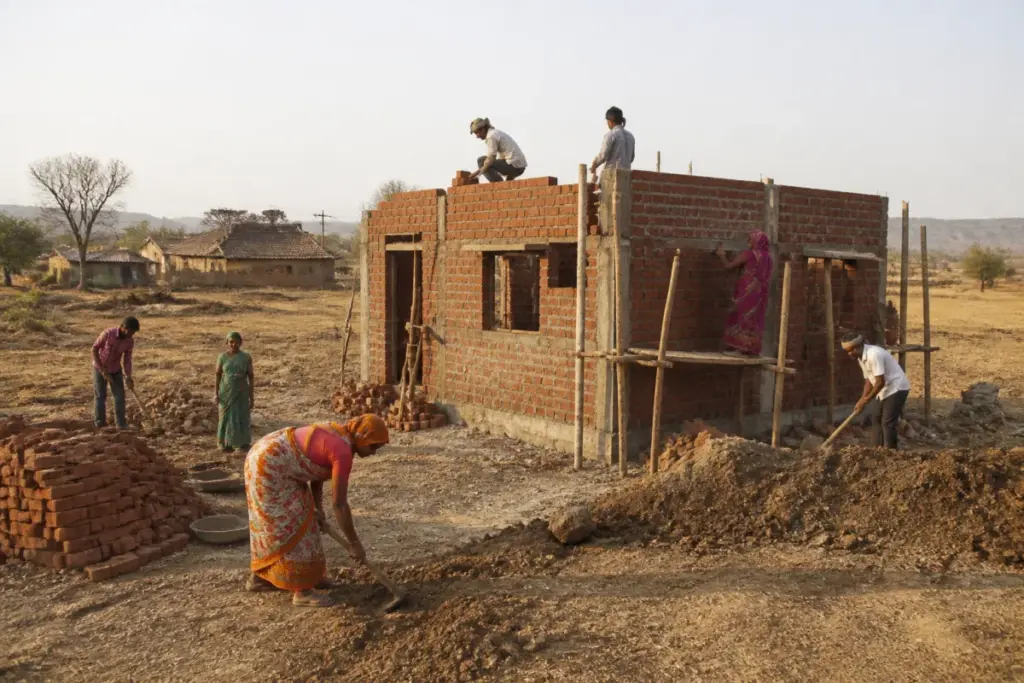
The programme combines immediate wage employment with household and community asset creation. A major component is housing construction under the Pradhan Mantri Awas Yojana, with around 79,077 houses included in the employment shelf. Beneficiaries receive daily wages of Rs 312 while building their homes under the scheme.
For families whose crops have failed, the arrangement is intended to keep income-generating work within the village rather than forcing workers to leave in search of employment. Shankar Gavit, a resident of Akkalkuwa whose paddy crop was wiped out by the rainfall deficit, told the Times of India that he had been preparing to travel to Surat with his family. He instead began building his house under the housing programme.
“ No rain, no paddy, no income,” Gavit said, according to the report. He said he and his elder son usually migrated for work in December, but the crop loss had led them to consider leaving earlier. After starting house construction, the family planned to complete the home and then take up digging a well.
The district’s individual-benefit works also include 3,901 irrigation wells, 6,679 horticulture and fruit orchard plantations, 2,162 cattle sheds and poultry farming shelters, according to deputy collector for the employment guarantee scheme Usharani Devgune. These projects are designed to combine wage support with assets that can support farming and household livelihoods.
The administration has also prioritised water conservation works, including contour trenches, farm ponds, stream desilting and weirs. Other projects in the work shelf include anganwadi buildings, protection walls and village roads, extending the response beyond individual households to local public infrastructure.
Officials said the 25,524 projects have been lined up at a cost of Rs 23 crore. The employment capacity could rise further if demand increases in the coming months, as the district manages the effects of the rainfall deficit and the risk of migration from rural areas.