

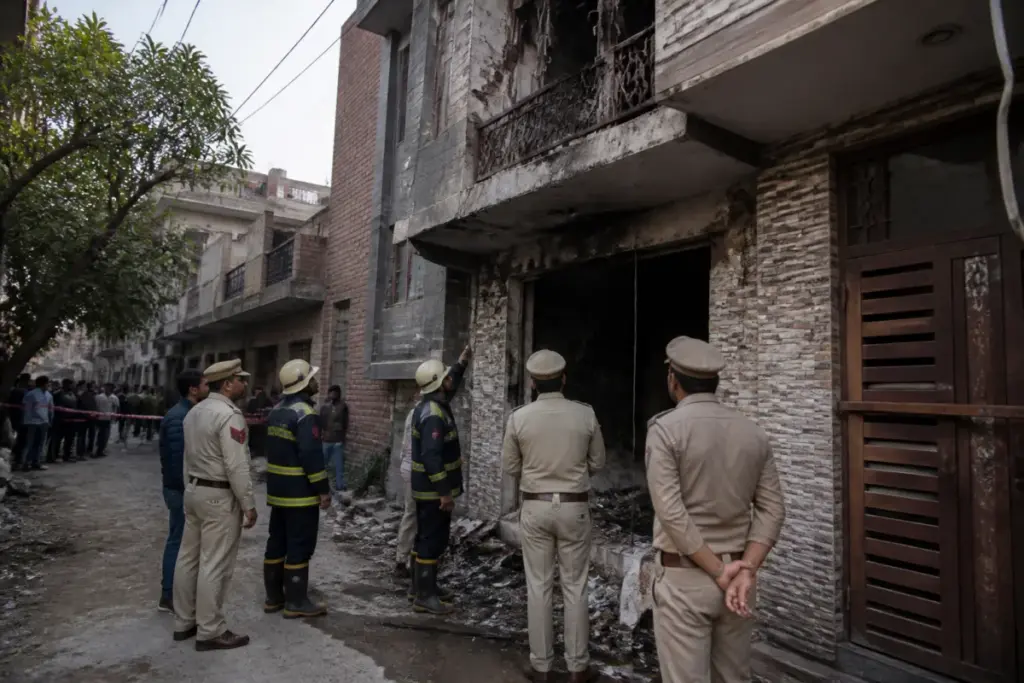
The Najafgarh LPG cylinder blast that killed four members of one family within 12 days was not only a tragic household fire. It also showed how a gas leak inside a poorly ventilated room can turn a routine domestic risk into a multiple-fatality incident, while leaving investigators to reconstruct the precise chain of events after the damage is done.
The blast occurred on the night of 22 September at a house in Ranaji Enclave, Najafgarh. Police found six people, including children, injured at the scene. The injured were taken first to Indira Gandhi Hospital and later to Safdarjung Hospital. According to the report, four members of the family died in sequence: Ramji Lal’s daughter Monica, 29, on 28 September; his 25-year-old son Keshav on 1 October; his daughter-in-law Sonam on 3 October; and his wife Kamlesh the following day.
The deaths therefore unfolded over nearly two weeks rather than at the scene itself. That distinction matters. A fire or explosion may be over within minutes, but the public-health consequences can continue through prolonged treatment, severe burns, loss of income, family separation and the care of surviving children. In this case, the report says that some seriously injured people suffered burns over 60% of their bodies.
The immediate human consequences extend beyond the four deaths. Keshav and Sonam’s son was reported to be living with his grandfather after both parents died. Monica’s daughter was also injured but was described as out of danger. The report says the incident left a three-month-old child without a mother and separated a four-year-old girl from hers. These details place the incident within the wider urban question of how a household accident can rapidly become a crisis for children, caregivers and extended families.
What the police have established so far is narrower than the full explanation of the blast. Their preliminary investigation found that the room was completely closed, without an opening through which air could escape. Police said LPG may have leaked from the cylinder and accumulated inside the room, creating a combustible mixture of gas and air. They also said that the exact cause of the incident was still being investigated.
That wording is important. The reported explanation describes a possible mechanism, not a final finding. It indicates why ventilation may have intensified the danger, but it does not by itself establish whether the leak originated in the cylinder, regulator, hose, stove connection or another part of the household installation. It also does not establish what ignition source triggered the fire. Those questions remain central to the investigation.
The physical damage described in the report shows how an incident on one floor can affect the rest of a building. Police said the explosion took place on the ground floor but damaged the first floor as well. The first-floor gate was badly damaged. This suggests that the risk was not confined to the room where the gas accumulated; pressure, flames and panic affected other parts of the house and potentially the escape routes used by residents.
The case therefore brings ventilation, detection and escape into the same safety discussion. A closed room can allow leaked gas to accumulate, while a damaged entrance can make evacuation more difficult once ignition occurs. The report does not say whether the house had a gas-leak detector, what condition the regulator and hose were in, whether the cylinder had been recently inspected, or whether residents had received any safety guidance. Those details should not be assumed, but their absence identifies the information needed to understand the incident fully.
The investigation has been registered at Najafgarh police station under Sections 287 and 106(1) of the Bharatiya Nyaya Sanhita, according to the report. The inclusion of criminal provisions indicates that the authorities are examining the incident as more than an unfortunate domestic mishap. However, the filing of a first information report is the beginning of the investigation, not a conclusion about responsibility or the final cause.
This institutional sequence is significant for urban safety. Police document the incident and investigate possible negligence or unsafe conduct. Hospitals manage the consequences of severe burns. Fire and emergency services may be involved in rescue and suppression. Gas distributors and equipment suppliers are relevant to the safety chain around cylinders, regulators and hoses. Building occupants, landlords and local authorities may also hold information about the physical condition of the premises. The supplied report does not identify the findings of all these agencies, so the full accountability structure remains unclear.
The Najafgarh case also shows why household fire safety cannot be treated only as a matter of individual caution. The event occurred inside a residential building, where cooking fuel, enclosed rooms, children and shared access routes intersect. Once a leak occurs, the outcome can depend on the condition of the installation, the design of the room, the ability to detect the smell of gas, the availability of ventilation and the speed with which residents can leave.
At the same time, the available evidence does not support broader claims about the frequency of LPG accidents in Delhi or the performance of the city’s safety systems. No statistics, inspection records, fire-service audit or regulatory report were provided with the source material. It is therefore not possible to say from this case alone whether the incident represents a citywide trend, a failure of enforcement in Najafgarh, a defective appliance or an isolated household event.
What can be established is the severity of the consequences. Six people were found injured, four later died, and surviving children were left dependent on other family members. The preliminary police account points to gas accumulation in a closed room, while the exact cause remains open. The damage reached the first floor, and the case is being investigated under specified provisions of the criminal law.
The next stage should clarify the physical and administrative record: the condition of the LPG equipment, the source of the leak, the ignition point, the building’s ventilation and access arrangements, and the findings of the agencies involved. Until those details are established, the Najafgarh blast is best understood as a documented family tragedy with a clear household-safety dimension, but not as proof of a wider pattern that the supplied evidence does not yet demonstrate.


