

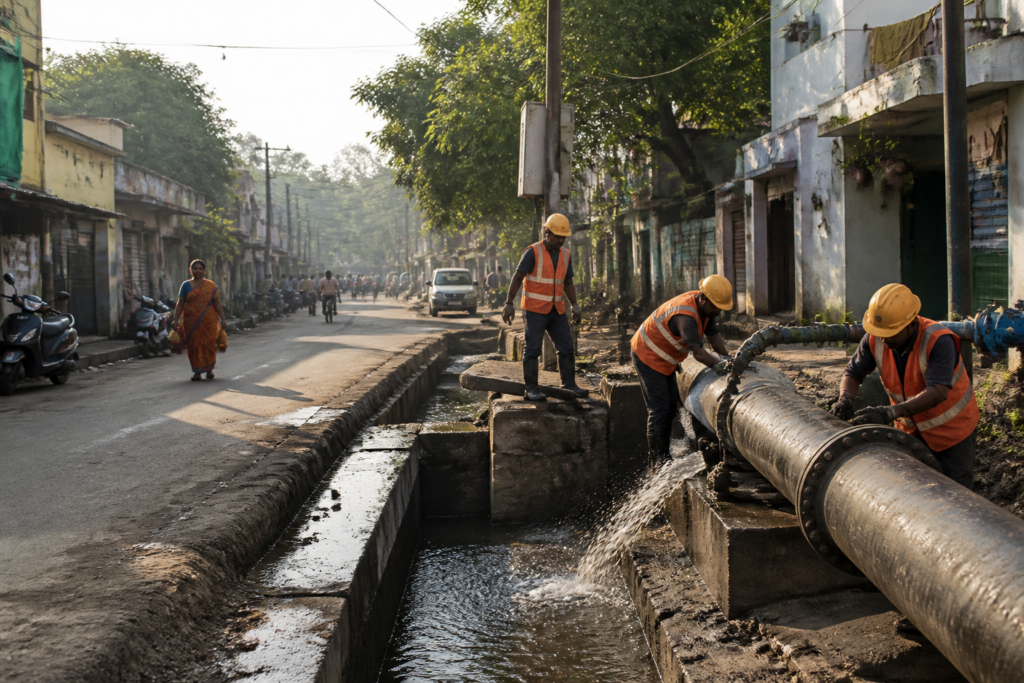
Nagpur Municipal Corporation has ruled out an immediate cut in Nagpur water supply despite a state government directive requiring a 10% reduction, choosing instead to recover lost water by repairing leakages and acting against illegal connections. The civic body will continue pumping 740 million litres per day from the Totladoh reservoir and Kanhan river for now.
The decision was announced before the state government’s deadline for reducing supply. Mayor Neeta Thakre told the Times of India that there would be no water cut for the time being, while leaving open the possibility of a later reduction depending on reservoir conditions.
“We will analyse the status of the reservoirs in the coming days and take a decision on whether to reduce supply or continue with the current arrangement,” Thakre said.
NMC’s immediate strategy is focused on non-revenue water, the portion of treated water that is supplied into the distribution network but does not generate revenue. The civic body estimates that around 259 million litres per day, or nearly 35% of the city’s current supply, is lost through leakages, unauthorised connections and other distribution losses.
The scale of the reported losses is significant. A 10% reduction in Nagpur’s present supply would amount to approximately 74 million litres per day. NMC is attempting to meet the conservation objective through distribution management rather than by reducing the volume delivered to households.
Superintending engineer Shweta Banerjee said the civic body had saved 300 million litres over the previous six days through measures that included plugging leakages and converting illegal connections into legal ones. The reported saving averages 50 million litres per day over that period, although NMC has not indicated how much of the reduction is expected to be sustained.
Banerjee said repair work and action against illegal connections would continue. The civic body has also appealed to residents not to waste treated drinking water on activities such as washing cars and cleaning roads.
For households, the immediate effect is that routine supply will continue without the announced 10% cut. For NMC, however, the decision shifts the immediate responsibility for conservation from consumers to the distribution system. The civic body must demonstrate that leak repairs, connection regularisation and tighter network management can produce savings at a scale comparable to the state’s directive.
The reported 259 MLD of non-revenue water also makes the issue larger than the current supply decision. It indicates that a substantial share of water entering Nagpur’s system is not reaching paying users or is not being accounted for as billed consumption. Reducing this gap can increase effective availability without increasing abstraction or imposing an immediate household cut.
NMC’s approach remains dependent on two factors: whether the reported savings continue and how reservoir levels evolve. The mayor said the supply position would be reviewed in the coming days. That assessment will determine whether the current arrangement continues or whether the civic body eventually reduces supply.


