

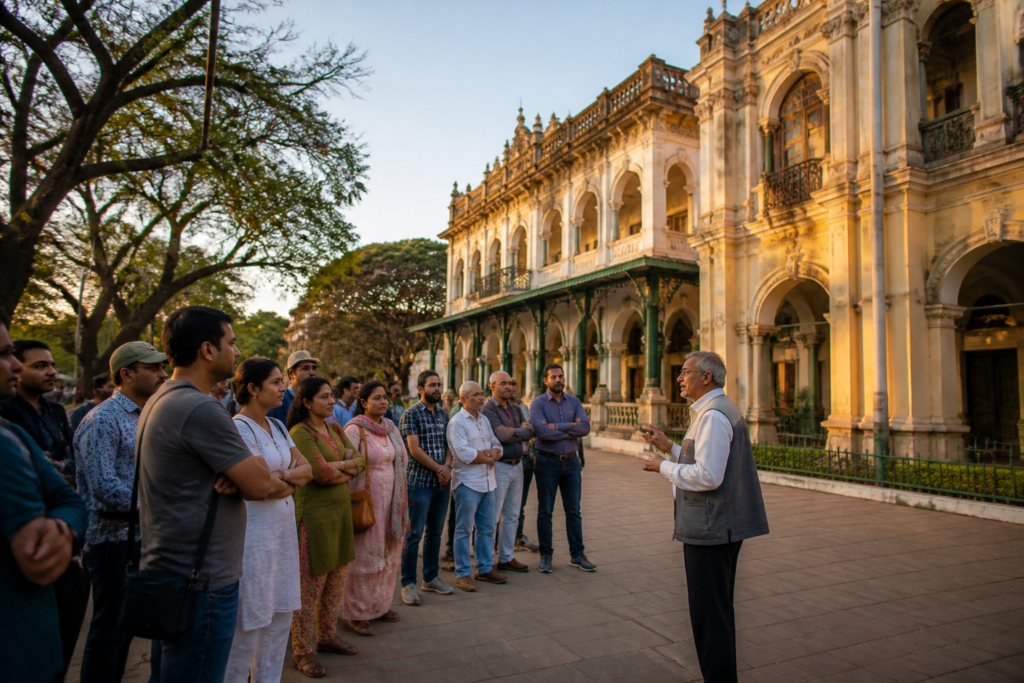
Mysuru’s heritage structures, including the homes of prominent writers and 129 listed buildings, received renewed attention during a Dasara heritage walk organised in the city on Thursday, with calls for stronger conservation and public protection.
Kannada film director B Suresh, who flagged off the walk at Town Hall, said Mysuru’s identity extended beyond its palaces and included a wide range of heritage buildings spread across the city. He urged government authorities to conserve, protect and promote these structures for future generations.
Suresh specifically referred to the houses associated with writers Kuvempu, R K Narayan, Tara Su and Triveni. He said these properties carried their own historical and cultural significance and should be safeguarded as part of Mysuru’s wider heritage landscape.
The guided walk was organised by the Department of Archaeology, Museums and Heritage along with the tourism department. Participants were introduced to the architectural styles, construction periods and histories of the buildings and monuments included in the route.
Heritage commissioner A Devaraju said the department conducted heritage walks to showcase Mysuru’s architectural assets and historic structures. The programme was intended to help visitors understand the significance of the buildings rather than view them only as individual landmarks.
The department has printed brochures covering 129 heritage structures. These are being used during the Dasara heritage walk tours to explain the history and importance of the listed properties to visitors.
The heritage department has also extended cooperation to the government for conserving heritage monuments that currently house government offices. These include the Mysuru fire station office in Saraswathipuram, as well as prominent landmarks such as Devaraja Market and the Lansdowne building.
According to the department, it has provided technical support for the conservation of these structures. The latest call for protection places the focus on how Mysuru’s heritage buildings, including privately associated writers’ homes and public landmarks, can be retained as part of the city’s architectural and cultural record.


