

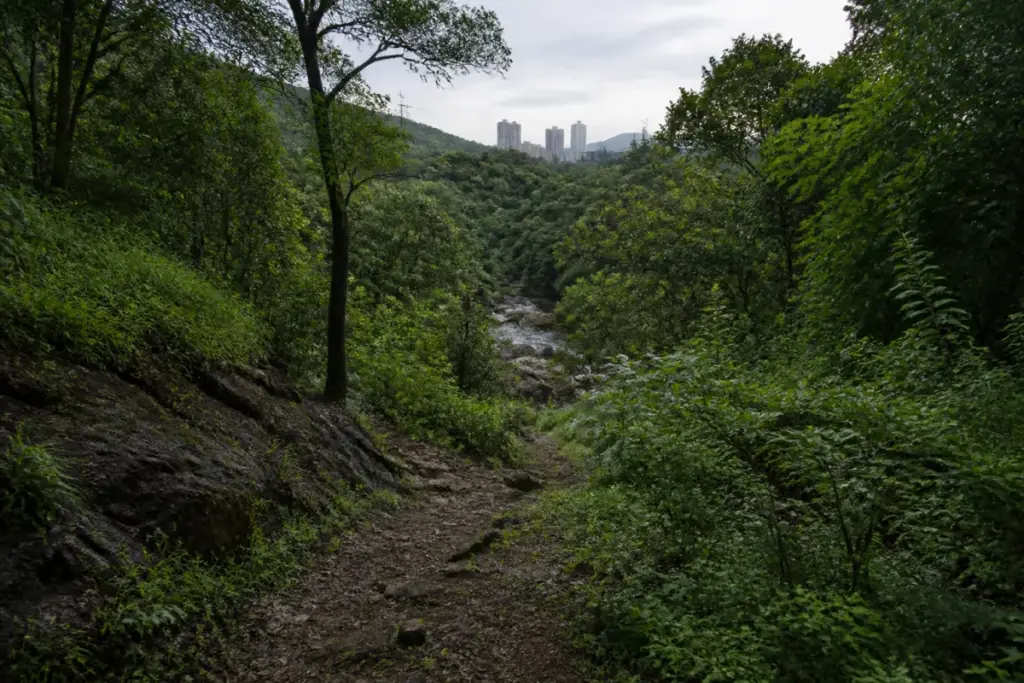
The death of 60-year-old civic worker Vijay Sukharu Sapte inside Sanjay Gandhi National Park has brought Mumbai’s hidden poaching economy and the difficulty of governing a large forest within a rapidly expanding metropolis into sharp focus. Sapte was allegedly mistaken for a wild boar and shot on October 20 near the Yeoor Hills range towards Thane, according to a preliminary forest department investigation reported by The Indian Express. Officials also suspect that he may have been part of a group of hunters involved in the shooting.
The incident is not only about an illegal hunting trip that went wrong. It reveals a more difficult urban governance problem: how a city protects wildlife in a landscape where roads, housing colonies, settlements, hamlets, creeks and forest boundaries increasingly sit alongside one another. Sanjay Gandhi National Park is not an isolated wilderness far from urban life. It is a 103-square-kilometre forest embedded within the Mumbai metropolitan region, bordered by the same patterns of expansion that make land more valuable and natural habitats more fragmented.
That setting creates a complicated enforcement environment. Forest officials told The Indian Express that hill ranges, creeks and inaccessible stretches make it difficult to monitor the entire park. A force of 433 Maharashtra Security Force personnel patrols the area, but the department acknowledged that the scale and terrain limit effective coverage. The number indicates a substantial security presence, but it does not automatically translate into continuous surveillance across every trail, slope, water source or forest edge.
The gap between personnel strength and actual visibility is central to understanding the problem. A forest can be formally protected and still remain difficult to police. Patrol teams must cover uneven terrain and areas that officials say are inaccessible to the department. Animals also move beyond administrative boundaries, while hunters can track their movements across adjoining forest and non-forest areas. In this landscape, jurisdictional maps do not necessarily correspond to the routes used by wildlife or people.
The reported location of the shooting adds another layer. Officials said it took place near a creek, where animals often approach water sources to drink. Such locations can become predictable points of movement, making them easier for hunters to watch. The same ecological features that sustain wildlife can therefore create enforcement vulnerabilities when access, surveillance and local intelligence are limited.
The evidence cited in the report suggests that the October shooting was part of a continuing pattern rather than an entirely isolated event. In March, forest officials found that macaques were being shot with bows and arrows in Thane’s Upvan area. In 2019, carcasses of deer and leopards were found in separate incidents inside the park. The forest department launched an anti-snare drive after traps were discovered at multiple locations in 2020, and live animal traps were found at different parts of the park in 2021.
These incidents involve different species and methods, but they point to a recurring enforcement challenge. Poaching does not require a large organised operation to damage a protected landscape. Snares, bows, firearms and knowledge of animal movement can allow hunting to continue in areas where the department cannot maintain constant physical presence. The discovery of traps also indicates that enforcement is often reactive: officials find evidence after a threat has already been placed in the forest.
Pawan Sharma, honorary wildlife warden of Mumbai and director of the Resqink Association for Wildlife Welfare, told The Indian Express that wild boars, deer and hares are preferred targets because they are comparatively easy to spot and hunt. Forest officials identified demand for wild animal meat in illegal markets as a key driver. Sharma also said that some poachers may preserve skeleton remains as trophies.
The reported demand matters because it connects activity inside the forest to a market outside it. Hunting is not sustained only by access to animals; it also depends on buyers, intermediaries and the ability to move meat or animal remains. The source material identifies illegal markets as a driver, but does not establish their size, organisation or geographic reach. That limitation is important. The existence of demand is clear in the officials’ account, while the full structure of the market remains outside the evidence supplied here.
The legal framework is not ambiguous. Hunting protected wild animals is prohibited under the Wildlife (Protection) Act, 1972. The challenge lies in translating that prohibition into regular detection, prosecution and deterrence across a forest that is difficult to access and surrounded by urban settlement. Laws define the offence, but forest governance depends on patrol systems, intelligence, community cooperation, boundary management and the capacity to respond quickly when animals or suspected hunters move through the landscape.
The role of settlements inside and around the forest makes that task more complicated. Officials alleged that some residents provide information about animal movements or help poachers gain access. At the same time, the forest department has started sensitisation camps in villages so residents cooperate with authorities. The department also said that many people remain unaware that killing animals is an offence under the Wildlife Protection Act.
This dual approach—enforcement alongside community outreach—reflects the institutional reality of protected forests within metropolitan regions. Villages and hamlets are not simply external threats to a park boundary. They are part of the social geography through which people, animals, information and access move. Treating all local residents as enforcement risks would undermine cooperation, while ignoring the possibility of local facilitation would leave a significant intelligence gap. The report records the department’s attempt to address both sides through sensitisation and policing.
Mumbai’s wider urban growth intensifies the problem. The Indian Express describes roads, housing colonies and expanding settlements increasingly hemming in wildlife. As the built environment approaches forest edges, encounters become more likely and the distinction between an urban area and a protected landscape becomes harder to maintain in practice. Wildlife may cross boundaries in search of water or food, while people may enter forest areas through informal routes, work-related access or hunting trails.
That does not make the forest’s legal status uncertain. It makes administration more demanding. A protected area within a large urban region requires more than a boundary on a map. It requires coordination between forest authorities, security personnel, local administrations and communities in adjoining areas. The source material confirms the presence of a 433-person Maharashtra Security Force contingent and village sensitisation efforts, but it does not provide details on patrol frequency, conviction rates, surveillance technology, inter-agency coordination or the department’s budget. Those are significant unanswered questions in assessing how effectively the system is working.
The available figures nevertheless show the scale mismatch clearly. The park covers 103 square kilometres, while wildlife moves beyond forest jurisdictions and some areas remain inaccessible to officials. A force of 433 personnel may support patrols, but the number alone cannot demonstrate full coverage. The incidents recorded over several years—from carcasses in 2019 to anti-snare operations in 2020 and 2021, macaques being shot in March and the October death—show that enforcement actions have reduced some threats without eliminating poaching.
That distinction is important. An anti-snare drive can remove traps, and sensitisation camps can improve awareness, but neither measure proves that the underlying drivers have disappeared. Officials said the measures reduced the problem, while also acknowledging that poaching continued. The evidence therefore supports a cautious conclusion: enforcement has had an effect, but the park remains vulnerable because demand, access and difficult terrain continue to operate together.
The larger urban question is whether Mumbai’s protected forests are being governed as living landscapes or treated mainly as bounded security zones. The reported incidents suggest that protection involves several connected systems: ecological movement, settlement patterns, illegal markets, local knowledge, patrol capacity and public awareness of wildlife law. Failure in any one of these areas can weaken the others.
The shooting near Yeoor Hills has made that hidden system visible because a human death drew attention to a problem usually experienced through animal carcasses, traps and missing wildlife. The incident does not by itself establish the full scale of poaching in Sanjay Gandhi National Park. It does establish that hunting remains possible inside a protected forest surrounded by one of India’s largest metropolitan regions, despite existing patrols and earlier anti-snare measures. The next developments to monitor are the outcome of the forest department’s investigation, any criminal proceedings, further enforcement action and whether community sensitisation and patrol systems expand beyond individual drives.


