

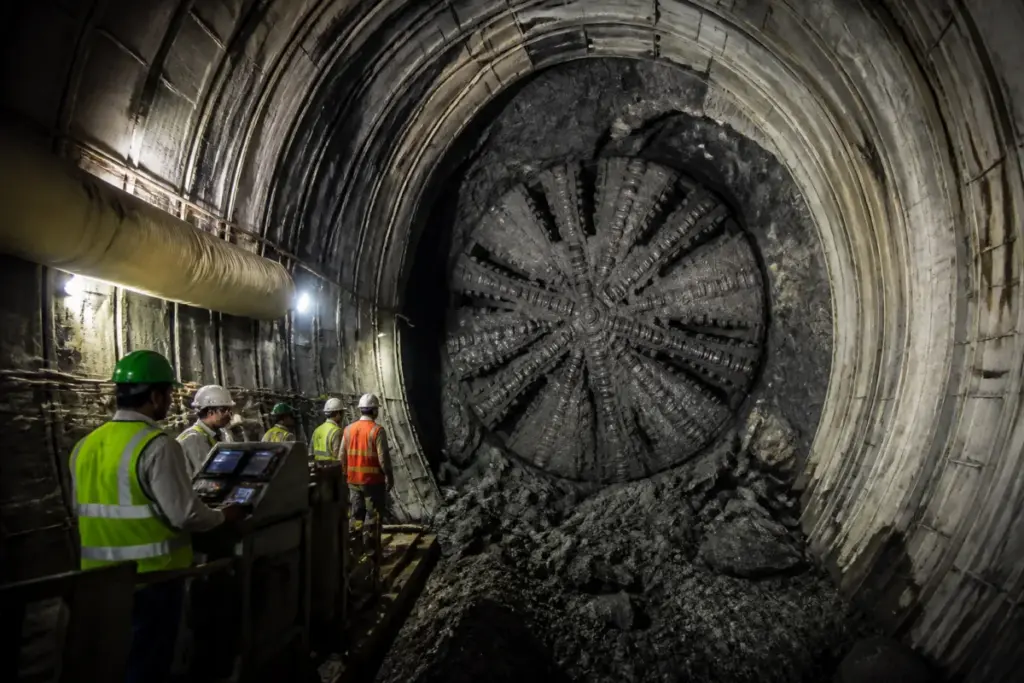
Mumbai’s Goregaon-Mulund Road tunnel is moving through one of the city’s most difficult underground environments, where hard Deccan basalt, changing ground conditions and an ecologically sensitive alignment are forcing engineers to balance speed against safety. Nearly two months after the Brihanmumbai Municipal Corporation began boring beneath Sanjay Gandhi National Park, the first tunnel boring machine has excavated 183 metres, advancing at an average of 5.5 metres a day and falling below three metres on some days.
That pace is not simply a construction statistic. It is a measure of the challenge involved in extending Mumbai’s road network through a landscape where the surface cannot be treated as an ordinary construction site. The 6.65-km twin-tunnel system will pass beneath Film City and the forested hills of Sanjay Gandhi National Park before emerging at Khondipada in Mulund. Around 5.3 km of the tunnel length will be excavated using tunnel boring machines, while the remaining sections will be built through other methods.
The project is a key part of the 12.2-km Goregaon-Mulund Link Road corridor, which is intended to create a direct east-west road connection between Mumbai’s western and eastern suburbs. The Brihanmumbai Municipal Corporation expects the corridor to reduce the journey between Goregaon and Mulund to less than 20 minutes, compared with the 60 to 90 minutes the trip can take depending on traffic. The estimated cost of the full corridor is around Rs 14,000 crore, including Rs 6,600 crore for the tunnels.
The central engineering problem is the rock itself. Basalt, formed from the cooling of ancient lava flows, is the principal geological formation along much of the alignment. The Indian Express reported that the Deccan Trap basalt varies in quality, with hard, thick and sharp formations that can affect the efficiency and safety of the cutting process. Its properties also change according to mineral composition, texture and weathering.
For the Japanese-made machine named Tulsi, this means that excavation cannot proceed at a fixed mechanical rhythm. The TBM uses rotating cutting blades at its head to break through the rock as it advances. Engineers must monitor the condition of the ground and the cutting operation continuously. If the blades are not controlled, officials said, they could be damaged. Slowing the machine on difficult days is therefore part of managing the excavation rather than evidence of a uniform failure to progress.
The alignment adds another layer of complexity. The tunnel’s depth will vary from around 20 metres to 160 metres, and it will not follow a straight line. According to a civic official quoted by The Indian Express, engineers assess each forward movement because the machine is passing through different geological formations and changing depths. A day with less than three metres of excavation may be followed by a faster day, but only after the ground and equipment have been assessed.
This is significant because the tunnel is being built under a landscape that includes areas near Tulsi and Vihar lakes. The alignment is designed to reach depths of up to 160 metres beneath the hills to reduce the impact on tree roots and the water table. The decision to go deeper illustrates the trade-off built into the project: protecting the surface environment requires a more demanding underground construction process.
The tunnel therefore represents two distinct infrastructure challenges at the same time. The first is the conventional urban requirement to move traffic more efficiently between suburbs. The second is the need to construct that connection beneath a forested and water-sensitive landscape without treating environmental protection as an afterthought. The deeper alignment may reduce surface disruption, but it also exposes the project to greater variation in rock conditions and makes the excavation process more technically sensitive.
The project schedule reflects the scale of that balancing act. The BMC has planned a 21-month excavation period, with the first tunnel targeted for completion by March 2028 and the second by June 2028. A second TBM is expected to begin excavation later this month. The two machines will bore parallel tunnels to carry traffic in opposite directions, allowing excavation to proceed on both sides of the twin-tunnel system.
Deploying two machines is linked directly to the length of the tunnel section. The BMC had earlier used a Chinese-made TBM named Mavala to excavate the 2.07-km Coastal Road tunnel between Marine Drive and Priyadarshini Park. The Goregaon-Mulund tunnel is substantially longer, making parallel excavation central to the planned schedule. The comparison also shows that Mumbai’s experience with TBMs is expanding from water-supply tunnels and the Coastal Road to a much longer road connection beneath the city’s northern landscape.
However, the current excavation figures also show why a schedule cannot be understood only through its headline completion date. At an average rate of 5.5 metres a day, the first machine has excavated 183 metres after nearly two months of work. The reported rate is not constant: on some days, progress has fallen below three metres because engineers have had to adjust the cutting operation. The project’s 21-month excavation plan will consequently depend not only on machine capacity but also on how consistently the machines can operate through changing rock conditions.
The use of a second TBM may help maintain the programme, but the supplied report does not establish how the pace of the second machine will compare with Tulsi’s progress or whether the excavation schedule has been revised. Those details matter because the project’s public purpose rests on delivering a reliable east-west connection, while its financial scale makes construction delays an important administrative concern. The available information confirms the targets, but not whether the current pace will alter them.
The institutional structure is also visible in the way the project is being managed. The BMC is responsible for the corridor and is monitoring the machine’s performance through engineers and civic officials. The decisions involve equipment protection, geological assessment, environmental safeguards and sequencing between the two parallel tunnels. This is not a project in which construction can be separated from municipal administration: the city body must coordinate technical execution with a long-term transport objective and a sensitive environmental setting.
The tunnel’s public value comes from addressing a clear gap in Mumbai’s road network. The western and eastern suburbs currently lack a comparable high-speed road connection between Goregaon and Mulund. The proposed corridor is intended to shorten a journey that can take up to 90 minutes in traffic to less than 20 minutes. Whether it achieves that objective will ultimately depend on the completed corridor, its connections at either end and how traffic uses it, but the current construction stage establishes the physical challenge involved in delivering the link.
The project also raises a broader question about how Mumbai expands infrastructure in a city where transport demand, dense development and environmental constraints increasingly overlap. Building at the surface can create direct disruption to roads, neighbourhoods and vegetation. Going underground can reduce some surface impacts, but it requires expensive specialised machinery, detailed geological monitoring and longer construction planning. In the GMLR case, the choice to tunnel beneath the hills transfers much of the difficulty below ground rather than eliminating it.
What the evidence confirms at this stage is that the tunnel is under construction, that the first TBM has excavated 183 metres, and that hard and variable basalt is affecting the daily pace. It also confirms that the BMC is using depth, monitoring and controlled excavation to manage the alignment beneath the forest and near the lakes. What remains uncertain is whether the second machine will progress at a similar rate and whether the March and June 2028 targets will remain unchanged as excavation continues.
The next important milestones are the start of the second TBM and the progress of the two machines against the BMC’s 21-month excavation plan. Those milestones will show whether parallel boring can offset the difficult geology while maintaining the project’s stated schedule and its promise of a faster east-west connection across Mumbai.


