

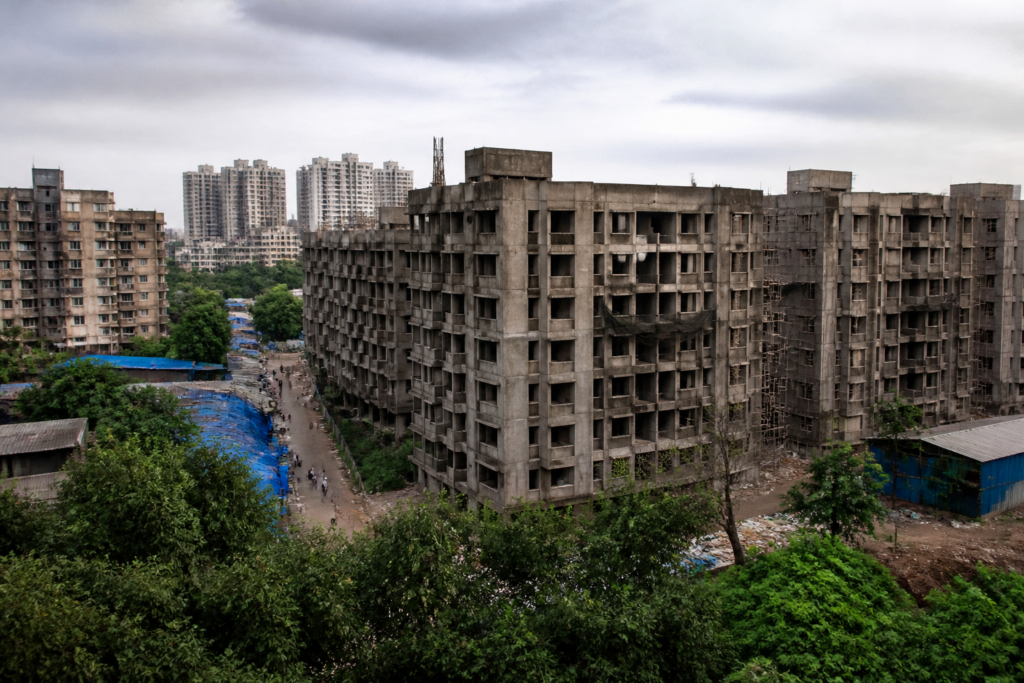
The FIR against the developer of Royal Palms in Aarey Colony is not only a report about 349 missing rehabilitation homes. It is a record of how a slum-redevelopment project can remain incomplete for three decades while the obligations created by the scheme continue to affect residents, project-affected persons, regulators and buyers of the sale component.
The Royal Palms scheme, registered by Amir Park and Amusement Pvt Ltd, received its letter of intent in March 1996. The proposal provided for 12 rehabilitation buildings and 10 sale-component buildings. According to the report, only seven rehabilitation buildings were completed and received occupancy certificates, allowing around 104 eligible slum-dwellers to be rehabilitated. The remaining five rehabilitation buildings were not completed, and 349 tenements meant for project-affected persons were not handed over to the Slum Rehabilitation Authority.
The central institutional problem is therefore not simply construction delay. It is the failure to close the chain connecting an approved redevelopment proposal, the delivery of rehabilitation homes, the issue of occupancy certificates and the transfer of the promised tenements to the public authority responsible for the scheme. The Royal Palms case shows that an approval can exist for years without producing the full housing outcome that justified the redevelopment in the first place.
The project also illustrates the dual structure of Mumbai’s slum-redevelopment model. Rehabilitation buildings are intended for eligible residents or project-affected persons, while sale-component buildings create the commercial value that supports the development. At Royal Palms, five of the 10 sale-component buildings received occupancy certificates, while the remaining five did not. The incomplete status of both components has left different groups facing different consequences.
Residents of the sale-component buildings that lack occupancy certificates have to pay double for civic amenities because the structures are deemed unauthorised, the report said. This creates a direct connection between the regulatory status of a building and the everyday cost of living in it. A project that remains unresolved on paper can therefore impose continuing financial consequences on occupants, even when buildings have already been constructed and occupied.
The rehabilitation shortfall carries a different and more serious consequence. The 349 homes were intended for project-affected persons, but they were not handed over to the SRA. Mumbai North-West MP Ravindra Waikar alleged that flats meant for project-affected persons had been sold to ineligible slum-dwellers. The allegation is part of the complaint and must be distinguished from the fact that the SRA has filed an FIR and initiated action against the developer.
The immediate trigger for the latest action was Waikar’s complaint to Deputy Chief Minister Eknath Shinde, who handles the housing portfolio, seeking an inquiry into the scheme and the whereabouts of the 349 homes. The FIR was registered with Aarey police, and Waikar was informed about it at a meeting with SRA officials. The report does not state whether the investigation has established the alleged sale of the rehabilitation flats, nor does it identify the eventual legal outcome for the developer.
That distinction matters because a police case is an escalation, not a completed remedy. It may establish a route for investigating alleged violations, but it does not by itself deliver the undelivered tenements, regularise buildings without occupancy certificates or resolve the status of affected residents. Those outcomes require action by the housing and planning authorities, the municipal corporation, the police and, where necessary, the courts.
The SRA’s administrative powers are also visible in the other cases discussed at the meeting. An FIR was filed against developer Satish Dattani after a complaint from the SRA over the redevelopment of Bhagat Singh Nagar in Goregaon West. Waikar said 229 rehabilitation flats had been sold instead of being handed over to the SRA. The SRA has initiated action under Section 13(2) of the Maharashtra Slum Areas (Improvement, Clearance and Redevelopment) Act, 1971, to remove the developer and appoint another.
The same removal process has been initiated against Shrimali Realty for the Koyna Nagar Redevelopment Scheme in Goregaon East, which has been delayed for more than 20 years. SRA officials told Waikar that the developer would be removed within a week. In the Mayur Nagar case, also in Aarey Colony, officials said the proposal had been sent to the state government for approval.
Taken together, these cases indicate that developer replacement is being used as a corrective mechanism when redevelopment schemes fail to progress or when the delivery of rehabilitation units is disputed. But the Royal Palms timeline shows the limits of delayed intervention. The scheme began in 1996, and only 104 eligible slum-dwellers were rehabilitated in the completed buildings. The remaining obligation has continued across changes in officials, political representatives and administrative circumstances.
The numbers also reveal how incomplete projects can become administratively fragmented. At Royal Palms, 12 rehabilitation buildings were proposed, seven were completed and five remained unfinished. Of the 10 sale buildings, five received occupancy certificates and five did not. The scheme consequently produced partial completion rather than a single clear outcome: some rehabilitation housing was delivered, some was not; some sale buildings were certified, while others remained without the required document.
This fragmentation complicates accountability. The developer’s obligation is tied to the approved scheme, but the consequences are experienced through separate institutions. The SRA is responsible for the redevelopment framework and has now filed the FIR and begun action. The BMC’s failure to issue occupancy certificates affects the legal and civic status of buildings. The police investigation concerns alleged wrongdoing. The state government is involved in approvals and housing administration. For residents and project-affected persons, however, these separate processes appear as one unresolved housing problem.
The report does not establish why the five rehabilitation buildings were not completed, how the 349 tenements were treated after construction or whether any authority had previously ordered corrective action. It also does not provide the current status of the eligible beneficiaries, the total number of residents affected by the missing homes or a timeline for completing the scheme. Those gaps will be important to the investigation and to any administrative decision to replace the developer.
The use of Section 13(2) points to a possible transition from an allegedly non-performing private developer to another implementing agency. Such a change may address construction and execution, but it will still have to account for the existing records, eligibility lists, building approvals, occupancy certificates and the status of homes that were allegedly sold or occupied improperly. The supplied report does not say whether a replacement developer has been appointed in Royal Palms.
The larger urban question is how Mumbai should prevent rehabilitation commitments from becoming indefinite liabilities. A slum-redevelopment scheme is not complete when part of its built form is visible. It is complete only when the eligible households or project-affected persons receive the promised homes, the relevant buildings receive the necessary approvals and the obligations between the developer and public authority are formally closed.
Royal Palms now places that question before the police and the SRA after 30 years. The immediate developments to watch are the investigation into the 349 tenements, the status of action against the developer, the possible use of Section 13(2), and whether the five incomplete rehabilitation buildings and uncertified sale buildings receive a defined administrative resolution. Until those steps are documented, the project will remain an example of partial delivery being mistaken for redevelopment completion.


