

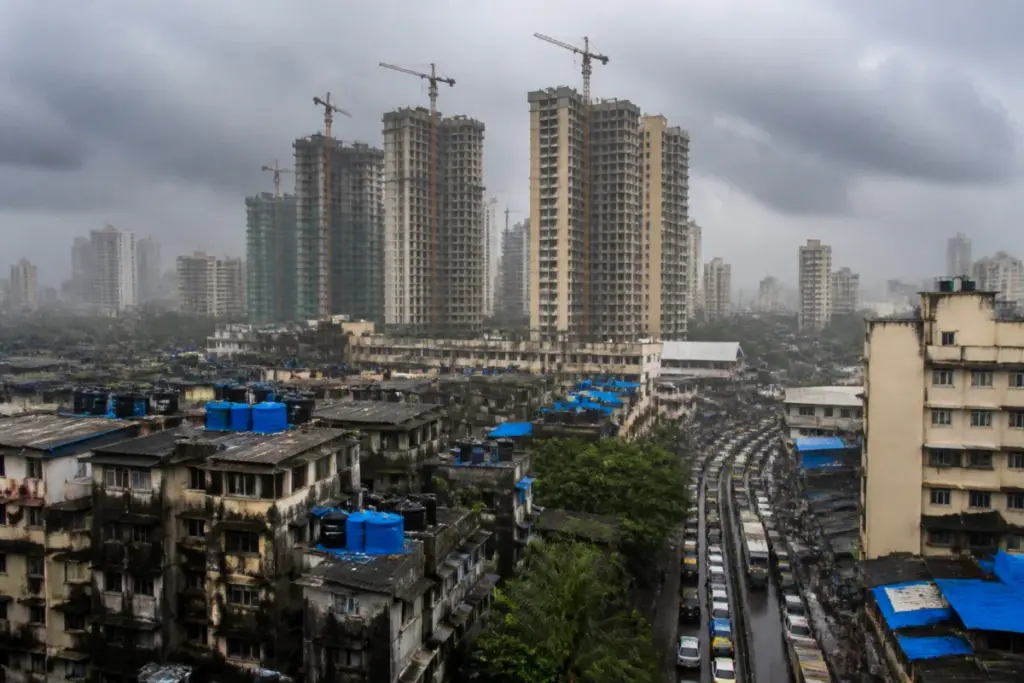
Mumbai’s redevelopment boom is being presented as a housing and renewal strategy, but urban and environmental experts have warned that the city is expanding its built form faster than its water, transport, ecological and public-space systems can absorb. The warning, issued at a seminar organised by Nat Connect Foundation and Mumbai Press Club, points to a structural problem: redevelopment is being measured mainly through the number and height of buildings, while the supporting infrastructure needed to make those buildings liveable remains less visible.
The seminar, titled ‘Towering Crisis: The City We Are Rebuilding’, brought together speakers from environmental groups, urban research organisations and civil society. They argued that unchecked redevelopment is shrinking open spaces, worsening the housing crisis and placing additional pressure on water and other essential services. Their concerns are not limited to individual projects. They relate to the cumulative effect of thousands of construction decisions across a dense metropolitan region.
That distinction matters. A redevelopment project may satisfy planning and building permissions on its own, yet the combined demand from multiple projects can create pressure that is difficult to see at the level of a single approval. Water supply, sewage networks, roads, public transport, drainage, air quality and access to sunlight and ventilation are shared systems. Their capacity does not automatically increase simply because additional floor space is legally permitted.
The speakers traced the current construction surge to changes in Mumbai’s real estate and planning landscape. Journalist Gurbir Singh linked the city’s redevelopment trajectory to the closure of textile mills in the early 1980s and the subsequent real estate boom. The seminar also focused on the rise in permissible floor space index, or FSI. Experts cited an increase from an average of 1.33 to 4 in recent years, arguing that the change has enabled much taller construction across the city.
FSI determines the amount of built-up floor area that can be created on a plot in relation to its size. Higher FSI can support more homes and make redevelopment financially viable, especially in a city where land is scarce and older buildings require renewal. But it also concentrates more residents, workers, vehicles and service demand within the same urban geography. The central issue is therefore not whether higher FSI is inherently beneficial or harmful. It is whether permissions for additional floor area are being matched by infrastructure planning and investment.
The experts at the seminar argued that this matching process is inadequate. They associated rapid redevelopment and insufficient planning with possible water shortages, traffic congestion, ecological damage, shrinking open spaces and a decline in quality of life. These claims were made by speakers at the event and were not accompanied in the supplied report by a new infrastructure-capacity assessment or official response. That limitation is important: the discussion establishes a strong public warning, but does not by itself quantify the gap between projected demand and available supply.
Water emerged as one of the most immediate concerns. Bittu Sahgal of Sanctuary Foundation referred to the human cost of dense urbanisation and questioned how residents of 50- and 60-storey buildings would manage if shortages became severe. The image is powerful because water access in a high-rise city depends on more than the presence of a municipal connection. It also relies on pumping systems, storage, electricity, internal distribution and the ability of residents to reach and use those systems during interruptions.
The report does not provide Mumbai’s current water demand, supply capacity, ward-level shortages or the number of redevelopment projects that have received permissions. It also does not establish a direct causal link between any particular project and a water failure. What it does show is that the water question is being raised alongside a broader concern about the city’s carrying capacity. That is a governance issue: planning authorities must consider how cumulative development affects systems that operate across plot and ward boundaries.
The discussion also connected redevelopment to the city’s open spaces and ecological assets. D Stalin of Vanashakti questioned the expansion of what he described as “Mumbai 2, 3 and 4” across the Mumbai Metropolitan Region, asking whether additional urban sprawl is being allowed at the cost of forests, salt pans, green areas and open spaces. The concern is that relieving pressure in the core city through peripheral expansion may not eliminate the underlying problem. It can shift the demand for roads, water, drainage and public transport to new areas while consuming land that performs ecological functions.
Stalin also argued that proper breeze and sunlight should be treated as essential components of human rights. In practical planning terms, access to daylight and ventilation is shaped by building spacing, height, street width, orientation and the density of surrounding construction. These qualities are difficult to capture through a single project-level metric. They are also vulnerable to cumulative change: a neighbourhood can become darker, less ventilated and more congested even when individual buildings comply with formal rules.
The seminar placed these concerns in the context of Mumbai’s Development Plan 2034. Speakers pointed to what they described as gaps in the plan and warned that it could permit construction to reach 300% of present levels. The supplied report does not specify the exact provision, location or calculation behind that figure, nor does it include an official interpretation of the plan. It should therefore be treated as an attributed warning rather than an independently established projection.
That distinction is especially relevant because the Development Plan is not merely a blueprint for buildings. It is the framework through which land use, infrastructure reservations, transport networks, environmental protections and development potential are coordinated. If built-up capacity rises without parallel decisions on public services and ecological protection, the plan can produce growth in floor area without producing a corresponding improvement in urban life.
The housing argument adds another layer. The speakers questioned why property prices remain high despite the construction boom. This challenges the assumption that more supply automatically produces affordability. The report does not provide sale prices, rental data, income figures or details of the types of homes being created, so it cannot establish how redevelopment has affected affordability across Mumbai. But the question is central to the policy debate: redevelopment can increase the number of units while still failing to serve households that face the greatest housing pressure.
This is also where the institutional mechanics of redevelopment become important. Landowners, societies, developers, planning authorities, infrastructure agencies and residents operate within different incentives and responsibilities. A developer may have a financial reason to maximise saleable floor area. A housing society may seek better homes or safer buildings. A planning authority may permit additional FSI under defined rules. Water, roads, drainage and public transport agencies, however, must support the resulting population and activity. Without coordinated sequencing, the benefits and costs of redevelopment are distributed unevenly.
The event’s speakers also raised air quality, traffic and the monsoon deficit. Subhajit Mukherjee of Mission Green Mumbai referred to an ongoing monsoon deficit and warned that the El Nino effect could produce a water crisis in the immediate future. The report does not provide rainfall data, a forecast or an official assessment linking current weather conditions to Mumbai’s water position. The claim remains an attributed concern, but it underlines the vulnerability created when a dense city depends on limited and climate-sensitive resources.
The larger evidence available from the report is therefore about direction rather than measurement. Mumbai is seeing taller buildings, continuing redevelopment and pressure to create more housing and real estate value. At the same time, experts are warning about water security, mobility, ecological loss, open-space reduction and liveability. The report supplies the cited FSI change and the projected 300% construction figure, but not the service-capacity data needed to determine the precise scale of the gap.
For citizens, the practical question is not simply how many buildings Mumbai can approve. It is whether residents can reliably access water, move through the city, breathe cleaner air, find usable open space and live in homes that remain affordable. These outcomes depend on decisions that are often separated administratively: development permissions, transport planning, environmental regulation, municipal water management and housing policy.
The seminar’s warning should therefore be read as a demand for integrated capacity planning rather than as a rejection of all redevelopment. Mumbai needs to renew ageing buildings and accommodate residents, but the supplied discussion suggests that the city’s planning conversation is focused more strongly on permissible construction than on the public systems that construction depends on. What remains to be established is the size of the infrastructure deficit, how the Development Plan 2034 addresses it, and whether project approvals are being tied to measurable water, transport, ecological and open-space capacity.
Those are the next questions for Mumbai’s planning authorities, municipal agencies and developers. Until the city publishes that evidence in a form that can be tested against the scale of proposed redevelopment, the debate will continue to be driven by competing claims: more construction as a route to renewal on one side, and warnings of an increasingly unliveable city on the other.


