

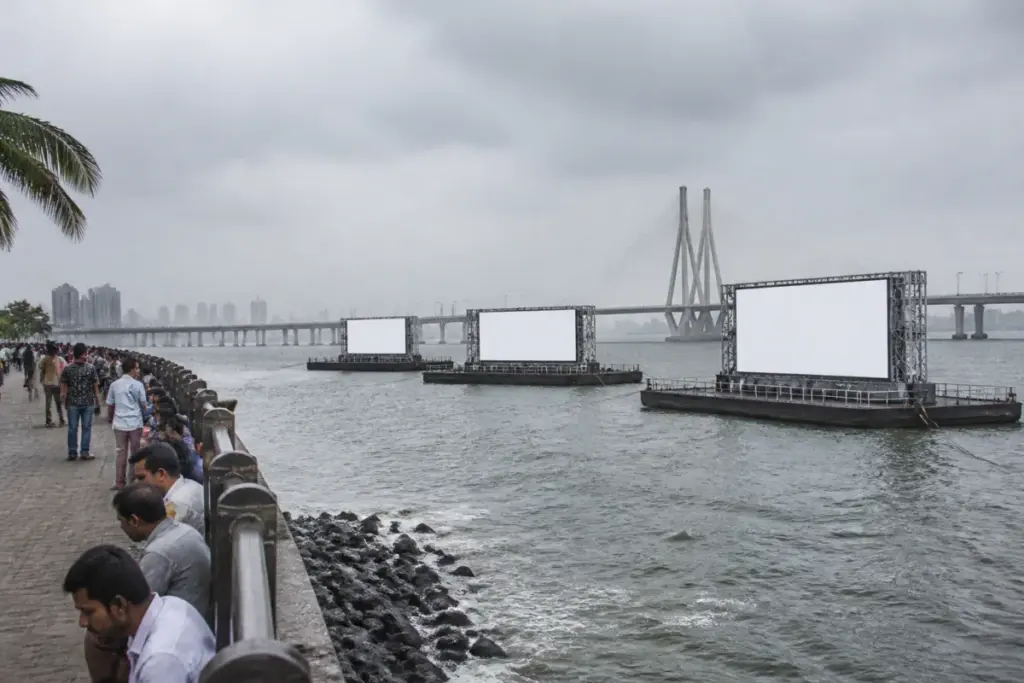
Mumbai’s plan to place floating advertising barges and hoardings at prominent waterfront locations is being presented as a new revenue stream for port and water transport infrastructure. But the proposal also exposes a recurring urban governance tension: how public waterfronts can be commercially used without weakening coastal regulation, visual quality and the character of open civic spaces.
The Maharashtra Maritime Board has floated tenders to appoint advertising agencies on a Design, Build, Finance, Operate and Maintain basis for installations at around 20 locations across the Mumbai Metropolitan Region. The proposed sites include Juhu Beach, Lotus Jetty, the Bandra-Worli Sea Link jetty in Worli, Carter Road and Marve Jetty.
The model would shift the board from merely permitting advertising activity to directly earning revenue from it. Maharashtra Ports and Fisheries Minister Nitesh Rane said the MMB had previously issued no-objection certificates for advertisements but would now generate income from the installations. The board’s stated objective is to use commercial activity around waterfront assets to support port and water transport infrastructure.
That distinction is important because the proposal is not simply about placing another set of hoardings along a road. Floating advertising structures would occupy or operate within visually prominent coastal settings, including beaches, jetties and the seafront near the Bandra-Worli Sea Link. Their presence would therefore be experienced not only as advertising but also as a change to the public landscape.
The Maharashtra Coastal Zone Management Authority has recently said that the proposed installations lacked Coastal Regulation Zone clearances. This introduces a regulatory issue before the commercial model can be judged on its financial or operational terms. The available information does not establish whether the clearances will be sought, whether the proposal will be modified, or whether the tenders will proceed before the regulatory question is resolved.
The MMB has said the installations will comply with environmental and coastal regulations and meet international standards. Rane also said a detailed hoarding and advertising policy had been prepared. These statements indicate that the project is being framed as a regulated infrastructure and advertising programme rather than as an informal extension of roadside signage. However, the reported objection from the coastal authority means that compliance cannot be treated as an assumption; it remains a condition that must be demonstrated through the relevant approval process.
The proposed Design, Build, Finance, Operate and Maintain structure also places the waterfront within a long-term commercial arrangement. Under such a model, a private advertising agency would be responsible for designing, building, financing, operating and maintaining the installations. The supplied report does not specify the contract period, expected revenue, concession terms, maintenance obligations, bidding criteria or the allocation of liability if an installation affects navigation, safety or coastal compliance.
Those details matter because waterfront infrastructure serves several functions at the same time. Jetties support movement and access, beaches function as public open spaces, and the seafront is part of Mumbai’s civic identity. A commercial structure introduced into any of these spaces has to fit within the operational needs of the site as well as the visual and environmental restrictions that apply to coastal areas.
The location list illustrates the range of contexts involved. Juhu Beach and Carter Road are closely associated with public recreation and the city’s seafront experience. Lotus Jetty, Marve Jetty and the Bandra-Worli Sea Link jetty are linked to waterfront access and transport infrastructure. Treating all proposed locations as one advertising category could obscure the different planning, safety and public-use conditions at each site.
The issue also reveals an institutional overlap. The MMB is pursuing a revenue-generating use of waterfront assets, while the Maharashtra Coastal Zone Management Authority is responsible for assessing compliance with coastal regulations. Municipal bodies, transport agencies and other authorities may also have an interest depending on the precise location and structure. The reported dispute therefore concerns not only whether billboards are visually acceptable, but also which authority can permit, regulate and monitor a new commercial use of coastal public infrastructure.
The source report says residents and activists have criticised the proposal as an eyesore. Their objection adds a public-space dimension to the regulatory question. Advertising on a conventional urban road is often assessed through signage rules, traffic safety and streetscape controls. Advertising on water or beside a major seafront changes the scale of the visual intervention: the structure can be seen against open water, beaches and skyline views, where there are fewer competing elements to absorb it.
The proposal’s revenue logic is understandable within the financial pressures faced by public infrastructure agencies. The MMB has indicated that advertising income could support port and water transport infrastructure. Yet the financial case cannot be separated from the cost of administration. If the authority must resolve clearance disputes, manage complaints, inspect structures, monitor environmental conditions and enforce design standards, those responsibilities become part of the programme’s institutional cost.
The available material does not provide an estimate of the revenue expected from the 20 locations or compare that figure with the cost of building and maintaining the installations. It also does not specify whether the advertising structures would be fixed, mobile, illuminated or connected to electrical systems. Without those details, the public can assess the direction of the policy but not its full operational or financial consequences.
The reported reference to legal challenges and public opposition in other global cities is a warning about the risks of treating visual advertising as a purely commercial matter. The source does not identify those cities or provide details of the cases, so it cannot establish a direct comparison with Mumbai. It does, however, place the proposal within a wider pattern in which advertising structures in prominent public environments can trigger disputes over regulation, aesthetics and public ownership.
For Mumbai, the central question is whether revenue generation can be made subordinate to the rules governing coastal spaces, rather than becoming the reason those rules are stretched. The answer will depend on the clearances obtained, the final locations, the design standards, the tender conditions and the mechanisms used to monitor compliance after installation.
The proposal also tests how Mumbai defines its waterfronts. If beaches and jetties are treated primarily as underused assets, advertising may appear to be a practical way to support infrastructure. If they are treated as public spaces with environmental, recreational and civic value, commercial use will require a more site-specific assessment. The two approaches are not necessarily incompatible, but the balance must be established transparently.
At present, the evidence confirms that the MMB intends to tender advertising rights across around 20 MMR locations, including several prominent Mumbai waterfronts, and that the proposal has encountered a Coastal Regulation Zone clearance concern. It does not yet establish the final design, approval status, financial terms or implementation timeline. Those are the next facts that will determine whether floating billboards become a controlled infrastructure-funding mechanism or another contested layer of commercialisation along Mumbai’s seafront.


