

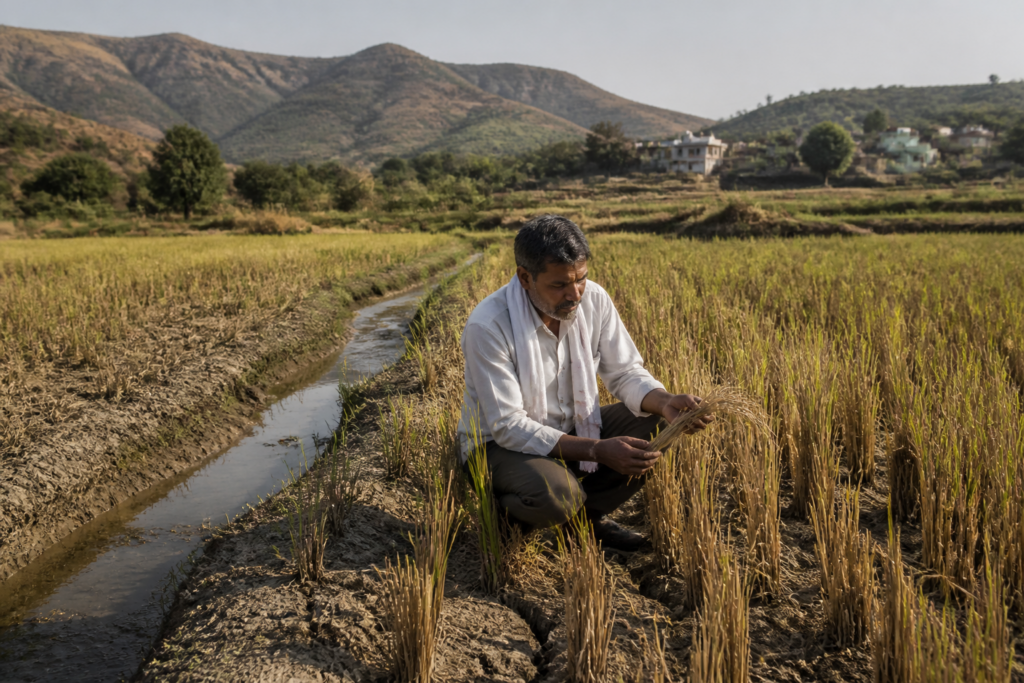
Mulshi taluka in Pune district has been left out of Maharashtra’s newly expanded list of 40 drought-affected talukas, triggering protests from farmers and renewed demands for crop damage assessments and inclusion in the relief framework. The state government has included Ambegaon and Junnar talukas from Pune district in the new list, but not Mulshi, where farmers say rain shortages have damaged paddy and other crops.
The exclusion has raised questions over how drought criteria are being applied across a geographically diverse taluka. Local representatives said Mulshi’s hilly areas have experienced crop losses even though the taluka did not meet the government’s specified “Trigger One” and “Trigger Two” criteria for drought classification.
Vijaykumar Chobe, Mulshi’s tehsildar, said orders to conduct crop damage assessments had not yet been received. “Once orders come from the senior level, crop assessments will be carried out,” he said, according to Sakal. The absence of a formal panchnama process means the extent of eligible crop damage has not yet been officially recorded in the material available.
MLA Shankar Mandekar said he met the district collector on Wednesday, October 14, to renew the demand for Mulshi’s inclusion in the drought-affected list. He said the collector would send a proposal to the state government and had instructed the sub-divisional officer for Maval-Mulshi to conduct crop damage assessments. Mandekar also said a water rotation had been released for crops in the taluka.
Farmers and local political representatives have argued that applying uniform drought indicators to Mulshi overlooks differences within the taluka, particularly in its hilly agricultural areas. Mahadev Kondhare, taluka chief of the Nationalist Congress Party (Sharadchandra Pawar), and representatives of the Shiv Sena (Uddhav Balasaheb Thackeray) said they had previously written to the district collector seeking inclusion, but claimed their requests had not received adequate attention.
Local farmer representative Tukaram Temghare claimed that paddy and other crops across about 70 per cent of Mulshi had dried up because of inadequate rain. That figure remains a local claim and has not been independently established in the supplied report. The report also does not specify the total number of affected farmers, the relief benefits linked to the drought list or the state government’s reasons for excluding Mulshi beyond the stated criteria.
The immediate administrative issue is whether the crop assessments ordered at the district level will provide the evidence needed for a fresh proposal. Until those assessments are completed and the state government takes a decision on the proposal, Mulshi farmers remain outside the newly announced drought-affected taluka list.


