

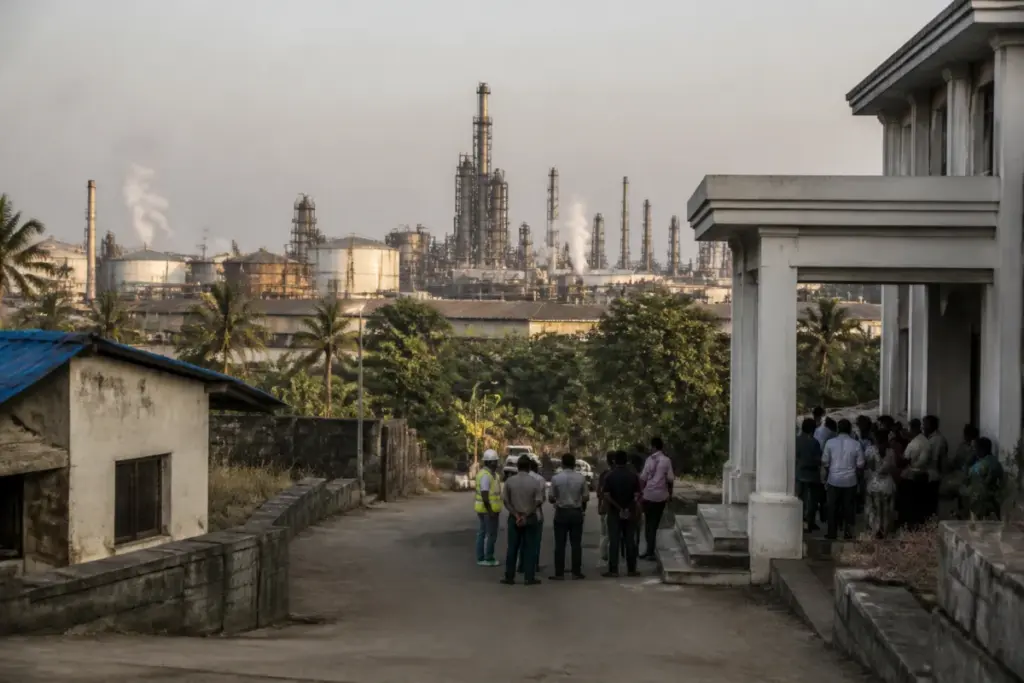
A memorandum submitted by the MRPL-MSEZ Contract Workers and Affected Persons Struggle Committee to the Dakshina Kannada district administration has brought a wide set of industrial-area grievances into one public demand: workers’ rights, rehabilitation after land acquisition, local employment, environmental conditions, basic infrastructure and the use of corporate social responsibility funds. The episode shows how the impact of a major industrial project is measured not only inside its boundary wall, but also in the settlements and households that support, surround and give up land for it.
The committee, led by its president Satyajit Surathkal, submitted the representation to Additional Deputy Commissioner K. Raju. According to the report by Prajavani – Dakshina Kannada, the committee asked the district administration to address problems it attributes to Mangalore Refinery and Petrochemicals Ltd (MRPL) and the Mangalore Special Economic Zone (MSEZ). The demands were presented by contract workers and people affected by the industrial development.
The immediate trigger was anxiety following what the report describes as a recent explosion at MRPL. The supplied report does not provide details about the incident, including its date, cause, injuries, damage or the findings of any official inquiry. That limitation matters. The committee’s reference to the explosion establishes that safety concerns have become part of the current representation, but it does not by itself establish the circumstances or accountability for the incident.
The protest therefore has two layers. One concerns an immediate sense of insecurity among people working in or living near an industrial facility. The other concerns obligations that affected residents and workers say arose from the longer process of industrial expansion. The committee has linked the two by asking for action on contract labour conditions, land displacement and local environmental and infrastructure problems at the same time.
That combination is significant because industrial projects produce several administrative relationships rather than one. Workers’ conditions may involve the principal company, contractors and labour authorities. Land acquisition and rehabilitation involve public agencies and the commitments made during the acquisition process. Wastewater, odour and local infrastructure involve environmental regulators, local administration and civic agencies. CSR spending involves the company’s stated social investment priorities and the needs identified by the surrounding district. A grievance that crosses all these areas can easily become fragmented between institutions.
The committee has specifically asked that the problems of contract workers be resolved. The report does not specify the number of workers, their employers, the nature of their contracts, wages, safety arrangements or the particular remedies sought. Even so, the demand identifies an important feature of industrial employment: the people performing work at a large facility may not all have the same formal relationship with the operating company. This can make responsibility less visible to the public, especially when workers seek recognition of common workplace concerns through a collective platform.
The committee has also demanded that people displaced for the fourth-phase expansion of MRPL receive jobs and other facilities promised at the time their land was acquired. The report does not reproduce the acquisition agreements, rehabilitation package or the exact promises made. It therefore cannot establish whether the commitments were contractual, administrative or informal, or how implementation has been assessed. But the demand puts the credibility of land acquisition under scrutiny. For affected households, compensation at the time of acquisition may not settle the question of long-term livelihood if land is the basis of employment, housing or community security.
The call for direct employment opportunities for local residents extends that question from displaced families to the wider region. The report does not state how MRPL or MSEZ currently recruit, what proportion of employees are local, or whether a local hiring policy exists. The demand nevertheless reflects a recurring expectation around industrial development: communities that host infrastructure and surrender land expect visible economic participation, not only a one-time transaction or indirect activity.
Environmental complaints form another part of the memorandum. The committee has asked for the wastewater problem and foul odour to be resolved, along with greater attention to basic infrastructure. The report does not identify the source of the wastewater, the affected locations, the duration of the odour problem, the relevant pollution measurements or the agency responsible for inspection. These details remain necessary before the environmental claims can be independently assessed. Their inclusion in the memorandum shows, however, that the industrial area’s relationship with nearby settlements is being judged through everyday conditions such as smell, drainage and public amenities.
This is where an industrial dispute becomes an urban governance issue. Wastewater and odour are not confined to production processes. They influence how communities experience roads, drains, water bodies, homes and public spaces around an industrial zone. If responsibility is divided among a company, an industrial development authority, a local body and environmental agencies, residents may have difficulty knowing where to complain and how a complaint moves from acknowledgement to measurable correction.
The CSR demand is similarly institutional. The committee has requested that 75 per cent of CSR funds be reserved for the development of Dakshina Kannada district. The report does not state the total CSR allocation, the present spending pattern, the legal basis for the 75 per cent demand or whether the company has responded. The figure should therefore be treated as the committee’s request, not as an established funding formula or an agreed commitment.
Still, the demand raises a larger question about how corporate social spending is connected to industrial geography. Projects may affect a small number of directly acquired villages while drawing workers, transport and services from a wider district. A CSR programme designed without public disclosure of locations, beneficiaries, project status and outcomes can leave residents uncertain about whether spending addresses their most immediate needs. The committee’s demand for a district-level share indicates that the dispute is not only about the amount of money available, but also about who gets to define development priorities.
The district administration’s role is important because the memorandum has brought together issues that do not sit entirely within the company’s control. The Additional Deputy Commissioner has received the representation, but the supplied report does not record a decision, a formal response, a review committee or a meeting schedule. It also does not state whether MRPL, MSEZ, contractors or environmental authorities were asked to respond. The next administrative step will determine whether the memorandum remains a political and civic appeal or becomes a coordinated grievance-resolution process.
The deadline announced by the committee is October 31. It has said that the agitation will be intensified if there is no response by then. The report does not define what form that escalation would take. The deadline nevertheless creates a clear test for the administration: whether it can acknowledge each demand, identify the competent authority, publish a time-bound response and distinguish between issues requiring immediate action and those requiring documentary or technical examination.
The evidence currently available confirms the existence of a collective representation, its principal demands, the officials and representatives involved, and the committee’s stated deadline. It does not establish the details of the recent explosion, the scale of contract employment, the number of displaced families, the status of rehabilitation promises, the extent of wastewater or odour impacts, or the CSR budget. Those gaps are not minor if the administration is expected to resolve the dispute credibly.
The MRPL-MSEZ episode therefore points to a governance problem that is broader than a single protest. Industrial expansion creates obligations across time: safety during operations, livelihood support after land acquisition, access to employment, environmental protection and investment in surrounding communities. When these obligations are addressed separately, residents may experience them as one unresolved burden. A credible response will depend on whether the district administration and the concerned institutions can connect the claims to records, inspections, responsible authorities and publicly stated timelines. The immediate milestone is the committee’s October 31 deadline and any formal response issued before it.


