

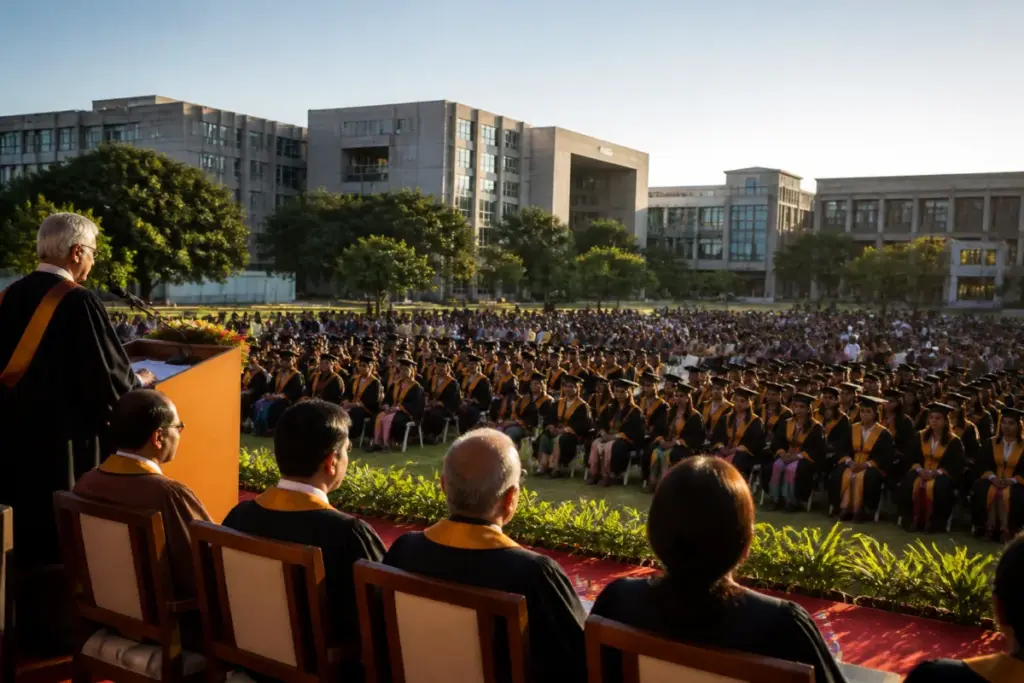
India must expand its medical seats without compromising the quality of education, National Medical Commission chairperson Dr Abhijat Sheth said at a convocation in Wardha, linking the country’s growing training capacity to the need for stronger research, clinical infrastructure and equitable healthcare delivery.
Sheth was speaking at the 17th ceremonial convocation of the Adani Institute of Higher Education and Research, a deemed-to-be university. Degrees were awarded to 2,320 graduates, including 123 PhD scholars, while 83 students received medals.
India now has more than 1.4 lakh undergraduate medical seats and 86,000 postgraduate seats, Sheth said. Further expansion is expected in the coming years, but he cautioned that increasing capacity must not be treated as a dilution of prescribed standards.
“We have done the capacity building, but we must not shy away from focusing on quality of education,” Sheth said. He described capacity building as the first step towards excellence and equity, while stressing that medical education must produce professionals who can adapt to emerging technologies, make sound clinical decisions and communicate effectively with patients.
Sheth said the NMC was pursuing closer integration between medical education and research. From next year, the commission will collaborate with the Indian Council of Medical Research to start postdoctoral PhD programmes, he said. The NMC is also working to strengthen clinical research requirements at undergraduate and postgraduate levels by improving access to logistical resources and funding.
The commission has introduced reforms including competency-based medical education, digitalisation and digital literacy, changes to faculty qualification requirements and rationalisation of minimum standards for medical colleges. According to Sheth, the reforms are intended to remove unnecessary barriers to expansion while retaining educational requirements.
The quality question is significant for a system that is expanding both the number of training places and the institutional infrastructure needed to support them. Medical seats cannot be assessed only by their number: the availability of qualified faculty, clinical exposure, research support, technology and hospital capacity also shapes the education received by students.
Sheth also highlighted the role of technology in addressing inequities in healthcare delivery. He said specialist expertise must reach remote rural communities and that medical graduates should be clinically competent, ethically grounded and socially responsible. “Medical competence and compassion must go hand in hand,” he said.
At the event, AIHER chancellor Priti Adani announced plans to strengthen hospital infrastructure, clinical research and super-speciality services at the organisation’s Wardha and Nagpur campuses over the next two years. She said the institution would prepare a roadmap for applied research and centres of excellence, with focus areas including prevention, early diagnosis, affordable treatment, and maternal and child care.
Adani said each proposed campus would respond to local healthcare needs while following common standards. The organisation’s Wardha and Nagpur campuses would remain central to that expansion, she said. The next steps will involve developing the institutional roadmap and implementing the planned hospital, research and super-speciality infrastructure over the stated two-year period.


