

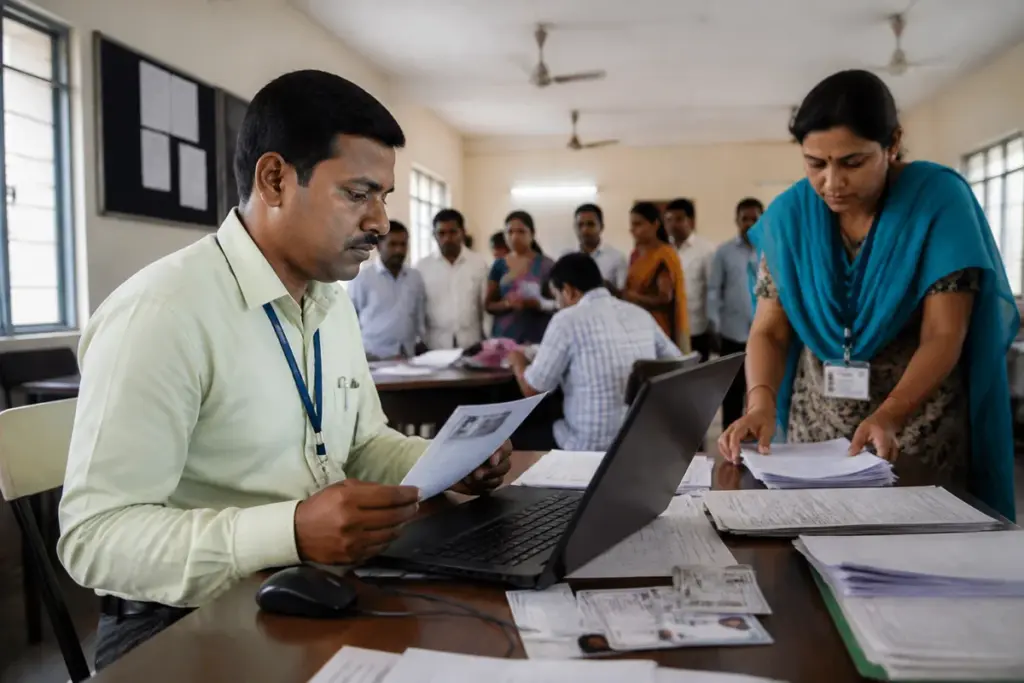
Maharashtra voter roll changes have eased four procedural and software restrictions in the Election Commission of India’s Special Intensive Revision of electoral rolls, shifting more responsibility back to Electoral Registration Officers while reducing the risk that software-generated discrepancies become barriers for citizens. The changes affect how voters respond to notices, what documents they can submit, whether they must attend hearings and who has the authority to decide disputed cases.
The changes were sought by Maharashtra Chief Electoral Officer S Chockalingam in a September 24 letter to senior Election Commission officials. According to the reported details, Chockalingam argued that restrictions built into the ECINet software were limiting the powers of officers who are legally responsible for preparing and revising electoral rolls. The Election Commission subsequently altered the relevant procedures and software functions.
The immediate issue is not the creation of a new category of voter or a change in eligibility rules. It is the administrative process used when an existing voter’s record cannot be linked to the previous Special Intensive Revision roll, or when the system flags an apparent inconsistency in the information submitted. These flags are described as “logical discrepancies”. Examples include a mismatch in a parent’s name or an implausible age difference between a parent and child.
Such a flag does not, by itself, establish that a voter is ineligible. It initiates a process of field verification, document collection and officer review. The changes matter because each stage of that process can either help a voter correct or explain a record, or create another procedural hurdle between the voter and continued inclusion on the roll.
The first change concerns personal hearings. Under the procedure announced by the Election Commission on September 26, Booth Level Officers visit voters’ homes, collect supporting documents and upload them on ECINet for consideration by the Electoral Registration Officer or Assistant Electoral Registration Officer. A voter who receives a notice because of a discrepancy will no longer be required to routinely attend a personal hearing at the office of the ERO or AERO.
Hearings may still be held in exceptional cases, preferably online. This is a significant administrative shift because it makes a home visit and document submission the normal channel, rather than treating an office hearing as the default response to a software-generated problem. The change also recognises that the practical burden of appearing before an officer can be substantial, particularly for voters who are elderly, disabled, working during office hours or unable to travel easily.
The second change expands the range of documents that voters can submit. Earlier notices listed 13 document categories. The Maharashtra Chief Electoral Officer’s office said in an October 1 press note that the BLO App had been updated with an “Any other Documents” option.
The change followed an argument that the 13 categories should be treated as indicative rather than exhaustive. Chockalingam specifically referred to voters from tribal, homeless and other vulnerable communities who may not possess any of the specified documents. A fixed list can appear administratively neat, but it can also produce an exclusionary outcome when the population being verified does not hold documents in the forms assumed by the system.
The new option does not remove the need for supporting evidence or officer assessment. It changes the starting point for that assessment. Instead of requiring a voter to fit their proof into one of 13 predefined categories, the process allows the material collected by the BLO to be submitted for review by the ERO or AERO.
The third change gives EROs greater discretion in dealing with logical discrepancies. Previously, when an ERO could not resolve a discrepancy using a BLO’s report alone, supporting documents had to be sent to the District Election Officer for verification. Under the revised procedure, the ERO or AERO can assess the documents and field-level verification material and decide the case.
The Maharashtra CEO’s September 30 instructions said eligible voters should be given an opportunity to submit documents. That instruction is central to the revised process. A discrepancy is not treated as a final finding; it is a reason to seek clarification and evidence. Giving the officer closest to the case greater authority may reduce the number of matters that must move up the administrative chain, while also placing greater responsibility on the quality and consistency of decisions made at the local level.
The fourth change removes the mandatory upload of an “Extract of Last SIR” in every logical discrepancy case. The software identified discrepancies by comparing voter records with the previous Special Intensive Revision roll. Chockalingam argued that requiring officers to upload an extract of the earlier roll in every such case was unnecessary because the comparison had already generated the discrepancy.
He confirmed to The Indian Express on October 15 that the upload was no longer compulsory and said the change would reduce the workload of Booth Level Officers. This adjustment addresses a different part of the process from the expanded document option. It does not broaden the evidence available to voters; it removes a repetitive administrative task from field-level verification.
Taken together, the four changes expose a tension that is increasingly important in public administration: the relationship between standardised digital systems and legally assigned human authority. ECINet is being used to organise notices, records, document uploads and discrepancy handling. But the legal and administrative responsibility for preparing and revising electoral rolls remains with designated election officers.
The Maharashtra episode shows what happens when the logic of the software becomes narrower than the responsibility of the officer. A software workflow can define mandatory fields, document categories and escalation routes. It can make a process uniform and create a record of each action. However, a system designed around predetermined categories may struggle with residents whose documents, family records or living arrangements do not match those categories.
That problem is especially relevant in a state with varied settlement patterns and populations. The source material identifies tribal and homeless voters among those who may not possess documents from the specified list. It also refers to discrepancies involving family relationships and age gaps. These are not simply technical errors. They require a decision about whether the available evidence is sufficient to establish that the voter’s record should remain on the roll.
The revised procedure therefore creates a division of labour between field staff, software and registration officers. BLOs visit homes, collect information and upload documents. The ECINet system records and organises the material. EROs and AEROs assess the evidence and decide cases, including cases previously requiring referral to a District Election Officer. Each layer has a different function, but the process depends on the handoff between them working correctly.
This also means that reducing software restrictions does not automatically eliminate administrative risk. Greater discretion can make the process more responsive, but it can also make the quality of outcomes depend more heavily on training, documentation and consistent application of instructions. The material supplied does not establish how many voters received notices, how many cases involved logical discrepancies or how many decisions were affected by the four changes. Those figures would be necessary to measure the scale of the problem and the effect of the revised process.
The changes followed an Indian Express investigation published on September 23, which reported concerns raised by Election Commissioners Sukhbir Singh Sandhu and Vivek Joshi that software controls were restricting the powers of officers concerned. The sequence is important. The issue was not presented only as a complaint from voters about paperwork; it was also identified as an institutional problem involving the relationship between the Election Commission’s digital platform and its field officers.
For urban governance, the broader lesson lies in how digital administration reaches residents at the last mile. A voter may experience the process not as a national software architecture but as a notice, a visit from a BLO, a request for documents and a decision about whether their explanation is accepted. The formal system is national, but the interaction is local and personal.
That local interaction becomes particularly important when the digital system marks a record as inconsistent without establishing ineligibility. The distinction between a flag and a finding must remain clear throughout the process. The revised rules, as reported, move in that direction by allowing broader documentation, making hearings exceptional and giving EROs authority to examine the complete material rather than treating the software pathway as determinative.
The changes also raise a question about accountability. If an ERO is given greater discretion, the administrative record must show how the decision was reached and what documents or field findings were considered. The source material does not provide details of any new audit mechanism, appeal process or public reporting system connected to the revised procedure. Those elements will determine how the expanded discretion operates in practice.
What is established is that Maharashtra’s request produced four changes: routine personal hearings were replaced by home-based document collection except in exceptional cases; voters can submit documents beyond the listed 13 categories; EROs and AEROs have greater authority to decide logical discrepancies; and the mandatory upload of an extract from the previous Special Intensive Revision roll has been removed.
What remains unclear from the available material is the number of affected voters, the distribution of notices across different communities and the eventual impact on additions, corrections or deletions from the electoral rolls. Those details will be necessary to assess whether the revised software and procedures merely reduce workload or also improve the substantive ability of eligible voters to remain represented in the roll. For now, the central administrative change is clear: software continues to structure the process, but local election officers have been given more room to exercise the responsibility assigned to them.


