

The Election Commission of India’s changes to the Special Intensive Revision (SIR) process in Maharashtra do more than simplify a software workflow. They alter how voters respond to notices, how field officials collect evidence and how much decision-making authority remains with Electoral Registration Officers (EROs), the officials legally responsible for preparing and revising electoral rolls.
The changes followed a September 24 request from Maharashtra Chief Electoral Officer S Chockalingam to senior ECI officials. They address four restrictions in the ECINet software and related procedures: the limited list of documents that voters could submit, the routine use of personal hearings, the escalation of discrepancy cases to District Election Officers and the mandatory upload of an extract from the previous SIR roll.
Together, the revisions reveal a central administrative problem in technology-led governance. A digital system can standardise procedures and help officials process large volumes of records, but its categories and mandatory fields can also narrow the choices available to both officials and citizens. In this case, Maharashtra’s election authorities argued that software controls were constraining powers assigned to EROs under the electoral-roll process.
The first change concerns voters whose records could not be linked to the previous SIR roll or whose details were flagged for what the system calls “logical discrepancies”. These discrepancies may include a mismatch in a parent’s name or an implausible age gap between a parent and child. The material supplied by the Election Commission process makes clear that such flags do not, by themselves, establish that a voter is ineligible.
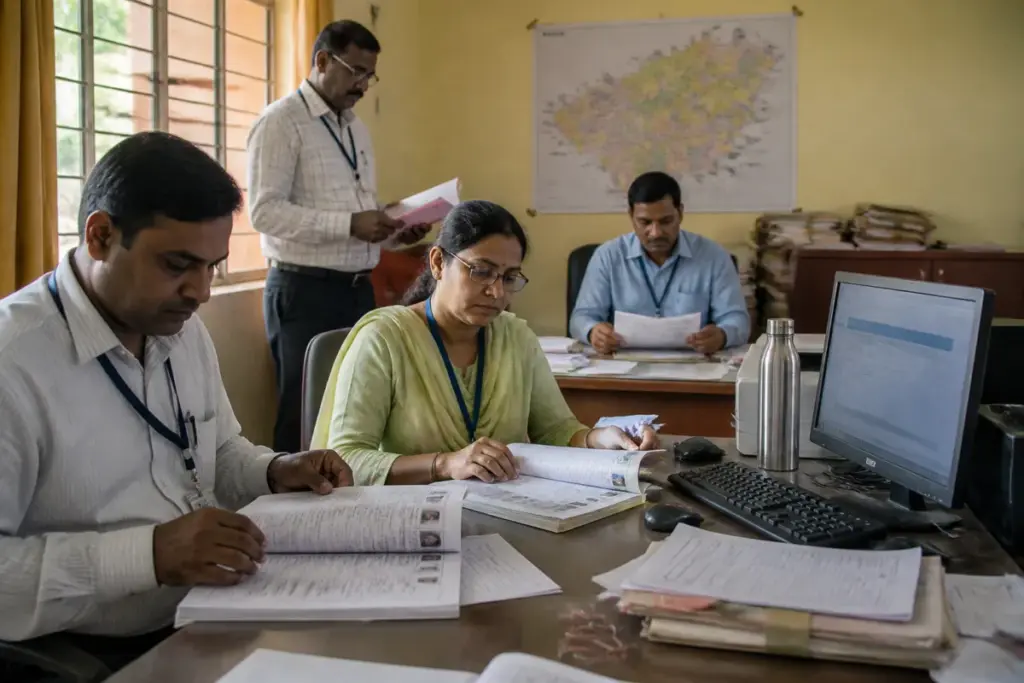
Under the procedure announced by the ECI on September 26, Booth Level Officers (BLOs) visit voters at home, collect supporting documents and upload them on ECINet for the ERO or Assistant Electoral Registration Officer to assess. Personal hearings are now to be held only in exceptional cases and, preferably, online. This shifts the default from requiring voters to appear at an office to allowing field verification and document review to carry more weight.
That distinction matters for people who may find it difficult to attend an official hearing. Chockalingam’s office specifically referred to tribal, homeless and other vulnerable communities when arguing that the document list should be treated as indicative rather than exhaustive. The revised BLO App consequently includes an “Any other Documents” option, allowing voters to submit material beyond the 13 categories listed in notices.
The change does not remove the requirement for evidence. It changes who can determine whether the evidence is relevant and sufficient, and recognises that a fixed document menu may not reflect the varied ways in which people establish identity, residence or family links. The supplied material does not specify which additional documents will be accepted in individual cases, leaving that assessment to the relevant election officials.
The third revision concerns the distribution of authority. Previously, when an ERO could not resolve a logical discrepancy using a BLO’s report, supporting documents had to be sent to the District Election Officer for verification. Under the revised procedure, the ERO or AERO can assess the documents and field-level verification material and decide the case. Maharashtra’s September 30 instructions also said that eligible voters should be given an opportunity to submit documents.
This is an administrative adjustment with direct consequences for the voter. A case that might earlier have moved upward through the hierarchy can now be decided closer to the point at which the notice was issued and the field verification was conducted. It may reduce procedural movement, but it also places greater responsibility on EROs and AEROs to apply the rules consistently and document their decisions.
The fourth change removes the mandatory upload of an “Extract of Last SIR” in every logical-discrepancy case. Chockalingam argued that the software had already identified the discrepancy by comparing current voter records with the previous SIR roll, making a separate upload unnecessary. He later confirmed that the upload was no longer compulsory and said the change would reduce the workload of BLOs.
This detail illustrates how a seemingly minor digital requirement can affect the capacity of an entire verification exercise. BLOs are responsible for household-level visits and data collection. Removing a duplicate or unnecessary upload may free time for fieldwork, although the supplied material does not establish the scale of the saving or how it will affect processing timelines.
The revisions followed an Indian Express investigation published on September 23, which reported concerns raised by Election Commissioners Sukhbir Singh Sandhu and Vivek Joshi that software controls were restricting the powers of officials concerned. The sequence is significant: concerns about the relationship between statutory authority and software design were followed by a state-level request and then by changes to the operating procedure.
The episode places ECINet within a broader institutional question: when public administration is mediated through software, where does discretion reside? A mandatory field, a restricted document menu or an automated discrepancy flag can influence outcomes even when the underlying law gives an officer room to assess the facts. Conversely, greater discretion can make decisions more responsive to individual circumstances while increasing the importance of training, records and review mechanisms.
For voters, the revised process appears to provide four practical changes: they may submit documents outside the listed categories, they need not routinely attend personal hearings, EROs have greater authority to decide logical discrepancies and BLOs no longer need to upload the previous SIR extract in every such case. These changes do not mean that every flagged record will be accepted, nor do they establish that a discrepancy is harmless in every case. They change the route through which the case is examined.
The most important unresolved issue is how these provisions will work in practice across different electoral areas. The supplied material records the revised procedures and the authorities’ stated reasons, but it does not provide data on the number of notices issued, cases resolved, documents accepted or decisions challenged. Those figures would be necessary to assess whether the changes improve access, reduce administrative workload and produce more consistent outcomes.
What is established is that Maharashtra’s SIR process has moved away from a strictly prescribed software pathway. The ECI’s revisions give voters a wider documentary window, make hearings exceptional, return more decision-making power to EROs and remove one mandatory upload. The next measure of the system will be whether this added flexibility is matched by clear decisions and a process that voters can navigate without losing their opportunity to remain on the electoral roll.


