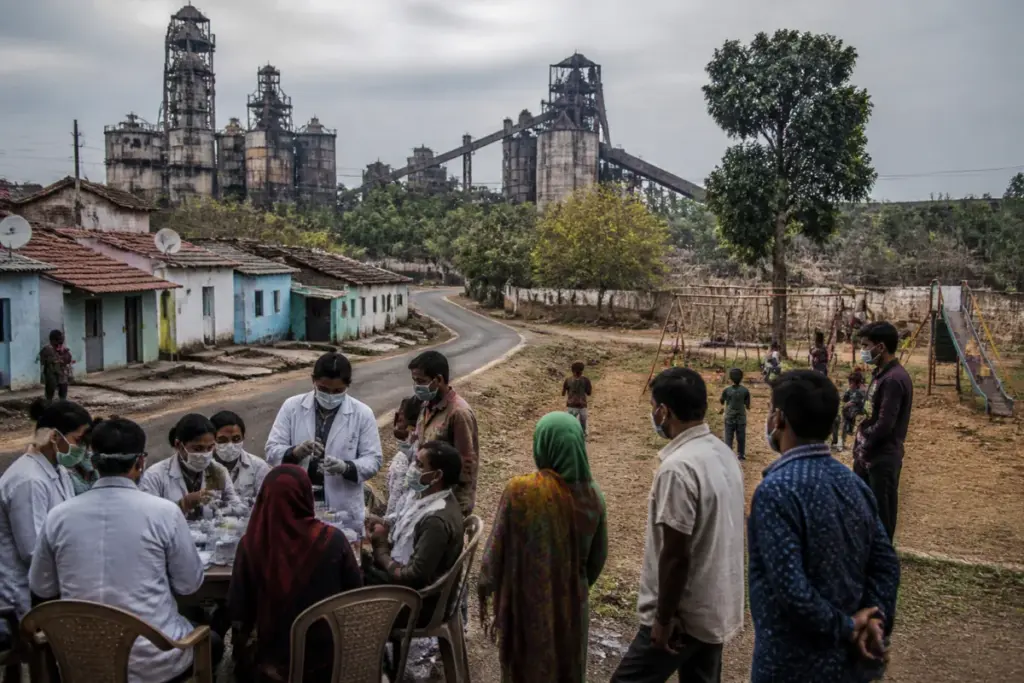
Kymore asbestos exposure has produced a public-health question that a two-day screening camp cannot answer: how many residents have been exposed, diagnosed, treated or lost to disease over decades? The camp in Katni district screened 274 people on October 9 and 10, while 100 sputum samples are being tested for tuberculosis through CBNAAT. One person showed suspected symptoms, but the case has not been confirmed.
The immediate event is therefore less a measure of Kymore’s disease burden than a measure of how little is known about it. Health department officials recorded 112 attendees on the first day and 162 on the second. The samples are being tested using Cartridge-Based Nucleic Acid Amplification Test, a molecular diagnostic method that can detect TB bacteria and identify resistance to rifampicin, a key anti-TB drug. Those results may clarify the status of the samples collected. They cannot, by themselves, establish the prevalence of TB across the town or determine the extent of asbestos-related illness.
That distinction matters because Kymore is not an ordinary screening location. The town was home to India’s first asbestos factory, established in 1933. The plant has been defunct for decades, but concerns about exposure extend beyond former factory workers. A 2016 assessment by Canadian environmental consultancy ECOH Management documented asbestos contamination in Kymore and neighbouring Kalhara, including material found in residential yards, agricultural fields and playing areas. The reported findings indicate that the potential exposure environment included places where people lived, worked and spent time, rather than only the factory premises.
The camp’s limited reach highlights the difficulty of investigating a legacy industrial hazard. A health survey can count those who attend. It cannot automatically account for people who are elderly, too unwell to travel, unaware of the camp, living outside the immediate area or no longer present in the town. It also cannot reconstruct exposure histories without records linking residents to workplaces, neighbourhoods, housing conditions, family histories and earlier diagnoses.
The report says experts considered the exercise insufficient to establish the extent of infection and called for a wider, systematic survey. That conclusion is important because the screening exercise appears to have been organised around an immediate health concern, while the underlying problem is cumulative. Asbestos-related diseases can raise questions that differ from those addressed by a short TB camp: who was exposed, for how long, through which pathways, whether symptoms were diagnosed correctly and whether affected people received continuing medical surveillance.
The absence of a consolidated government database is consequently not a minor administrative inconvenience. It prevents the health system from seeing the population as a connected group with a shared exposure history. The Times of India’s earlier investigation, published on September 25, highlighted the lack of a government record documenting how many residents were exposed to asbestos, diagnosed with related diseases or may have died from their effects. Without such a record, individual cases remain isolated, compensation claims are difficult to connect to present medical needs and public authorities cannot readily assess whether health risks are concentrated in particular settlements or age groups.
The question of compensation adds another institutional layer. The T&N Trust, established in the United Kingdom to handle asbestos-related claims linked to Turner & Newall, has settled claims by Indian citizens, including more than 1,000 people from Kymore. But the available attendance records do not establish whether beneficiaries who received compensation attended the recent camps. Nor is it clear whether those claimants are receiving continued medical surveillance.
This is where compensation and public health can become disconnected. A settlement may recognise an injury or exposure, but it does not automatically create a durable public-health monitoring system. If the names and medical histories of claimants are not connected to local health records, doctors conducting later screenings may not know who requires follow-up. Conversely, a person who was never part of a compensation process may still face exposure-related risks and remain absent from any formal register.
The available evidence does not establish that the suspected TB case is linked to asbestos exposure. It also does not establish the prevalence of asbestos-related disease in Kymore. These limits should be maintained clearly. CBNAAT testing is relevant to identifying TB infection and drug resistance; it is not a comprehensive test for the full range of diseases associated with asbestos exposure. The camp’s results, once available, may answer questions about the samples collected, but they cannot substitute for a broader epidemiological and exposure assessment.
The numbers already reveal the gap between activity and coverage. Two hundred and seventy-four people were screened over two days, and 100 samples were selected for molecular testing. That means the camp generated a defined set of clinical observations, but not a population-wide denominator for Kymore. Without a verified estimate of the exposed population, the total number of residents at risk, the number of former workers and the number of people living in affected areas, even a positive or negative result from the camp would be difficult to interpret at town level.
The same problem affects historical comparison. The town’s industrial history dates back to 1933, while the contamination assessment cited in the report was conducted in 2016. The recent camp took place in 2026. These dates span several generations, but the available information does not connect them through a continuous health record. The absence of that continuity makes it difficult to determine how exposure patterns changed after the factory became defunct, whether contaminated material remains in places used by residents and whether people who moved into or out of Kymore are being tracked.
For municipal and health authorities, Kymore illustrates the administrative challenge of legacy industrial sites. Responsibility may be divided among district health officials, environmental agencies, local government, former employers, compensation bodies and institutions responsible for land and public spaces. Each may hold part of the evidence. Unless those records are consolidated, no single authority can reliably answer basic questions about the affected population.
This fragmentation also changes the meaning of a health camp. A camp is visible and immediate: residents arrive, clinicians examine them and samples are collected. A surveillance system is less visible but more consequential. It requires a defined population, repeat examinations, accessible medical records, referral pathways and a method for identifying people who do not attend. The supplied report does not establish that such a system exists in Kymore. It instead shows that the current exercise has exposed the need for one.
The question is not limited to TB. The report links the camp to fears of suspected asbestos poisoning, but the screening information available so far concerns TB symptoms and sputum testing. That distinction prevents the health response from being reduced to a single disease category. If asbestos contamination has affected residential yards, fields and playing areas, the relevant public-health record would need to account for exposure locations and histories alongside clinical diagnoses. The present material does not provide those records or quantify the resulting disease burden.
Kymore’s case also raises a broader urban question: what happens to communities after an industrial facility closes but its environmental and health legacy remains? Urban governance often responds more easily to operating infrastructure than to abandoned or defunct sites. A factory can disappear from the active economy while contaminated materials, affected workers, families and neighbourhood exposures remain part of the city’s social geography. In such settings, the boundary between industrial regulation, environmental remediation and public health becomes difficult to manage through short-term programmes.
The evidence currently confirms three things. First, a two-day camp screened 274 residents and sent 100 sputum samples for CBNAAT testing. Second, one person was suspected of having TB, but that case remains unconfirmed. Third, Kymore has a documented history of asbestos-related concern, including a 2016 contamination assessment and more than 1,000 compensation settlements involving Indian citizens from the town. What remains unresolved is the size of the exposed population, the prevalence of asbestos-related disease, the status of people who received compensation and the extent to which local records capture them.
The next meaningful development will be the test results from the samples collected. But the larger issue will remain whether authorities create a systematic, consolidated health and exposure record rather than treating the camp as a complete assessment. Until that gap is addressed, Kymore will continue to have fragments of evidence about a decades-old industrial risk without a reliable account of its human cost.