

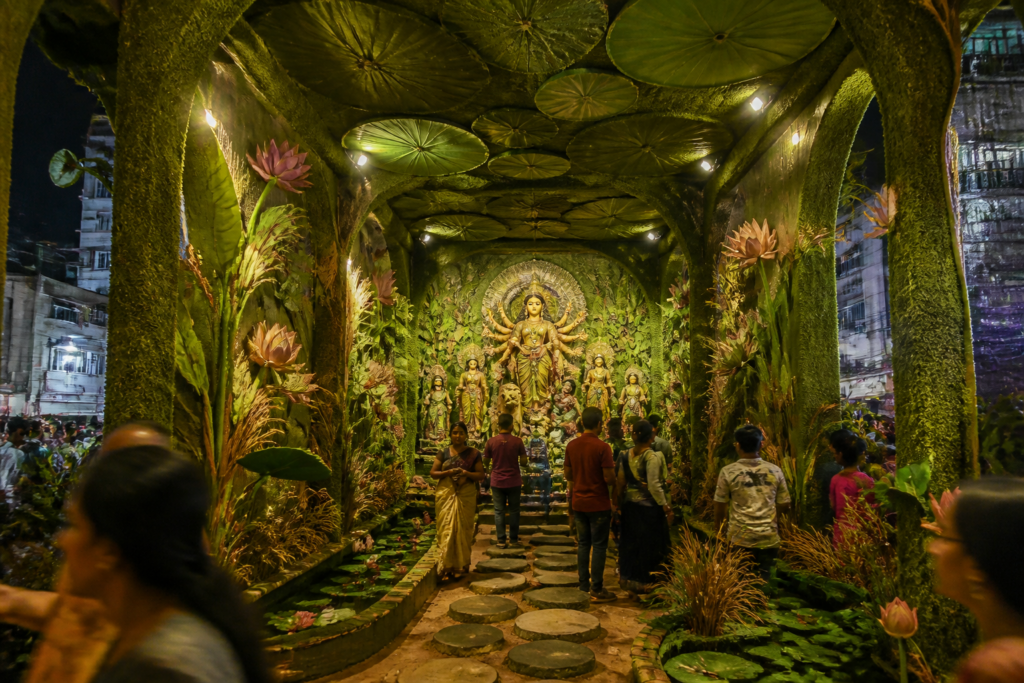
Kolkata’s 2026 Durga Puja pandals are doing more than competing for visual attention. Across neighbourhoods, organisers are using temporary architecture to place the city’s disappearing ponds, fading folk traditions, maritime history, social apathy and political memory before large public audiences. The result is a festival map that also works as a map of Kolkata’s urban anxieties.
Six installations highlighted this year show how the city’s community pujas continue to function as public cultural spaces. Their themes range from an immersive pond conservation project in Nagerbazar and live puppet performances in Dumdum Park to a historical account of Bengal’s trading links, a Mahabharat-inspired installation in Salt Lake, a biographical display in New Alipore and a critique of society’s response to crimes against women in North Kolkata.
The most direct environmental intervention is at Telipukur Nagerbazar Yubak Sangha, which is presenting “Ek Pukur Bhalobasha”, or “a pond full of love”. Conceptualised by artist Bhabatosh Sutar, the installation is built around the ecological and emotional role of an urban pond. It depicts the water body as part of everyday life, including weddings, rituals and leisure, while also showing how pollution affects aquatic habitats.
A video shot from inside the pond simulates the perspective of aquatic life encountering garbage, bottles and ritual offerings from above. Eighteen microphones placed at the pond floor capture underwater sounds, including fish nibbling, and relay them live inside the pandal. The moss-toned idol is around 20 feet tall, with jewellery and clothing made from aquatic elements such as water lilies and leafy greens.
Sutar said Kolkata had lost around 70 per cent of its ponds in 50 years, with real-estate promoters filling them to construct concrete high-rise buildings. The figure is presented in the source as the artist’s statement, rather than as an independently cited government statistic. Shubham Saha, the club’s assistant secretary, said the theme was based on a pond connected to local family history over several hundred years.
The installation therefore turns a familiar neighbourhood water body into a civic subject. It links ecological loss with the pressures of land conversion and shows how a community festival can communicate environmental concerns through sensory experience rather than through a conventional public campaign. The club, which is celebrating its 68th year, has put the budget at roughly Rs 50 lakh.
History and movement form the basis of another installation at Dum Dum Park Tarun Sangha. Its 41st-year theme, “Biniya Katha”, has been conceptualised by artist Anirban Das and focuses on Bengal’s trading history from the 7th century BC to the 18th century. The 11-to-12-foot-tall pandal is designed as a trading port, with a merchant ship at its centre.
The installation refers to Xuanzang’s voyage, Emperor Ashoka’s dispatch of the Bodhi tree to Sri Lanka, Dwarkanath Tagore’s shipping business and the transport of a giraffe to mainland India. Performers wearing traditional masks and carrying stylised wooden boats represent maritime merchants. The facade includes ship-like structures and painted murals of sailing vessels, while the terracotta-style idol refers to historical exports from the region. The reported budget is around Rs 45 lakh.
The adjoining Dumdum Park Sarbojanin places a fading performance tradition at the centre of its 75th-year celebration. “Panchalatika” focuses on traditional puppet dance, with live string and rod puppet performances scheduled every evening from 6 pm until around 4 am or 4.30 am. Organiser Moloy Dey described puppet dance as a declining folk art from which theatre originally evolved.
The rod-puppet performance includes an artist dancing inside a bamboo frame while the puppet moves in rhythm. The idol, made by artist Sanatan Dinda, is 12 feet tall in accordance with the West Bengal government’s immersion guidelines. That limit has a practical urban consequence: it is intended to make transport to the Ganga ghats easier and avoid obstructions near bridges. The pandal’s design, led by Tapas Dutta, has a budget of around Rs 30 lakh.
Dey also said the puja was not selling tickets, although invited passes had been issued. His clarification points to a recurring tension in Kolkata’s festival spaces: installations may attract large crowds and gain city-wide visibility, but the organisers continue to present the pujas as open community events. In this case, the pandal is a five-minute walk from Dum Dum Park Tarun Sangha, making the two installations part of a concentrated visitor circuit.
In Salt Lake, the EC Block Residents Association is marking its 50th year with “Mahabharat”. The installation uses large figures of Krishna and other characters made from plaster of Paris, clay, plywood and wood carving. Local team members produced the work under the guidance of artist Barun Chand from the Art College. The committee said the design used no artificial intelligence or digital posters, emphasising a hands-on production process.
The reported budget is Rs 50 lakh. One of the central visual devices is the alignment of the Durga idol, which is designed to appear to look directly at visitors from wherever they stand inside the pandal. The location, directly opposite City Centre 1 and accessible from the East-West Metro’s City Centre station, places the installation within a major commercial and transit-oriented part of Salt Lake rather than in an isolated festival zone.
Suruchi Sangha in New Alipore has chosen “Utsa”, meaning source or origin, for its 2026 celebrations. The theme marks the 125th birth anniversary of Dr Syama Prasad Mookerjee, founder of the Bharatiya Jana Sangh. Conceptualised by Anirban Das, the installation moves from broad nationalist themes to a biographical account using archival photographs and rare visual documents relating to Mookerjee’s upbringing, personal milestones and writings.
The source also notes a change in the puja committee’s organisational leadership. The committee has historically been associated with Trinamool Congress figures, including Sports Minister Aroop Biswas and Swaroop Biswas, while BJP Dum Dum MLA Sourav Sikdar now serves as puja secretary. That detail shows how major community pujas can operate simultaneously as cultural institutions, neighbourhood gatherings and spaces where public political identities become visible.
At Sadanga Durgotsav Samity in North Kolkata, the theme is less concerned with spectacle than with social critique. “Hutom Pyanchar Naksha”, or “The owl’s sketchbook”, draws on Kaliprasanna Singha’s literary work. The owl is used as a symbol of silent observation, while the installation addresses social apathy towards crimes against women and passive spectatorship during contemporary tragedies, including the “Tilottama” or RG Kar incident.
The six locations also demonstrate how pandal-hopping depends on the city’s transport network and neighbourhood-level connections. Dum Dum station provides access to Nagerbazar through an auto-rickshaw journey, while Dum Dum Park Tarun Sangha can be reached by auto, toto or cab from Dum Dum or Belgachia. Bus routes through VIP Road and Jessore Road offer another approach. Salt Lake’s EC Block installation is directly accessible from City Centre station, while Sadanga Durgotsav Samity requires a short walk from Shyambazar Metro station.
These routes are not merely logistical details. They reveal how temporary cultural destinations are absorbed into Kolkata’s everyday systems of metro travel, autos, buses, pedestrian movement and bridge crossings. The source reports high crowd turnout at Dum Dum Park Tarun Sangha from as early as Tritiya, suggesting that the timing and distribution of visitors can affect local streets well before the main festival days. It does not, however, provide traffic counts, crowd-management plans or official estimates for visitor volumes.
The budgets, ranging from around Rs 30 lakh to Rs 50 lakh among the installations where figures are provided, also show the scale of resources being directed into temporary public environments. These structures combine artistic labour, local volunteer organisation, materials, performers, transport planning and immersion requirements. Their annual construction cycle makes the puja committee an important neighbourhood institution, although the supplied material does not establish the full funding sources or procurement arrangements behind the budgets.
Taken together, the six themes show Kolkata’s pandals working as informal civic classrooms. The Nagerbazar installation asks what happens when urban water bodies are treated as developable land. The Dumdum Park installations preserve performance traditions and connect the festival to regional trade history. Salt Lake’s installation foregrounds local craftsmanship and the role of mass transit in reaching public cultural events. New Alipore’s display demonstrates how festival platforms can carry political memory, while North Kolkata’s theme uses literature to question public indifference to violence.
What remains clear from the supplied accounts is that the city’s temporary festival architecture is carrying permanent urban questions. What is not established is whether these installations lead to measurable changes in pond protection, folk-art preservation, crowd management or public safety. For now, their significance lies in making those questions visible, at street level, to residents moving through the city’s neighbourhoods during the festival.


