

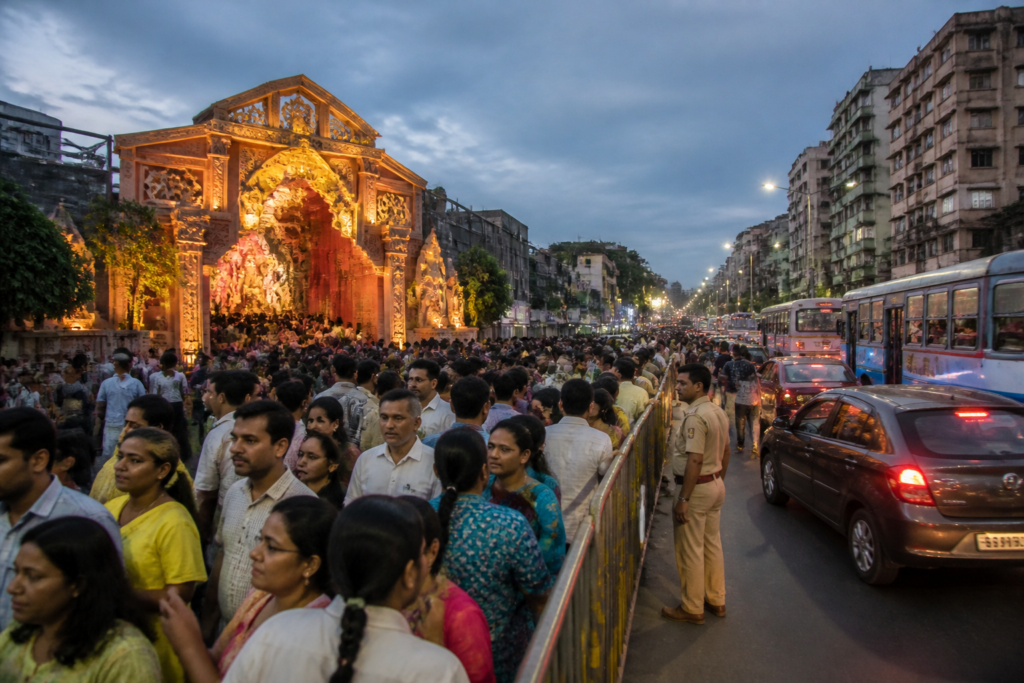
Kolkata’s Durga Puja footfall is no longer concentrated only around the city’s established pandal landmarks. On Sasthi, newly prominent venues in Behala, Nagerbazar, Salt Lake, Patuli and New Town drew large crowds, while several traditional hotspots recorded more manageable conditions. The change points to a festival city whose movement patterns are being reorganised by suburban growth, social media visibility and the growing appeal of themed public spaces.
The shift was visible in the contrast between emerging attractions and legacy crowd-pullers. Thousands of visitors travelled across the city to see new installations, with many using packed Metro trains and paying steep public fares. At the same time, established names such as Sreebhumi, Ekdalia and Suruchi Sangha did not experience the same intensity of crowd concentration reported in previous years. The redistribution did not eliminate congestion, but it altered where police and transport systems had to manage it.
This matters because Durga Puja footfall is also an annual test of Kolkata’s urban capacity. The festival temporarily changes the use of roads, stations, neighbourhood streets and public spaces. A pandal that becomes popular can transform a residential or peripheral area into a high-volume visitor destination within hours. The resulting pressure is not determined only by the size of the installation. It is also shaped by online visibility, word-of-mouth recommendations, access to public transport and the ability of organisers and authorities to manage queues.
## How new pandals gained urban importance
Several first-time or newly prominent contenders benefited from the combination of distinctive themes and rapid public circulation through social media reels. The Netaji Sadak Anchalik Adhibasibrinda puja in Muchipara, East Behala, created a 28,000-square-foot structure for its golden jubilee edition. Its theme compares Indian and Chinese Buddhist architecture and includes a recreation of the Longmen Grottoes in Luoyang, China.
Nearby, Behala Young Men’s Association presented the theme ‘Chhuti’, designed by artist Sanatan Dinda. Its central installation imagines a cloud factory in which children ride elephants and horses through layers of sky. Organiser Sourav Roy said the installation addresses two forms of lost childhood: poverty that pushes some children into work and growing dependence on mobile phones that keeps others away from outdoor play and nature.
The significance of these installations extends beyond their artistic treatment. Their popularity shows how neighbourhood-level cultural infrastructure can become a citywide destination. A puja committee operating outside Kolkata’s most established visitor circuits can now attract attention from across the metropolitan area if its design is distinctive and gains online circulation.
The same pattern appeared in other parts of the city. The CA Block Cultural Association in New Town dedicated its ninth-year pandal to the gramophone, presenting it as a reminder of the role recorded music once played in Bengali homes. In Nagerbazar, Telipukur Yuba Sangha built its theme around an intricate pond installation titled ‘Ek Pukur Bhalobasha’. Theme artist Bhabatosh Sutar described the pond as a storyteller, a witness to generations and a reminder of what modern cities may be losing.
These themes connect festival design with questions about memory, childhood, technology and the changing urban environment. They also help explain why crowd movement is becoming less predictable. Visitors are not simply following a fixed list of famous pujas; they are responding to a changing collection of visual and cultural attractions distributed across a wider geography.
## The transport and policing consequences
The redistribution of visitors offered some relief to the most established hubs. A senior officer of Bidhannagar City Police said that senior officers had previously been concentrated in control rooms near a smaller number of major pujas. This year, the force was distributed more evenly across several locations because crowd conditions were more manageable at some traditional hotspots.
That change reflects a basic administrative challenge: policing plans based on historical crowd patterns can become less effective when visitor behaviour changes quickly. A force deployed heavily at known destinations may be stretched if a new attraction generates an unexpected queue elsewhere. Conversely, a venue that was previously treated as a secondary location may require traffic control, pedestrian management and emergency access once it becomes a social media-driven destination.
The city still recorded substantial queues at legacy venues. By 10.30 am, Dum Dum Park Tarun Dal in the north and Chetla Agrani in the south had each formed queues of roughly 2,000 visitors. The coexistence of large queues at old favourites and rising demand at new venues suggests that the city is not experiencing a simple transfer of popularity. Instead, the total festival circuit is expanding and becoming more dispersed.
That dispersal can reduce pressure on individual hotspots, but it can also spread congestion into more neighbourhoods. The report noted localised traffic bottlenecks, particularly during the transition from early morning to later commuting periods. Law enforcement kept major thoroughfares clear during the afternoon and evening, but the early morning period remained difficult for commuters.
The experience of Bhowanipore resident Soma Ghosh illustrates the citizen-level impact. She said her journey home from Tala took one and a half hours instead of an estimated 45 minutes. The delay shows how festival traffic can affect people who are not visiting pandals. When pedestrian queues, diverted vehicles and visitor traffic intersect with ordinary work and residential trips, the festival becomes a citywide mobility issue rather than a set of isolated events.
## A wider festival geography
Kolkata’s changing Puja map also reflects the growing importance of peripheral and suburban neighbourhoods in the city’s cultural life. Behala, Nagerbazar, Salt Lake, Patuli and New Town are not being treated merely as residential areas outside the traditional circuit. Their pujas are increasingly competing for metropolitan attention and attracting visitors from beyond their immediate catchments.
The available report does not establish whether this shift is permanent or how visitor numbers compare in absolute terms across all locations. It does, however, record a visible change in crowd distribution on Sasthi and links that change to new themes, social media circulation and word-of-mouth recommendations. Those factors make festival popularity more dynamic than a ranking based only on established reputation.
The institutional response is already adapting. Bidhannagar City Police said it was adjusting shift schedules to match changing footfall patterns across traditional hubs and emerging centres. This is an operational response to a city in which demand is moving faster than fixed assumptions about where crowds will gather.
For municipal and police agencies, the challenge is not only to identify the largest pandals. It is to understand how visitors move between destinations, where queues form, which roads carry spillover traffic and how public transport interacts with pedestrian surges. The report records packed Metro trains and high public fares, but it does not provide a systemwide assessment of station-level crowding, service frequency or the cost burden on visitors. Those details would be necessary to measure the full transport impact of the shift.
What the Sasthi experience confirms is that Kolkata’s festival infrastructure is increasingly distributed. Cultural attractions in peripheral neighbourhoods can produce metropolitan-scale movement, while traditional landmarks continue to generate major queues. The result is a more complex crowd map in which authorities must manage several centres at once.
The larger urban question is whether Kolkata’s policing, traffic and public transport systems can keep pace with this decentralised festival economy. The evidence from Sasthi shows both an opportunity and a pressure point: distributing visitors can make some legacy hotspots more manageable, but it also creates new demands in neighbourhoods that may not have been planned for sustained visitor surges. The next stages of the festival will show whether the new pattern remains dispersed or whether established favourites regain their customary dominance.


