

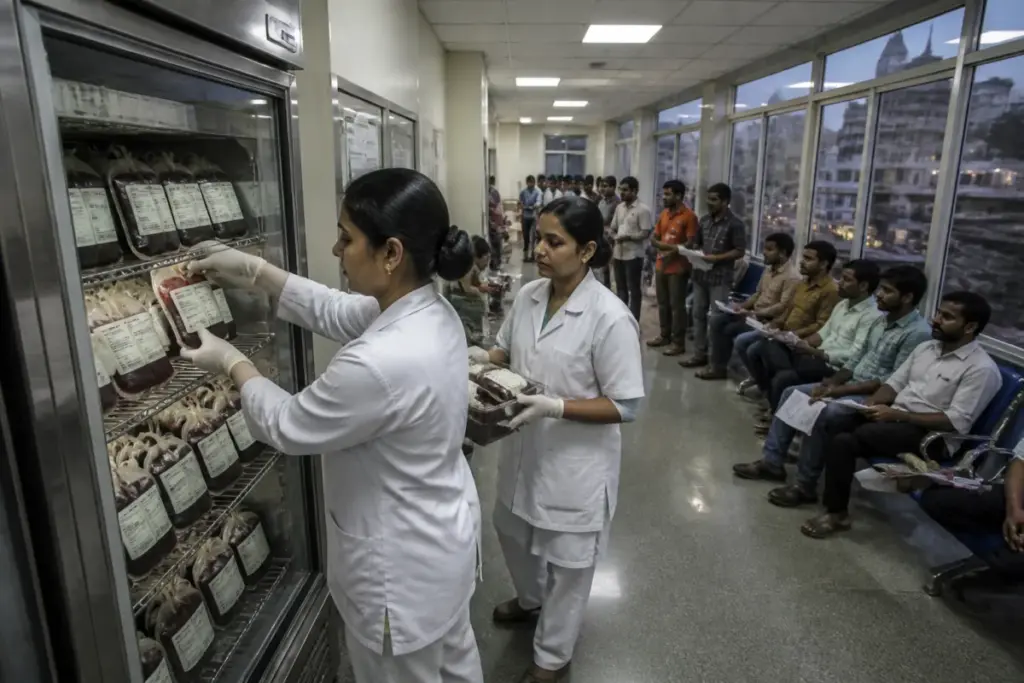
Kolkata’s reported blood shortage is exposing a deeper weakness in the city’s health system: the difference between blood units recorded in a government inventory and blood that patients can actually access when surgery, emergency treatment or regular transfusion is required. A report by Bartaman Patrika – Kolkata says several blood centres are asking patients’ families to bring replacement donors before issuing blood, while the state’s blood safety authorities maintain that overall stocks remain adequate.
The contradiction is not simply about whether the state has blood in storage. It is about how that blood moves through hospitals, blood centres and patients, and who carries the responsibility when the system cannot match a particular demand. The reported cases involve a patient needing B-positive blood after neurosurgery and a thalassaemia major patient requiring transfusions every three weeks. In both situations, families were described as being asked to arrange donors before additional blood could be issued.
The source report says that some blood centres are telling families that they must bring a donor to obtain blood, even when the replacement unit is not necessarily the same blood group. It also reports that replacement donation is being sought for patients with thalassaemia, whose transfusion needs are recurring rather than one-time emergencies. These accounts were presented alongside messages circulating in WhatsApp and Facebook groups seeking urgent donors.
For a city’s health infrastructure, this distinction matters. Blood is not supplied like an ordinary commodity that can be ordered only when a patient arrives. It depends on a continuous chain of voluntary donations, testing, component separation, storage, distribution and timely access. A shortfall at any point can become a crisis for a family, even when a broader inventory shows thousands of units across the state.
The report cites figures from the government’s e-Raktakosh portal, as shared by blood-donation campaigners. At about 8.30pm on a Saturday, the portal showed around 16,500 units in the state’s stock. Kolkata’s reported stock was 1,297 units, while Howrah had 33 units, North 24 Parganas 237 units and South 24 Parganas 256 units. The figures indicate that stock was present, but they do not by themselves establish how much was immediately usable, which blood groups were available, how much was reserved for scheduled procedures or how quickly units could be transferred between centres.
That limitation is central to understanding the dispute. A headline stock number can conceal uneven distribution between districts, differences between whole blood and blood components, and the operational needs of individual hospitals. A patient requiring B-positive blood cannot be helped by a unit of another group unless the relevant clinical and transfusion protocols permit it. Similarly, the existence of blood somewhere in the state does not automatically guarantee timely delivery to an emergency ward.
The report says 291 units were sent from Bankura to the Central Blood Centre on the Friday before publication. Such transfers suggest that the state’s network is capable of moving supplies between locations, but they also point to the logistical burden of managing shortages locally. The effectiveness of a centralised network depends on accurate inventory information, transport time, cold-chain management, coordination between centres and the ability of hospitals to request and receive the required component without delay.
The official position cited in the report is different from the experience described by patients’ families and volunteers. Dr Vijay Mukhopadhyay, identified as a senior official in the state’s blood safety division, said on Friday that there was no shortage and that nearly 20,000 units were in stock. Apurba Ghosh, described as a prominent figure in the blood-donation movement, disputed that assessment and said a serious shortage was taking place. He argued that the state had focused heavily on rules and compliance while doing less to encourage voluntary donation.
The competing claims reveal two ways of measuring the health of the blood system. The government’s measure is aggregate availability: how many units are recorded across the state. The campaigners’ and families’ measure is functional access: whether a hospital can provide the required blood at the time it is needed without making the family locate another donor. Both measurements can be true at the same time. A system may hold a substantial total stock while still failing patients because supplies are concentrated in the wrong locations, the required groups are unavailable or hospitals have limited access to shared inventories.
The state’s own response to the festival-period pressure appears to recognise the importance of donors. Bartaman Patrika – Kolkata reports that a 19-point circular issued to address blood availability during the Puja period asks blood centres to encourage patients’ relatives to donate blood. The wording, as translated in the report, indicates that families arriving at blood centres should be encouraged to donate. The practical effect of such guidance depends on how it is implemented and whether donation remains voluntary rather than becoming a precondition that families experience as compulsory.
That distinction is especially important for patients who cannot mobilise a donor network. Families of migrant workers, people living alone, low-income households and patients requiring repeated transfusions may have fewer relatives or colleagues available to donate. Thalassaemia patients face this problem repeatedly because their treatment involves regular transfusions. If replacement donation becomes the operating expectation, the burden shifts from the health system to the patient’s social network, making access partly dependent on who can be reached at short notice.
The report also links the pressure to increased admissions at private hospitals, including patients using Ayushman Bharat or the state’s health insurance scheme. It says in-house blood centres at these hospitals have struggled to meet demand. This creates an institutional question about how publicly supported treatment is connected to blood availability. Insurance may cover the medical procedure, but it does not itself create the donor pool, storage capacity or distribution network required to make that procedure possible.
This is where blood availability becomes an urban governance issue rather than only a hospital issue. Kolkata’s healthcare system includes government hospitals, private hospitals, standalone blood centres, district-level facilities, charitable organisations and volunteer networks. The system works only when these institutions share information and move supplies across administrative boundaries. If each hospital primarily depends on its own donors, the city can experience simultaneous surpluses and shortages in different locations.
The reported waiting around requisition slips adds another layer to the problem. A patient’s family may have to complete administrative procedures, locate a donor, wait for blood to be processed and then return to the hospital, even when the medical need is urgent. The source does not provide enough information to determine how widespread such delays are or whether they result from regulation, staffing, inventory management or hospital-level procedures. But the accounts indicate that access is shaped not only by medical need but also by the ability to navigate a complex institutional process.
The figures cited in the report also show why state-level totals need to be read alongside local availability. A stock of approximately 16,500 units across West Bengal cannot be treated as a single immediately accessible pool. Kolkata’s reported 1,297 units represented only one part of that total, while the figures cited for Howrah and the two 24 Parganas districts were substantially lower. Without a breakdown by blood group, component, expiry date, location and reservation status, the aggregate number cannot answer the question faced by an emergency patient: whether the required blood is available now and where it can be obtained.
The Puja period adds predictable pressure to this system. The report says blood shortages had traditionally become a concern during festivals, but that the current difficulty was also a shortage of donors. Even without an independent time series in the supplied material, the report points to a seasonal dependence on organised donation and the vulnerability of a system that must repeatedly appeal to families and volunteers. Seasonal disruption is not only a question of public participation; it also tests whether the state has enough institutional capacity to forecast demand and maintain distributed reserves.
The central issue, therefore, is not whether one side is correct in describing the situation as a shortage. It is whether the information available to authorities, hospitals, volunteers and families is sufficiently detailed and operational to prevent avoidable delays. A portal may show a stock figure, while a blood centre may face a shortage of a specific group or component. A hospital may have an in-house facility, while still needing external units for a complex operation. A family may be told that blood is available only if it first produces a replacement donor. These are different points in the same system, and the patient experiences the failure at the final point of access.
The evidence supplied in the report confirms a sharp disagreement between official aggregate-stock claims and reported patient-level access. It establishes the involvement of the state blood safety division, the use of e-Raktakosh stock figures, reported transfers between districts, and several accounts of replacement-donor demands. It does not independently establish the scale of the shortage across all hospitals, the exact blood-group composition of stocks or whether the reported practices comply with the applicable rules. Those are the facts that require closer scrutiny as the state implements its festival-period circular and manages the next cycle of demand.


