

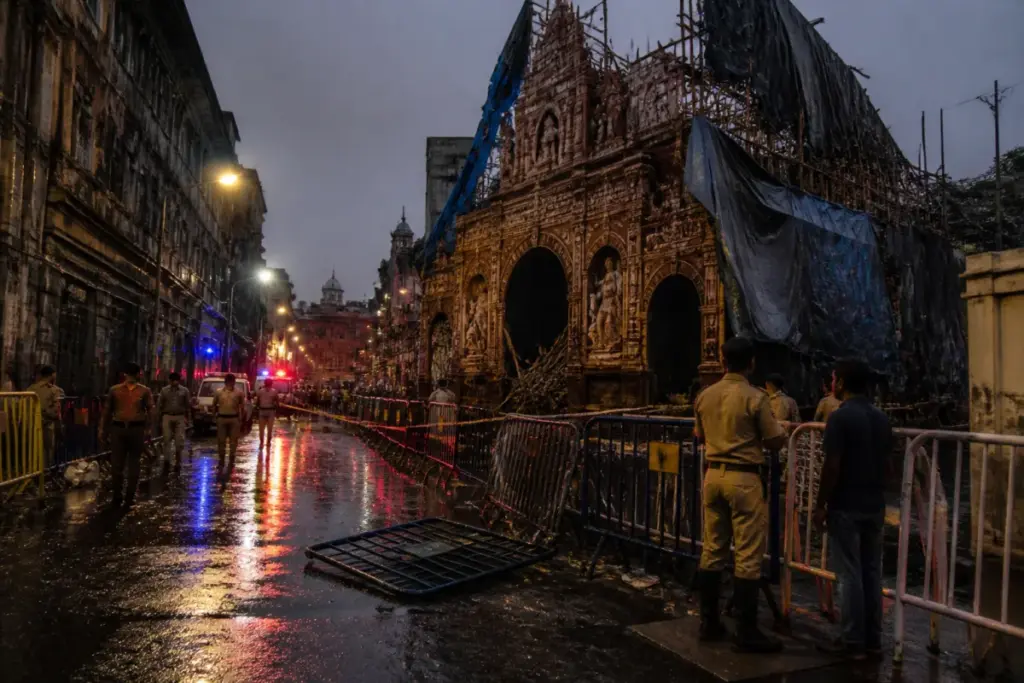
The reported deaths of 19 people at Kolkata’s Chorbagan Durga Puja pandal after a sudden downpour triggered a crowd surge have brought the safety of temporary public spaces, narrow access lanes and festival crowd management into sharp focus. The incident, in which 25 others were injured, was not simply a case of people gathering in large numbers. It unfolded at the intersection of weather, a constrained urban street, a crowded pandal layout, limited crowd-control personnel and an exit arrangement that witnesses said became impossible to negotiate.
The stampede occurred around 7.30pm at the pandal in north Kolkata’s Radha Madhab Saha Lane, where thousands of visitors were reportedly waiting in a narrow lane. According to the report, people already inside the pandal tried to move forward when rain began, while those outside rushed in for shelter. The exit was blocked by visitors who were reluctant to step out into the downpour. A sudden increase in pressure from behind then caused people to fall near a flight of stairs, with others falling over them.
The administration sealed the pandal after the incident. Chief minister Suvendu Adhikari said the site had been handed over to forensic teams, the Special Task Force and the fire brigade. He said the incident would be investigated and that action would be taken based on the findings. The chief minister also said preliminary information suggested that an announcement by the puja committee had played a role in the incident, while identifying the treatment of the injured as the immediate priority.
Doctors at Medical College Kolkata, where most of the injured were admitted, told the newspaper that the deaths were mostly caused by suffocation. Several victims also had injury marks associated with the stampede. The state government announced compensation of Rs 25 lakh and a government job for the families of those who died, and Rs 5 lakh for each injured person. Prime Minister Narendra Modi announced an additional compensation of Rs 2 lakh for the next of kin of the dead and Rs 50,000 for the injured.
The immediate facts point to a problem that urban safety systems repeatedly struggle to address: a temporary public venue can become a high-risk piece of infrastructure even when it is not formally treated like a permanent building or transport facility. A festival pandal is assembled for a limited period, but it still has to perform the same basic safety functions as any other crowded public space. It must manage entry, movement, waiting, shelter, evacuation and emergency access under changing conditions.
At Chorbagan, the risks were compounded by the physical setting. The pandal was located inside a narrow lane, limiting the space available for queues, emergency movement and dispersal. The design reportedly required visitors to move from an upper deck to a lower level near the exit using a flight of stairs. In normal conditions, such an arrangement may appear manageable. Under a sudden surge, however, stairs can turn a moving crowd into a pile-up point because they reduce walking speed and make it difficult for a person who falls to recover.
The geography of the venue also mattered. A narrow lane does not only restrict the movement of visitors. It can make it harder for emergency responders to reach the site, create competing flows between people entering and leaving, and leave crowds with few alternative routes when the main path becomes blocked. If rain drives people towards a covered structure, the venue’s capacity is effectively tested not just by the number of people who came to view it, but by the number seeking immediate shelter at the same time.
Witness accounts cited in the report describe a queue building outside, a growing pressure from behind and people inside refusing to exit because of the rain. One eyewitness said visitors fell near the stairs and that some people had to be pulled out after local residents dismantled part of the pandal. Residents also alleged that there were not enough policemen or volunteers for crowd management. These accounts remain part of the investigation, but they identify the operational points that authorities will need to establish: how many people were inside, how entry was controlled, whether the exit remained open, who issued the announcement, and what emergency plan was in place.
The involvement of local residents as first responders is significant. In crowded urban emergencies, the first few minutes often belong to people already at the site rather than specialised agencies. Their ability to help depends on whether barriers can be removed quickly, whether emergency passages are visible, and whether organisers have trained volunteers who understand how to stop entry and direct people towards safe exits. The report’s account that residents dismantled part of the pandal suggests that the structure itself became an obstacle during rescue operations.
The incident also raises questions about the division of responsibility. The chief minister blamed the organisers’ callousness and appealed to puja committees across Kolkata to illuminate their pandals properly and adopt safety measures. The report said the Chorbagan puja had long been a concern for authorities because of its location and that a change in the organising committee may have removed people with previous crowd-management experience from key roles. If confirmed by the investigation, that would point to a weakness in institutional memory: safety cannot depend entirely on whether experienced individuals happen to remain on a committee from one year to the next.
Public authorities and organisers operate in a shared safety chain. Organisers control the layout, volunteer deployment, announcements and entry arrangements. The police and civic administration are responsible for permissions, inspections, crowd regulation and emergency coordination. Fire and medical agencies must be able to access the site, while local authorities need to account for roads, lanes, lighting and weather-related risks. A failure at any one point can increase the burden on the others.
The fact that the Chorbagan pandal had reportedly been selected among the state government’s three ‘Serar-sera’ puja installations this year adds another layer to the scrutiny. Recognition for design or public appeal does not establish that a venue is safe under crowd pressure. A visually successful pandal can still have inadequate access, weak evacuation planning or an unsafe relationship with the surrounding street network. The incident shows why public-event assessment must treat crowd safety as a core criterion rather than a separate compliance exercise.
Rain was the immediate trigger described in the report, but the underlying risk was the interaction between weather and crowd behaviour. A downpour can rapidly change the purpose of a public space. Visitors who were moving through a queue become people seeking shelter. Those waiting outside may push forward, while people inside may slow down or stop at exits. This creates a conflict between incoming and outgoing movement. The safest response requires organisers to stop entry early, preserve a clear exit and communicate instructions that people can follow under pressure.
The reported incident is not Kolkata’s first warning about the consequences of festival crowds. In 2015, a large gathering at Deshapriya Park to view a Durga idol caused widespread traffic disruption and left several people ill or injured, although there were no deaths. The earlier episode demonstrated how quickly a popular attraction could overwhelm surrounding streets and transport movement. The Chorbagan tragedy has now added a far more serious question: whether lessons from crowd surges are being converted into enforceable site-level safety plans.
The investigation will need to establish the central facts rather than rely on assumptions. It must examine the pandal’s approved design, the capacity calculated for the venue, the location and width of entrances and exits, the presence of stairs, the number of police personnel and volunteers, the sequence of announcements, and the response after the first people fell. It will also need to determine whether the rain was adequately anticipated in the operating plan and whether the structure and lane allowed emergency access.
Compensation announced after a disaster can assist affected families, but it does not answer the administrative question of how the risks were assessed before the event. Nor does it substitute for accountability if permissions, inspections or operating procedures were inadequate. The state government’s decision to seal the site and deploy forensic, investigative and fire authorities is therefore important because the findings may establish whether the tragedy resulted from a single failure or from several weak controls operating together.
For Kolkata, the larger urban question is how the city manages temporary high-density spaces during a festival season that attracts large crowds to neighbourhood streets. The answer cannot rest only on adding more police after queues have formed. It requires the integration of street capacity, venue design, weather response, pedestrian movement, emergency access and trained volunteer systems before visitors arrive.
What the available evidence confirms is that a sudden downpour turned an already constrained pandal and lane into a dangerous crowd environment, resulting in deaths, injuries and a rescue operation involving local residents and multiple state agencies. What remains to be established is the precise chain of decisions that allowed the crowd to build up and movement to become blocked. The forensic and administrative investigation, along with the authorities’ next safety instructions to puja committees, will determine whether Kolkata treats the tragedy as an isolated incident or as a warning about the management of temporary public infrastructure.


