

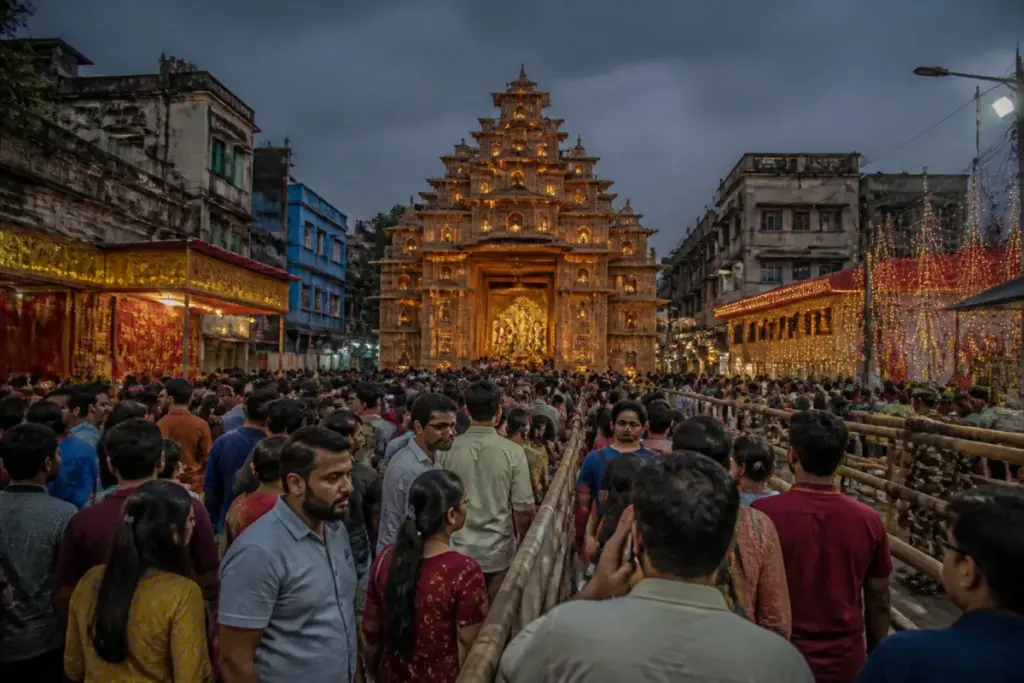
The Kolkata stampede at Chorebagan Sarbojanin Durgotsav Samity has left 19 families dealing not only with the loss of loved ones but also with the institutional question of how a public festival venue allowed a crowd emergency to become fatal. Relatives quoted by The Telegraph said the state government’s compensation would help surviving families financially, but insisted that money could not replace those who died. Their demands for better crowd management and safer puja pandals shift the focus from relief after the tragedy to the conditions that preceded it.
The incident occurred on a Saturday, according to the report, and the families’ accounts show how the consequences extend far beyond the immediate death toll. Sanjay Sonkar said his 33-year-old niece, Subham Sonkar, was the sole earning member of a family of five. She supported her parents, younger sister and brother while working at a private firm. For that household, the loss is simultaneously emotional and economic: compensation may provide financial support, but it cannot restore the income, care and daily responsibilities that one person carried.
The government has announced compensation of ₹25 lakh for the next of kin of each victim, along with a government job for one family member. These measures recognise that a mass-casualty incident can push surviving households into financial insecurity, particularly when a deceased person was the principal earner. But the accounts from the families also make clear that compensation addresses only one part of the damage. It may help a household sustain itself, yet it does not answer how the incident happened, who was responsible for crowd planning or what safeguards will prevent a recurrence.
The death of Dilip Ghosh, 59, and his wife, Dipali Ghosh, 54, illustrates another dimension of the tragedy. The Baranagar couple is survived by their 25-year-old son. Their relatives told the newspaper that he has completed his graduation and has been left alone. The couple was cremated late on Sunday, after a relative received a call from the morgue at around 3am to claim the bodies. The sequence reflects the immediate administrative burden families face after a disaster: identification, recovery of bodies, funeral arrangements and the uncertain task of rebuilding a household without its older support structure.
The evidence in the report points to crowd movement as the central safety concern. Kartik Naskar, Dilip Ghosh’s brother-in-law, said entrances at many pandals narrow near the main structure, creating bottlenecks. He called for exits wide enough to allow large numbers of people to leave simultaneously and urged the administration to monitor these arrangements. His account is not a formal investigation finding, and the report does not establish whether a specific bottleneck caused the Chorebagan incident. It does, however, identify a practical risk that can turn a dense festival crowd into a dangerous compression of people.
Crowd safety at a temporary public venue depends on more than the number of visitors. It is shaped by how people enter, where they pause, how quickly they can move, whether exits remain accessible and whether authorities can intervene before congestion becomes a crush. The family members’ observations suggest that the transition between an open approach route and a narrower space near a pandal may be a critical point. A venue can appear orderly at the entrance while becoming unsafe deeper inside, particularly if incoming and outgoing flows meet or if the main structure encourages visitors to stop in a confined area.
That is why the relatives’ demand for administrative monitoring is important. The report does not provide details of the permissions, inspections, crowd estimates, deployment arrangements or emergency plans for the Chorebagan pandal. It also does not state whether any inquiry has been announced or identify the agency responsible for assessing the venue’s crowd arrangements. These gaps matter because accountability cannot be established through compensation alone. A clear account would need to distinguish between the physical layout of the venue, the management of visitors, the response of organisers and the oversight exercised by public authorities.
The governance challenge is particularly visible in festival spaces that are temporary but serve a public function. A puja pandal may operate for a limited period, yet during that period it becomes a destination attracting large numbers of people. Its safety arrangements therefore cannot be treated only as a private organisational matter. The relatives’ statements place responsibility across two levels: organisers must ensure that entrances and exits can handle visitors, while the administration must monitor whether those arrangements are adequate in practice.
The compensation announcement also demonstrates the difference between post-disaster support and prevention. Financial assistance is necessary for families facing the sudden loss of an earning member. A government job for one family member may provide a longer-term livelihood pathway. But neither measure changes the physical conditions at a pandal, regulates crowd movement or confirms whether an emergency exit was usable. Without a public explanation of the failure, relief risks becoming the most visible government response while the safety system remains unclear.
The report offers no confirmed findings on the precise trigger of the stampede, the number of people present, the width of the entry and exit points, or the emergency response time. Those facts should be established before responsibility is assigned. What is already evident from the families’ accounts is that the tragedy has exposed a recurring urban management problem: public authorities and event organisers must plan not only for arrival but also for movement, waiting, evacuation and simultaneous exit.
For the families, the issue is immediate and personal. Sonkar’s family has lost its principal earner, while the son of the Ghosh couple has lost both parents. For the wider city, the incident raises a public-safety question about how temporary high-footfall venues are assessed and supervised. The next significant step is therefore not only the delivery of the announced compensation and jobs, but also a transparent account of the safety arrangements at the Chorebagan venue, the findings of any official inquiry and the measures adopted at other puja pandals to prevent bottlenecks and improve exits.


