

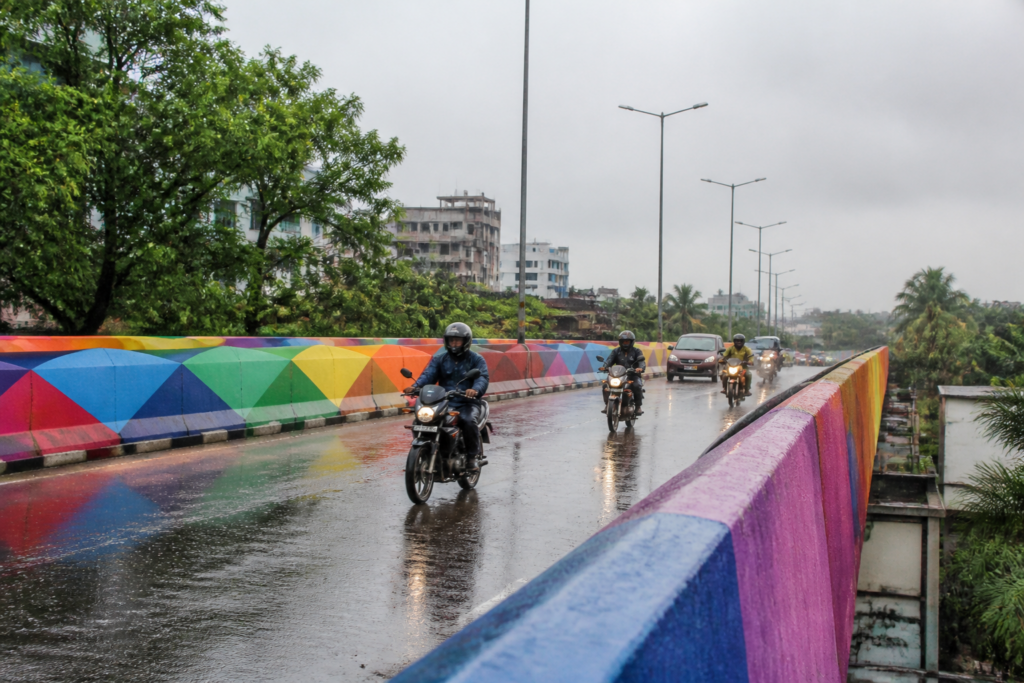
Kolkata’s rainbow-painted flyovers have come under scrutiny after a dashcam video appearing to show bikers skidding on the Chingrighata flyover circulated online. The Indian Express, which reported the video, said it could not independently verify its authenticity. Opposition parties and an environmentalist have questioned whether glossy conventional paint used as part of the city’s Durga Puja beautification drive could reduce tyre grip when wet.
The video appears to show three bikers losing balance on the Chingrighata flyover during what the report described as the first spell of rain. It has triggered claims that the painted carriageway may be unsafe for two-wheelers. Those claims remain unconfirmed because the footage has not been independently authenticated and the report does not include an official accident record, traffic police assessment or engineering inspection linking the reported skids to the painted surface.
The controversy comes as Kolkata’s flyovers and other public spaces are being decorated ahead of Durga Puja. Flyovers at Gariahat and Chingrighata have reportedly been painted in bright colours, while the Howrah Bridge has been decorated with lights. The road-painting drive is being led by Urban Development Minister Paul, who was also reported to have drawn an alpana, a traditional coloured motif, at the Park Circus seven-point crossing.
The Trinamool Congress alleged in a post on X that the newly painted flyover had become a “death trap” and that accidents were taking place after the first rain. The party called for the minister to be held accountable. These statements are political allegations and were not accompanied in the supplied report by an official accident database, police confirmation or a statement from the department responsible for the flyover.
Separately, Ashutosh Chatterjee, general secretary of the Congress’s West Bengal unit, wrote to Paul and Smita Pandey, commissioner and administrator of the Kolkata Municipal Corporation, warning about the use of coloured paint on roads carrying motor vehicles. His letter argued that glossy paint could make a wet carriageway more slippery and said ordinary household paint should not be used across the area traversed by vehicle tyres.
Chatterjee’s letter cited a possible fall in the coefficient of friction from 0.6–0.7 to below 0.3 when a glossy surface is wet with water, oil or diesel. The report attributed this technical claim to the letter; it did not say that an independent laboratory or road-safety authority had tested the Chingrighata flyover. The letter also referred to IRC:35-2015 and IS:164, standards it said govern road markings and related materials on Indian national highways.
The distinction between decorative paint and engineered road-marking material is central to the dispute. According to Somendra Mohan Ghosh, an environmentalist and green technologist quoted by The Indian Express, ordinary paints of different shades appeared to have been used instead of thermoplastic paint and did not appear to contain anti-skid materials. The report did not provide a materials specification, tender document, contractor detail or government confirmation establishing what product was applied to the flyover.
Road surfaces used by moving vehicles must provide adequate friction in both dry and wet conditions. Two-wheelers are particularly sensitive to changes in surface grip, but the supplied report does not establish the condition of the flyover before painting, the weather and speed at the time of the apparent skids, the presence of oil or diesel, or whether road geometry and drainage contributed to the incident shown in the video. These details would be necessary to determine causation rather than simply establish that a skid occurred.
The episode also raises a governance question about how public beautification projects are assessed when they alter infrastructure used for daily travel. A flyover is not only a visual surface or festival backdrop; its carriageway is part of a transport system with requirements relating to friction, visibility, drainage, maintenance and performance during rain. The available report, however, does not state whether a formal road-safety audit, material approval or post-application friction test was conducted before the painted flyover was opened to traffic.
The state government’s stated purpose, according to a video cited in the report, is to decorate the city for residents and visitors during the festival season. Paul described the initiative as representing “the road of trust, love and brotherhood” and said the government invited people to see the work. She also indicated that additional alpona painting could take place at Rashbehari and Park Street if time permitted. The supplied material does not contain a response from the minister or the Kolkata Municipal Corporation to the safety concerns.
For now, the verified facts are limited. A video circulated online showing what appeared to be bikers skidding on the Chingrighata flyover; the publisher said it could not verify the footage. Political parties raised safety objections, a Congress leader sent letters to state and municipal officials, and an environmentalist questioned whether the material used had anti-skid properties. Whether the paint caused the skidding, whether accidents occurred at the location and whether the surface complies with applicable technical requirements remain unresolved.
The next meaningful step would be an on-site assessment by the responsible road and municipal authorities, including verification of the video, review of the paint specification and measurement of wet-surface friction. Until those checks are made public, the rainbow-painted flyover remains the subject of a serious but unconfirmed road-safety concern rather than an established infrastructure failure.


