

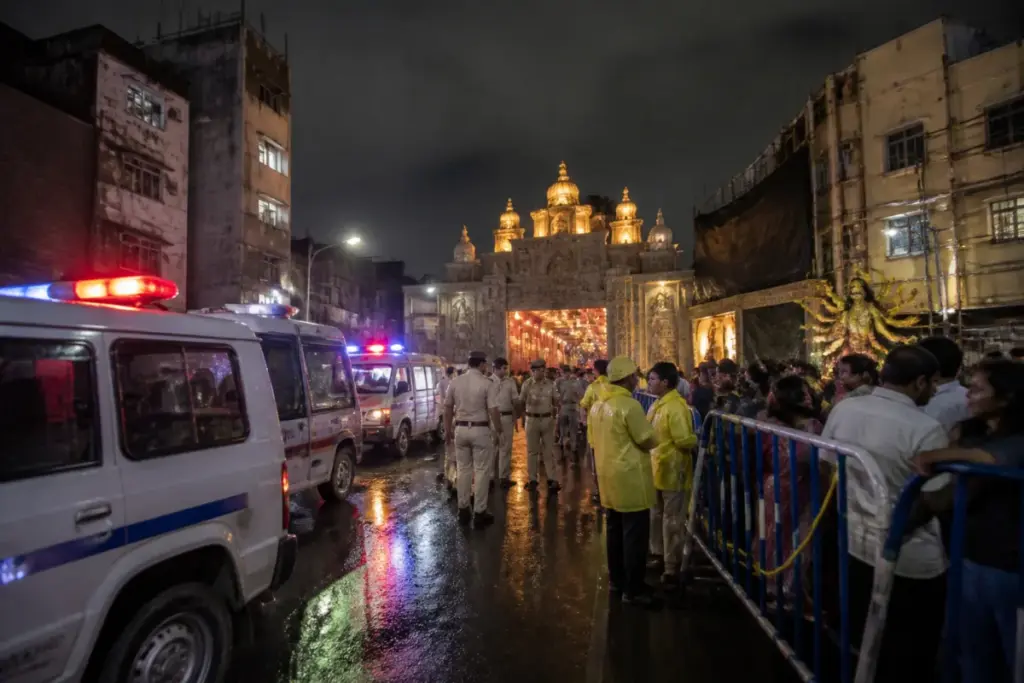
A reported stampede at a puja pandal in Kolkata has left the death toll unclear, after an account from a worker at Kolkata Medical College described 13 women, three men and a child being taken to the hospital, while the accompanying report summary refers to 13 women and three men. The discrepancy requires confirmation from the police, hospital authorities or the organisers before the toll can be treated as final.
The incident took place at the Chorbangan puja mandap, according to the report published by Bartaman Patrika. The account was provided by Dipak Mallik, identified as a worker responsible for carrying bodies at the hospital. He said he was on duty at Kolkata Medical College from 2 pm to 9 pm on Saturday and was called to the emergency department at about 8 pm after being told that a serious incident had occurred.
Mallik described a series of bodies arriving at the emergency department. He said he took them to a room on the second floor and placed them there one after another. His account identifies 13 women and three men, and separately mentions a child. The report does not establish whether the child is included in the total of 16 mentioned in its summary or is an additional casualty.
The account also illustrates the immediate institutional process that follows a mass-casualty incident. Mallik said that several relatives had identified victims during the night, while others remained unidentified. He described the next steps as entering names in the wardmaster office register, informing the police, issuing documents, conducting post-mortem examinations and handing over the bodies to family members.
These procedures are not administrative details alone. In a crowd disaster, the movement of victims from the site to hospitals, the recording of identities and the release of bodies to relatives become part of the emergency response. The report provides a first-hand account of one worker involved in that process, but it does not provide an official casualty list, a police statement, a hospital bulletin or a medical report.
The source account says that many of the victims did not appear to have major external injuries. Mallik said his experience was that people caught in stampedes can suffer internal injuries when one person falls on another. This is a description of his experience and should not be treated as a medical finding about the Chorbangan incident without confirmation from doctors or post-mortem reports.
The report also does not establish what caused the crowd movement, how many people were present at the puja mandap, whether entry and exit routes were available, or whether the venue had a crowd-management plan. It does not state whether emergency services were deployed at the site, how quickly victims were transported, or which authority was responsible for safety arrangements. Those questions are central to understanding how the incident occurred and whether preventable failures were involved.
Puja pandals are temporary public venues that can attract large crowds within a limited area. Their safety depends on more than the structure itself. The arrangements may include pedestrian circulation, separate entry and exit points, barriers, lighting, emergency access, fire safety, police deployment, volunteer coordination and communication with visitors. None of these factors is established in the supplied report for the Chorbangan venue.
The available account instead shows what happened after victims reached Kolkata Medical College. The emergency call to Mallik came after he had finished his shift-related work and gone to bathe. He said bodies then arrived one after another. His description places the hospital mortuary and identification process at the centre of the report, while leaving the conditions at the pandal and the sequence of events there unconfirmed.
The human consequences were visible at the hospital. Mallik said relatives arrived during the night to identify some of the victims and that many family members were crying. He also described the difficulty of handling the bodies while knowing that each person had family memories and close relationships. His account offers a ground-level view of the invisible labour required after a mass-casualty event, including carrying, counting, registering and preparing bodies for post-mortem examination.
That work is important to the functioning of the wider emergency system. Accurate counting affects police records, hospital documentation, family notifications and compensation or legal processes where applicable. A discrepancy in the reported toll can therefore create practical problems for relatives and authorities, particularly when some victims remain unidentified.
At present, the supplied report does not identify the official agency that confirmed the deaths. It also does not provide the names of the victims, the number of injured people, the status of those admitted to hospital, or the exact time at which the stampede occurred. It is therefore not possible from the available material to establish the final toll, the number of survivors requiring treatment or the operational response at the pandal.
The distinction between a reported account and an officially confirmed figure is especially important in a mass-casualty incident. Bartaman Patrika’s report attributes the details about the bodies to Mallik, who handled them at the hospital. However, the report’s summary and the quoted account do not match on whether a child is included in the total. Police and hospital records are needed to resolve that question.
The incident also raises a broader governance issue: public safety at temporary religious and cultural gatherings depends on coordination between organisers, local administration, police, emergency medical services and hospitals. A failure at any point can increase the consequences of a crowd surge. Yet the supplied material does not contain enough evidence to assign responsibility or determine whether any safety rule was violated.
The immediate priority is to establish the verified casualty list and notify families. The reported process includes police intimation, documentation, post-mortem examinations and the release of bodies to relatives. Further reporting should establish the official death toll, the number of injured people, the cause of the crowd movement, the safety arrangements at the Chorbangan puja mandap and the findings of any police or administrative inquiry. Until those details are confirmed, the number of deaths should be treated as provisional.


