

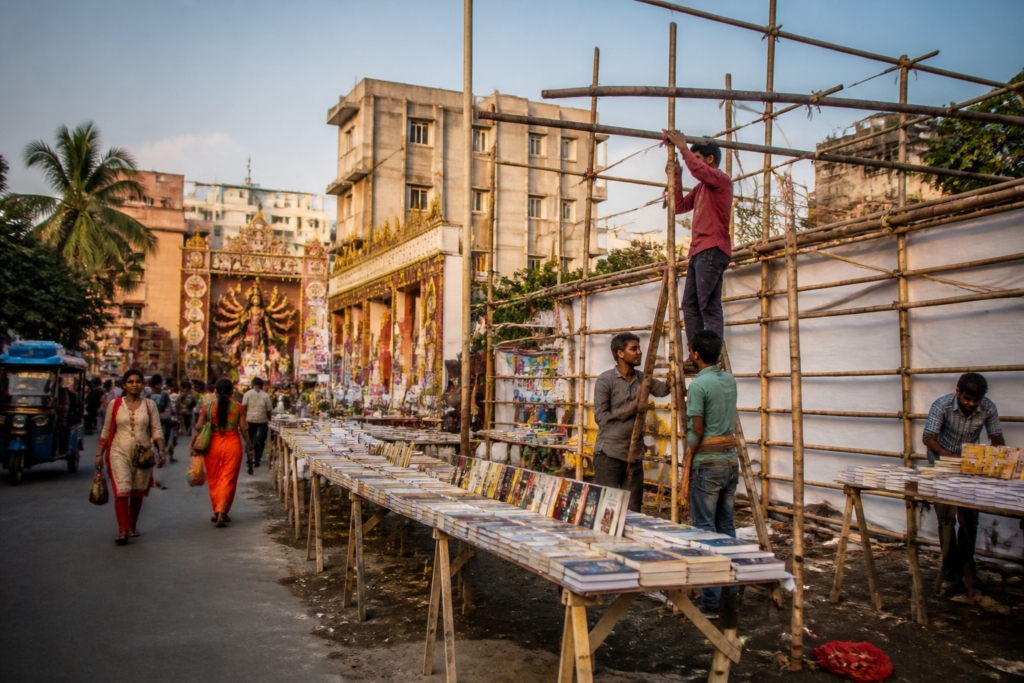
The Kolkata High Court has directed the police to submit a detailed report on the proposed temporary bookstalls associated with the Communist Party of India (Marxist) in the Bongaon-Naihati and Jessore areas during Durga Puja, after questions were raised over permissions for the structures.
Justice Sougat Bhattacharyya directed that the report be filed by Thursday. The police have been asked to specify how many stalls are being set up, whether work on them has begun and whether the required permission from the Public Works Department has been obtained.
The court’s directions came during the hearing of a petition filed by the CPI(M). The party told the court that temporary bookstalls had been installed in the areas every year during the Durga Puja period, but permission had allegedly not been granted this year. It also claimed that another organisation had been allowed to construct a temporary structure at the same location.
During the hearing, Justice Bhattacharyya questioned why a bookstall should not be allowed if other temporary stalls, including those selling balloons and toy guns, could be installed. “If a balloon-and-gun stall can be set up, why can’t a bookstall be set up? You are not setting up a lottery shop there. It will be a bookshop,” the judge observed, according to the report.
The court also sought clarity on which applicants had received permission from the Public Works Department to establish bookstalls. The police report is expected to include details of the permissions and the temporary structures proposed for the locations.
The dispute has also highlighted the division of administrative responsibility for temporary installations on public land. The CPI(M)’s lawyer told the court that the party had been putting up bookstalls in the area for many years and questioned why permission had been denied this year while another organisation had allegedly received approval.
Appearing for the West Bengal government, Advocate General Surjit Nath Mitra said the CPI(M) had applied to the sub-divisional officer for permission. Since the land belonged to the Public Works Department, he argued, the sub-divisional officer could not grant the required approval. According to the state’s submission, the application should instead have been made to the Public Works Department.
The court’s order places the immediate responsibility on the police to establish the status of the proposed stalls and identify the permissions obtained by different organisations. It does not, at this stage, record a final decision on whether the bookstalls may be installed.
The next procedural milestone is the submission of the police report by Thursday, including the number of stalls, the status of construction and details of Public Works Department permissions.


