

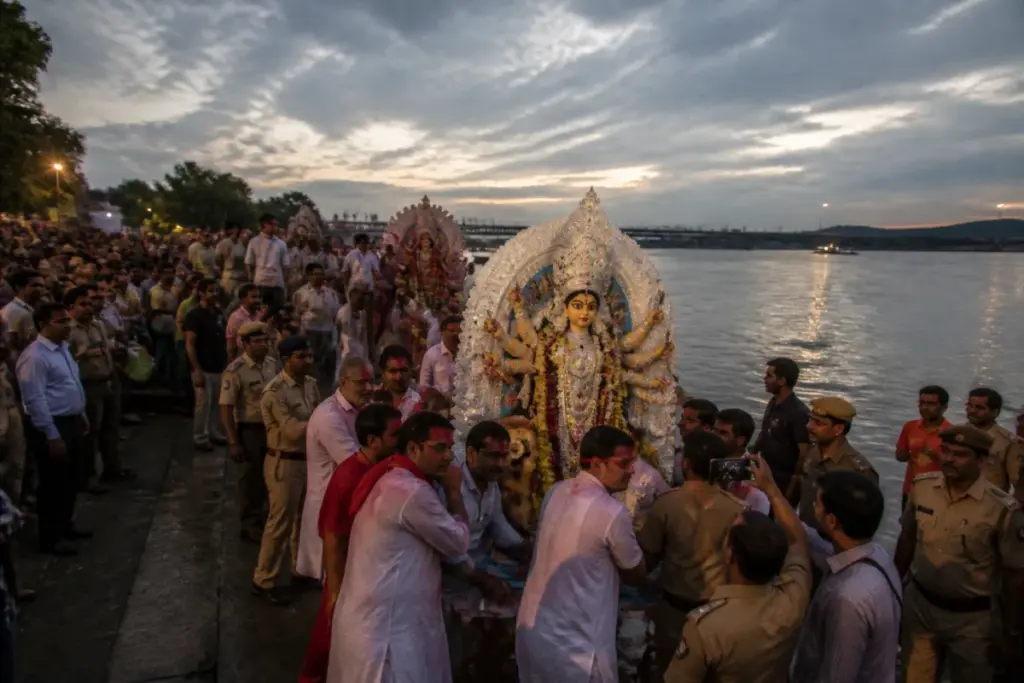
Kolkata’s Durga Puja idol immersions drew large crowds to the banks of the Ganga on Vijaya Dashami, with police and civic authorities deploying security arrangements at major river ghats to manage processions and protect devotees.
Puja organisers arrived at the ghats in colourful processions accompanied by dhaak drums as devotees carried idols of Goddess Durga and her four children—Lakshmi, Saraswati, Ganesha and Kartik—for immersion. Babughat in central Kolkata emerged as a major gathering point, with revellers in traditional clothing dancing and singing before the ceremonies.
Hundreds of devotees joined hands to lower the idols into the river. The immersion marks the close of the annual Durga Puja festivities and symbolises the end of the goddess’s stay at her parental home before her return to Lord Shiva’s abode at Mount Kailash, according to Bengali tradition.
The scale of the gatherings placed renewed attention on the management of Kolkata’s riverfront spaces. Police and civic authorities arranged security measures at several ghats to ensure that the processions and immersion ceremonies proceeded peacefully. The report said security was tightened after a stampede at Chorbagan in north-central Kolkata in which 19 people were killed.
The arrangements covered locations where large groups gathered simultaneously, including the approach roads and riverfront areas around the ghats. The ceremonies require coordination between puja organisers, police personnel, civic teams and devotees as idols are transported through crowded streets and brought close to the water.
The day also included rituals away from the river. Married women took part in sindoor khela, smearing vermilion on one another after offering it to the goddess and her children. Families exchanged Bijoya greetings and sweets, while younger people sought the blessings of elders. School students visited puja marquees and placed books and pens before the goddess.
The immersion process is preceded by a symbolic ritual in which priests reflect the image of the goddess in a vessel filled with water. Before the idols leave for the ghats, women offer sweets, betel leaves and oil lamps as a farewell. At the river, the final ceremony brings together religious practice, public movement and the operational challenge of handling large crowds in confined waterfront areas.
Vijaya Dashami, which usually coincides with Dussehra, is associated with the triumph of good over evil. For Kolkata’s civic agencies, however, the conclusion of the festival also marks the final phase of a high-volume public event involving traffic movement, crowd control, river access and the safe handling of idol immersions.
The authorities’ immediate priority remained the orderly completion of immersion ceremonies at the city’s major ghats, with devotees continuing to gather for the final processions and Bijoya observances.


