

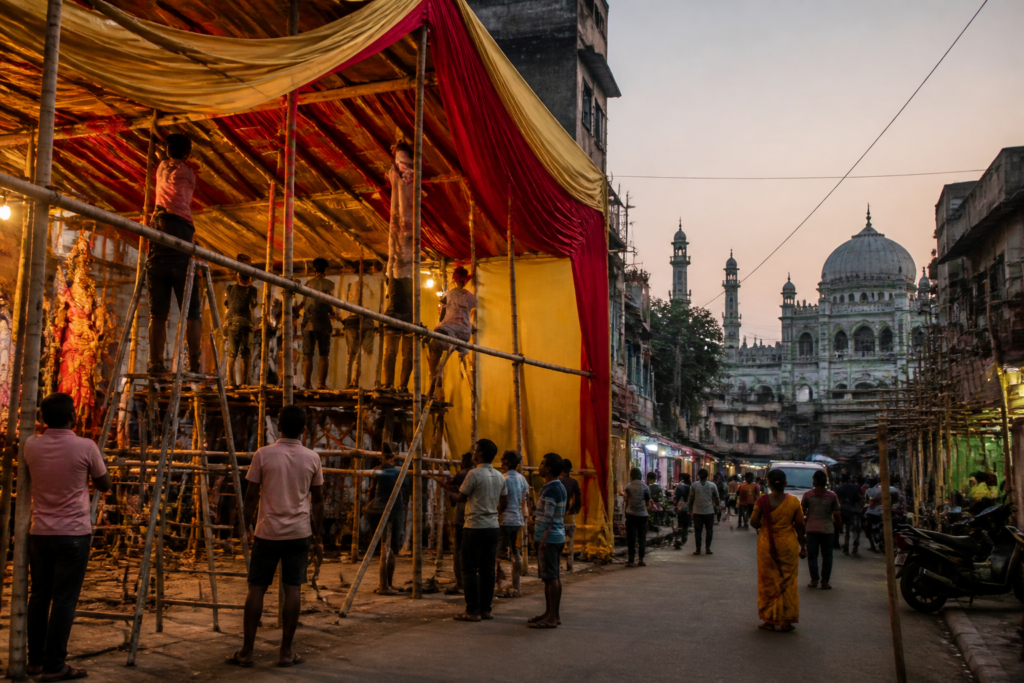
Kolkata’s Durga Puja committees are revealing a sharp change in how neighbourhood public life is organised. In several localities, Muslims who helped raise funds, build pandals and distribute bhog in earlier years have been excluded from committees or moved away from core responsibilities in 2026. In a smaller number of areas, Hindu-Muslim participation continues, but the contrast shows that the character of a public festival can change when control of its organising institution changes.
The reported shifts are not uniform across the city. In parts of Park Circus and central Kolkata, Muslim residents told the Times of India that they remained involved in organising pujas. Muslim members of committees in Kidderpore also said they continued to participate, although some reported that their roles had been reduced. Mohammad Ali Park, Akal Bodhan on College Street and Park Circus United Club Durgotsab were among the pujas identified as retaining Muslim members. At Mominpore Sporting Club Durgotsab, Serajul Karim said he had not been prevented from participating because of his religion.
Yet the wider pattern described in the report is one of institutional retreat. Several committees have reportedly been reconstituted without Muslim members, while others have limited their involvement. The change is particularly visible in neighbourhoods where participation had previously been treated as part of the puja’s identity rather than as a concession to a minority group.
At Alipore 78 Pally, the puja is held on a ground beside Aftab Masjid. For decades, Muslims in Gopalnagar reportedly helped raise funds, construct the pandal and distribute bhog. The committee was previously led by former Kolkata mayor and Trinamool minister Firhad Hakim. It has now been replaced by a panel headed by BJP leader Rakesh Singh, which has no Muslim members. Committee secretary Sumit Shaw told the newspaper that the puja would be conducted strictly according to Sanatani rituals and said there were no Muslims on the committee, while adding that the organisers had nothing against Muslims.
This change illustrates how a neighbourhood festival is also an institution of local governance. A committee decides who can participate, who controls funds, which rituals are prioritised, how public space is used and which version of neighbourhood identity is presented to visitors. The formal event may remain the same, but the distribution of organisational authority can alter who feels recognised as part of the community.
The distinction between ritual participation and institutional participation is important. A resident may still be allowed to attend a puja, contribute informally or visit a pandal while being excluded from decisions about fundraising, construction, programming and food distribution. The report’s account of Kidderpore suggests that this distinction is already emerging in some areas, where Muslim residents remain associated with committees but say their roles have been scaled down.
Ultadanga’s Gouriberia Sarbojanin Durgotsab o Pradarshani offers another example of a public tradition being redefined. In 2024, organisers had worshipped nine girls from Hindu, Muslim, Christian and Sikh communities during Kumari Puja. The organisers have since decided to break with that approach. Organiser Manta Mishra told the Times of India that the puja would follow Sanatani rules in 2026 and that its theme was Anandamath.
The significance of this decision lies not only in the ritual itself, but in what it says about the committee’s understanding of the public it represents. The earlier practice presented religious diversity as part of the festival’s public meaning. The current committee has chosen a narrower ritual framework. The report does not establish that every resident supports or opposes the change, but it does show that the symbolic boundaries of participation are being actively reconsidered by local organisers.
The pattern is also connected to changes in neighbourhood demography. Central Kolkata’s Sharif Lane will not have a Durga Puja this year, after a festival revived in 2021 was discontinued. The puja had originally been started by a Hindu family in a predominantly Muslim neighbourhood and had stopped around 2005. Social worker Tausif Rahman said it was revived after the earlier Hindu families had left, but that the sole Hindu family remaining in the area had since moved away. The puja was therefore not sustained in 2026.
Sharif Lane demonstrates a different kind of vulnerability. In this case, the issue described by the report is not the formal exclusion of Muslim organisers but the disappearance of the social base that had supported the festival. A neighbourhood puja requires more than a calendar date and a public site. It needs organisers, contributors, participants and a local network willing to assume responsibility. When residents move away, the institutional chain that sustains a festival can break even if the surrounding community remains active.
Together, the cases point to two pressures on shared neighbourhood traditions. One is demographic change: the movement of families and the weakening of older local networks. The other is institutional redefinition: the decision by new or existing committees to narrow participation or place greater emphasis on a specific religious identity. These pressures operate differently, but both affect how public celebrations function as shared urban spaces.
The report also records an explicit call for inclusion from some puja organisers and political figures. Sajal Ghosh, the BJP MLA from Baranagar and head of the Santosh Mitra Square Durga Puja Committee, pointed to a Muslim friend while addressing a puja function and said that celebrations were incomplete without his participation. Ghosh called for people to stay together, set politics aside for seven to 10 days and forget divisions. His remarks sit alongside reports of committees elsewhere changing their membership and limiting Muslim involvement.
That contrast shows why broad public statements cannot by themselves determine the character of neighbourhood institutions. Inclusion is ultimately experienced through everyday organisational practices: who attends meetings, who raises money, who approves spending, who supervises construction and who is visible when the festival is presented to the public. A call for harmony from a stage has a different effect from a committee structure that gives residents a continuing role in decision-making.
Kolkata’s puja committees occupy an unusual position in the city’s civic landscape. They are not described in the report as municipal bodies, but they organise activities in public or shared neighbourhood settings and coordinate residents around significant expenditure, construction and crowd activity. Their decisions therefore have an urban consequence beyond religious observance. They influence access to local public life and help define whether a neighbourhood is represented as internally diverse or culturally exclusive.
The evidence supplied does not establish a citywide collapse of Hindu-Muslim participation. It records a mixed picture: exclusion at Alipore 78 Pally, a changed ritual approach at Ultadanga, the discontinuation of the puja at Sharif Lane, reduced roles in parts of Kidderpore and continued participation in several other areas. That variation is central to understanding the story. Kolkata is not experiencing one uniform transformation; different committees are responding to demographic, political and organisational changes in different ways.
It also means that the most important question is not whether a particular puja is formally open to all visitors. The deeper question is who has the authority to shape the event and whether that authority reflects the full social composition of the neighbourhood. A festival may remain accessible at the level of attendance while becoming less inclusive at the level of governance.
The 2026 accounts therefore provide a record of institutional change rather than a final verdict on Kolkata’s shared celebrations. The evidence confirms that some committees have removed or reduced Muslim participation, while others continue older forms of association. It also shows that demographic change can make a neighbourhood festival difficult to sustain. Further developments will depend on whether committees retain these revised structures, whether excluded members return to organising roles and whether the pockets of shared participation identified in the report remain durable.


