

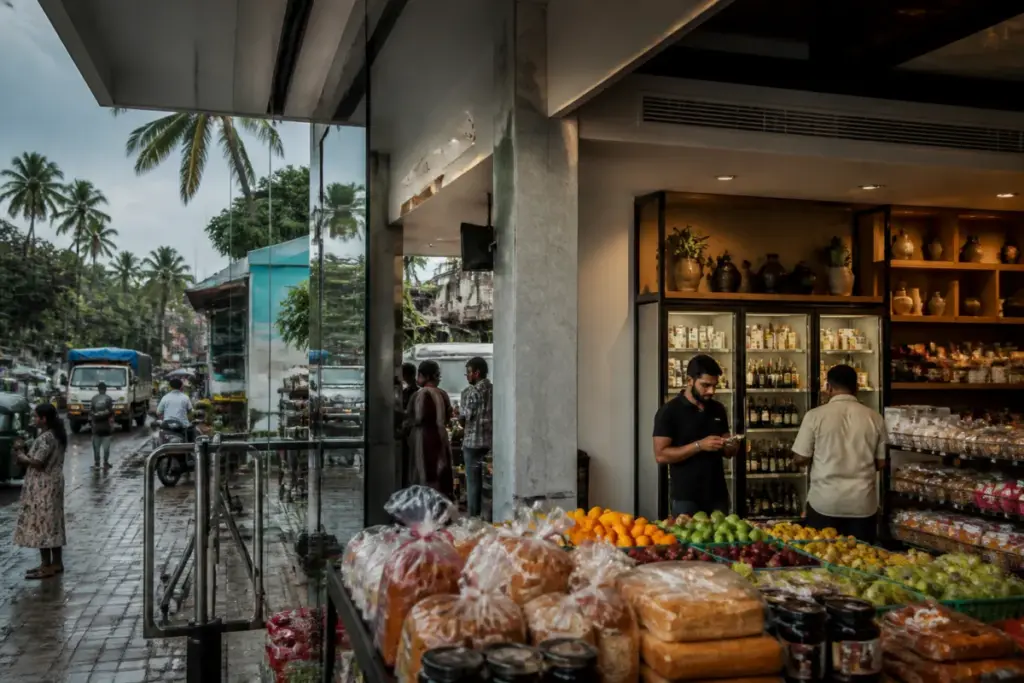
Kerala’s decision to freeze horti-wine sales outside Kerala State Beverages Corporation outlets has turned a single bakery licence controversy into a test of how the state designs, delegates and supervises liquor regulation. The immediate action stops sales through bakeries, malls, hypermarkets and supermarkets until a new liquor policy is announced, while the government reviews the legal basis of a permission issued under rules that had already created a separate framework for fruit-based wine.
The controversy began after an excise deputy commissioner granted a licence to a bakery in Chalakudy. The government said the licence was issued in June without the knowledge of Chief Minister V D Satheesan and Excise Minister M Liju. The officer, C K Anilkumar, was removed from his post and replaced by V Subhash. At the same time, the government initiated steps to seek legal advice on withdrawing the permission.
The reported dispute is therefore not only about whether a particular outlet could sell a beverage with an alcohol content of 15.5%. It is also about the boundary between authority delegated to the excise administration and policy control retained by the political executive. The excise commissionerate maintained that the licence had been issued in accordance with existing rules, while the minister sought an urgent report on when sales through bakeries had begun. Those two positions reveal the institutional gap at the centre of the matter: administrative permission may be technically available, but its wider social and policy implications may not have been settled.
That distinction matters because retail access is a policy decision as much as a licensing decision. A permission for a small-scale winery concerns production. Allowing a product to be sold through ordinary commercial outlets changes how consumers encounter it, where it is available and which businesses can participate in the market. The government’s freeze indicates that it now wants those questions considered as part of a broader liquor-policy review rather than handled through individual permissions alone.
The regulatory framework developed in stages. The LDF government’s 2022-23 liquor policy permitted small-scale production of fruit-based wine. The Kerala Small Scale Winery Rules were introduced in 2022, and later amendments allowed sales outside Bevco outlets. In September 2025, the minimum floor area for eligible retail outlets was reduced from 100 square metres to 10 square metres. That change potentially widened the range of premises that could qualify, moving the framework away from a model limited to larger retail spaces.
The reduction in the minimum floor area is important because the latest controversy concerns a bakery rather than a conventional liquor outlet. The supplied report does not establish how many licences were issued under the amended rule, how many outlets began selling horti-wine or how much revenue the category generated. It does, however, show that the rule changes created a route for retail sales beyond Bevco, while the government had not yet taken a final policy position on the wider distribution of low-alcohol beverages.
The episode also highlights the difference between a product’s technical classification and its social reception. Horti-wine has an alcohol content of 15.5%, and the Excise Minister had earlier said there might be no technical issue with the excise commissioner granting permission under existing rules. But the minister also said the matter should have been brought to his attention, citing concerns about the social impact of such permits. The government’s response suggests that compliance with a rule is not being treated as the end of the policy process.
This is a recurring administrative problem in regulated urban markets. Rules often divide responsibility among policy departments, licensing officials and implementing agencies. A department may interpret an existing provision as sufficient to grant permission, while ministers may view the same permission as carrying consequences that require explicit political approval. When the division is not clearly documented, the resulting uncertainty is transferred to businesses and local retail operators.
For entrepreneurs, the uncertainty is compounded by the economics of the product. Horti-wine attracts an 86% tax, similar to regular wine. Entrepreneurs have sought a reduction to make the product commercially viable. A market that faces high taxation, uncertain permissions and a pause on sales outside Bevco outlets may struggle to develop, even where production itself is legally permitted. The government’s decision has therefore created a second question alongside the licensing dispute: whether the existing tax and distribution structure is compatible with the small-scale industry the rules were intended to support.
The framework also involves a tension between decentralised market access and centralised state control. Permitting sales through bakeries, malls, hypermarkets and supermarkets would use established commercial networks rather than requiring every producer to rely on Bevco. That could make access easier for small producers and reduce dependence on a single state-controlled retail channel. But the same arrangement requires clear standards on outlet eligibility, supervision, records, taxation and enforcement. The supplied report does not provide details of those operational safeguards, making the government’s legal and policy review significant.
The question is particularly relevant to urban and semi-urban retail systems, where bakeries, supermarkets and hypermarkets function as high-footfall commercial spaces. Bringing a regulated alcoholic product into those settings would have implications beyond the producer. It would affect retailers seeking licences, consumers, excise officials responsible for enforcement and the state’s wider approach to liquor availability. The report does not establish the scale of actual sales or consumer demand, so the impact cannot yet be measured. What is clear is that the proposed channel would have extended liquor retail beyond the established Bevco network.
The government’s present course combines three actions: freezing sales outside Bevco outlets, seeking legal advice on whether the permission can be withdrawn and reviewing the issue through the broader liquor-policy process. The excise department’s reassignment of the officer who granted the licence is an administrative response, while the request for an urgent report is intended to establish how and when sales commenced. These steps indicate that the state is examining both the individual decision and the institutional process behind it.
The central policy lesson is that production rules and retail rules cannot be treated as separate questions when the product enters mainstream commercial spaces. Kerala’s 2022 framework established a route for small-scale fruit-based wine production, and later amendments enabled sales outside Bevco outlets. The current dispute shows that the implementation of that route remained politically and administratively unsettled. A rule can provide a technical basis for permission without resolving the state’s position on distribution, taxation and social impact.
The next stage will depend on the legal advice sought by the government, the excise commissioner’s report and the new liquor policy. Those documents will determine whether the Chalakudy permission can be withdrawn, how existing rules are to be interpreted and whether the broader retail model will be retained, modified or abandoned. Until then, the horti-wine freeze is less a final decision on a niche beverage than a pause in Kerala’s attempt to reconcile small-scale production, commercial retail access and central oversight of liquor policy.


