

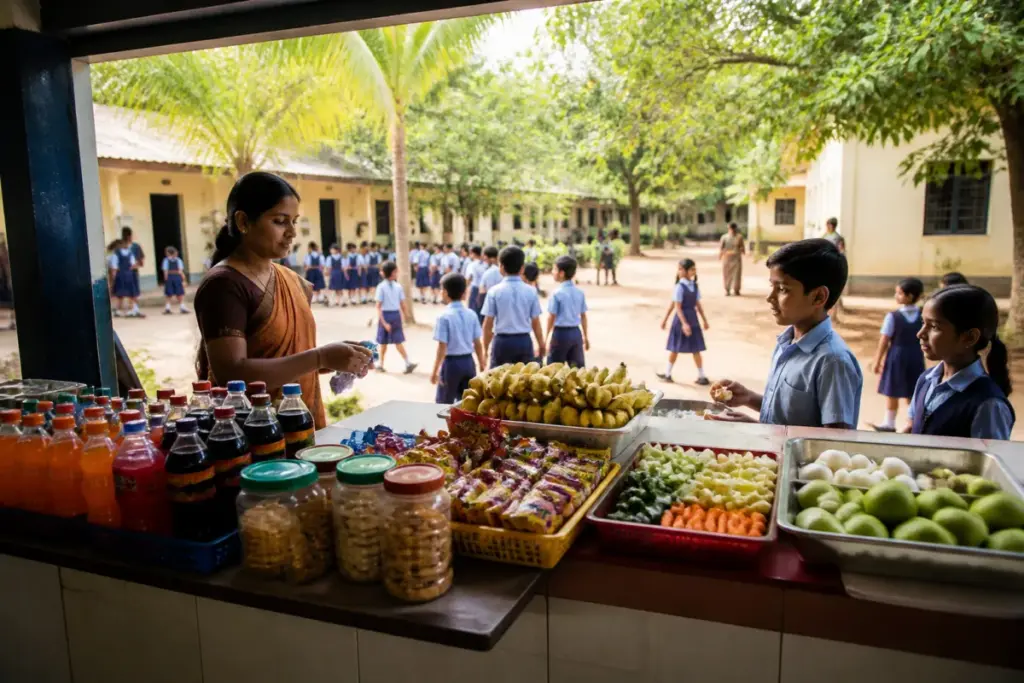
Kerala will ask the Food Safety and Standards Authority of India (FSSAI) to finalise rules for identifying foods high in fat, sugar and salt, a move that could allow the state to regulate or prohibit their sale on school premises. Health Minister K Muraleedharan said the absence of precise standards has made it difficult to determine which products should be classified as junk food.
The state government will write to FSSAI seeking early finalisation of the proposed regulations and their incorporation into the legal framework, the minister said in a statement. The request comes as Kerala expands programmes aimed at improving children’s access to safe and nutritious food and encouraging healthier eating habits.
Muraleedharan said the lack of a scientific definition had created uncertainty over which food products should be included in the category and how their sale should be regulated. While foods high in fat, sugar and salt may be classified as high-fat, sugar and salt (HFSS) products, the state wants clear thresholds to establish when these ingredients become excessive.
FSSAI published draft regulations on August 7 proposing limits for fat, sugar and salt in solid and liquid foods. Under the proposal, solid foods containing more than 4.2 grams of fat, three grams of sugar or 0.625 grams of salt per 100 grams would cross the respective thresholds. For liquid foods, the proposed limits are more than 1.5 grams of fat, two grams of sugar or 0.175 grams of salt per 100 millilitres.
The state said final regulations would provide the basis for preparing a list of products and restricting their sale on school premises. Until such standards are formalised, authorities face difficulty applying a consistent rule to packaged foods, snacks and beverages sold in or around educational institutions.
Kerala is also implementing programmes focused on food safety, hygiene and nutrition in educational and public institutions. The Eat Right School initiative has been implemented in 169 schools, including Model Residential Schools, and covers food safety, hygiene and the availability of balanced food in school and hostel canteens.
The SNF@School programme, or Safe and Nutritious Food at School, has been implemented in 2,500 schools and is intended to provide children with practical nutrition knowledge. The Eat Right Campus initiative, which promotes safe and nutritious food in canteens at colleges, universities, hospitals and government institutions, has secured certification for 456 establishments.
The minister said the state was also conducting inspections and taking legal action against establishments that violate food safety standards. The next step is Kerala’s communication to FSSAI seeking finalisation of the proposed HFSS regulations, which would determine the legal basis for identifying and regulating such products in schools.


