

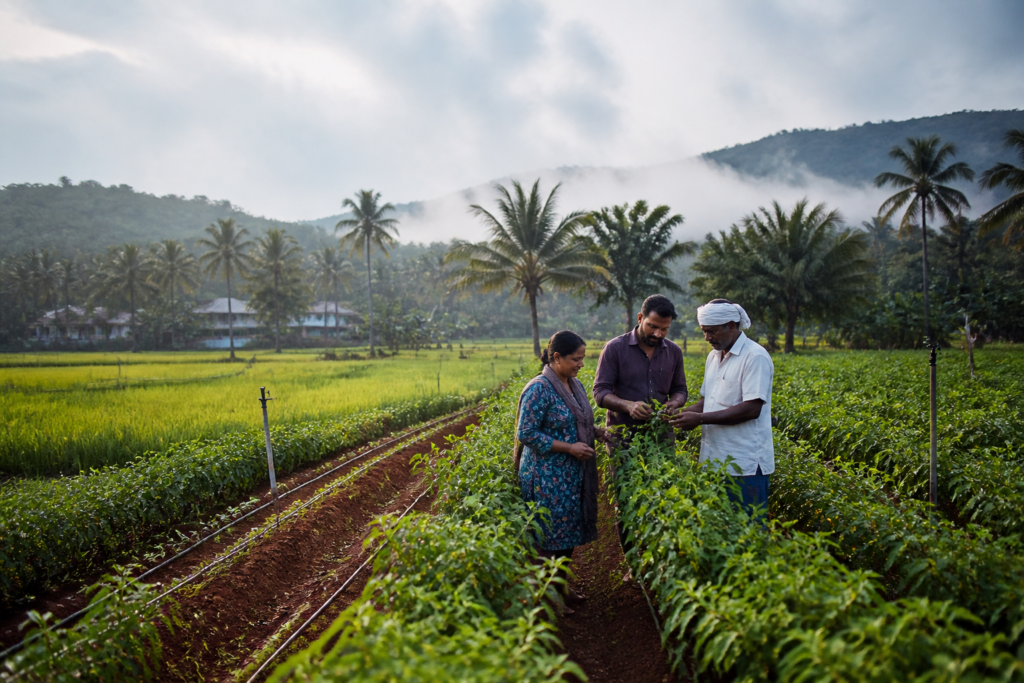
Kerala’s proposed agriculture policy revision is being shaped around a problem that is no longer confined to farm production: how the state can protect rural livelihoods, water resources and food security as weather conditions become more damaging. The policy will prioritise climate-resilient farming, technology adoption, crop diversification, market access and greater participation by women and young people, according to agriculture minister T Siddique.
The revision is significant because Kerala’s existing agriculture policy was framed in 1992 and revised in 2015. That document continues to underpin farmer-welfare measures including awards, pensions, debt relief and land-stability schemes. The new exercise therefore involves more than adding individual schemes. It is an attempt to connect farm support, land-use rules, climate adaptation, technology and marketing within a single policy framework.
The case for a new framework is visible in the state’s recent farm-loss figures. Between 2021 and 2025-26, severe summer conditions damaged 1,271.935 hectares belonging to 3,879 farmers, causing losses of Rs 179.366 lakh. Floods damaged a substantially larger 3,654.89 hectares belonging to 20,344 farmers, with losses reported at Rs 523.683 lakh. These figures show how climate-related disruption affects both the physical area under cultivation and the number of farm households exposed to loss.
They also explain why the proposed policy places water conservation, weather-based farm planning and improved compensation for crop losses at its centre. The objective is not only to respond after a flood, drought or heat event. It is to make decisions about crops, irrigation and cultivation practices more closely connected to local climate and water conditions.
## A policy built around regional variation
Kerala’s agricultural landscape is not uniform. As part of the KERA project, a climate-change vulnerability assessment was conducted across the state’s 23 agro-ecological units. The assessment is intended to support region-specific adaptation measures, recognising that the risks facing farmers can differ according to soil, rainfall, crop patterns, topography and water availability.
That regional approach matters for a state where agricultural policy must work across plantation areas, paddy landscapes, coconut-growing regions and mixed farming systems. The government is considering changes to land-use rules to enable crop diversification in plantation areas and promote activities such as farm tourism. The proposal connects land-use regulation with the search for additional income sources, although the supplied material does not specify the exact amendments or the approval process that will govern them.
The policy is also expected to encourage crop rotation, intercropping, mixed cropping and integrated farming. These practices are being presented as ways to reduce dependence on a single crop, improve soil health, use water more efficiently, control pests and diseases, stabilise farm incomes and strengthen nutritional security. Their inclusion indicates a shift from treating resilience as a standalone disaster-response measure to treating it as a feature of everyday farm management.
The evidence supplied does not establish how widely these practices are currently used across Kerala or how their adoption will be measured. It does, however, show that the proposed policy is designed to support a more diversified production system rather than rely solely on compensation after losses occur.
## Technology is moving from pilot language to farm support
Technology occupies a prominent place in the proposed framework. The government plans to promote artificial intelligence, drones, Internet of Things devices, sensors, smart irrigation and precision farming. These tools are intended to improve productivity, reduce costs and strengthen climate resilience.
The policy’s technology component is linked to practical farm decisions rather than presented only as a digital-modernisation programme. Farmers receive weather, pest-control and irrigation advisories through KATHIR, using forecasts from the India Meteorological Department. The government also plans to support agri-technology start-ups, food-processing units, farmer-producer organisations and rural enterprises.
The institutional challenge will be to ensure that these tools reach farmers in forms that can be used consistently. The material identifies programmes and proposed technologies but does not provide adoption targets, cost estimates for individual farmers or evidence on how many farms currently use sensors, drones or precision systems. Those details will be important in assessing whether the technology agenda becomes a broad farm service or remains concentrated among better-resourced producers and institutions.
The proposed KATHIR agri clubs in 500 schools add a different dimension. Alongside technology-driven agriculture, the government is introducing programmes for women farmers, farm tourism and school-based agricultural engagement for 2026-27. The stated aim is to make agriculture more attractive to younger people, while the Krishi Sakhi programme is intended to strengthen participation by women farmers.
The allocations identified for these initiatives include Rs 350 lakh for Krishi Sakhi, Rs 150 lakh for technology-driven agriculture and Rs 50 lakh for farm tourism. These amounts provide an initial indication of policy priorities, although the supplied report does not establish the total size of the revised agriculture-policy package or compare these allocations with earlier years.
## Water management is a measurable test
Micro-irrigation is one of the clearest areas where the policy sets out both support levels and a coverage target. Small and marginal farmers can receive subsidies of up to 55% of eligible costs for drip and sprinkler systems, while other farmers can receive up to 45%. With an additional top-up subsidy in coconut plantations, support can reach 85% for small and marginal farmers and 75% for other farmers.
The state aims to cover 10,350 hectares under micro-irrigation in 2026-27. This includes 5,080 hectares through drip irrigation and 5,270 hectares through sprinkler irrigation. The target gives the water-conservation agenda a defined implementation metric, even though the source material does not provide the current baseline area under micro-irrigation or the reasons for the split between the two systems.
The emphasis on irrigation is closely tied to the policy’s response to extreme weather. More efficient water use can reduce exposure during dry conditions, while weather-based advisories can help align irrigation with forecasts and crop requirements. At the same time, irrigation infrastructure alone cannot address all the risks identified in the policy. Flood damage, crop disease, soil degradation and market volatility require other forms of support.
Climate research is being connected to these needs. Kerala Agricultural University is developing climate-resilient seed varieties, while alternate wetting and drying is being tested in Palakkad and Thrissur to reduce carbon emissions from paddy cultivation. Training and capacity-building under KERA are also planned to promote climate-smart farming and strengthen agri-meteorological services.
A carbon cell is being planned to help farmers earn carbon credits, and climate-resilience research will receive support through grants involving national, international and state-level research institutions. The source does not specify the eligibility rules, verification process or expected income from carbon credits. Those administrative details will determine how the proposal translates into a usable opportunity for farmers.
## The policy extends beyond production
The proposed revision treats markets and post-harvest systems as part of farm resilience. It aims to strengthen marketing and value-addition chains and promote Kerala’s agricultural products in national and international markets through the Kerala Brand initiative. Support for food-processing units, farmer-producer organisations and rural enterprises is part of the same effort to connect primary production with higher-value activities.
This is important because farm income depends on more than yield. Delays in procurement, storage, transportation and payment can weaken the benefit of production support, particularly for crops that must move quickly through the supply chain. On paddy procurement, the government is examining integration of registration with the AIMS and KATHIR portals and has said it is taking steps to reduce delays in registration, verification, storage, transportation and payment.
The proposal places digital integration alongside physical logistics. A portal may simplify registration and information flows, but procurement outcomes will still depend on storage capacity, transport arrangements, verification procedures and payment systems. The supplied material identifies these stages as areas of concern but does not provide processing-time data or details of the proposed integration.
The policy’s wider objectives are to improve farm incomes, strengthen crop insurance and disaster-relief mechanisms and make agriculture a more attractive livelihood for younger people. These objectives bring together welfare, risk management and employment. They also create a broad implementation agenda that will require coordination between the agriculture department, research institutions, digital platforms, schools, market agencies and local farming organisations.
## The larger urban and regional question
Although the policy is focused on agriculture, its consequences extend beyond farms. Climate-related crop losses can affect food supply, rural incomes, migration patterns and the economic links between Kerala’s villages and towns. Farm tourism, food processing, rural enterprises and agri-technology are also forms of regional economic activity that depend on infrastructure, market access and institutional support.
The proposed changes to land-use rules raise a further governance question: how can agricultural land support diversification and new rural enterprises without weakening the productive base that the policy seeks to protect? The supplied material does not resolve that question, but it places land-use flexibility and climate resilience within the same policy conversation.
What the available evidence confirms is that Kerala is moving towards a policy framework that treats climate risk, water management, technology, markets and farmer welfare as connected issues. What remains unclear is how the revised policy will be notified, how its programmes will be evaluated, how responsibilities will be divided between institutions and whether the proposed targets will be matched by implementation capacity.
The next stages to monitor are the formal revision of the policy, the proposed land-use changes, the rollout of the 2026-27 programmes, progress towards the 10,350-hectare micro-irrigation target and the integration of paddy procurement systems. These steps will show whether the new framework can convert climate-risk assessments and programme announcements into reliable support for Kerala’s farmers.


