Karnataka’s village panchayats are facing a prolonged financial squeeze after ₹2,186 crore expected under the 15th Finance Commission for 2025–26 remained unpaid for about one and a half years, according to a report by Prajavani. The delay is now affecting payments to contractors, repairs to water infrastructure, sanitation work and the routine maintenance of rural public assets.
The immediate dispute is between panchayats and the contractors, suppliers and officials responsible for completing or paying for local works. But the larger issue is institutional: village panchayats that are expected to deliver essential services have limited own-source revenue and remain dependent on transfers whose timing they do not control. When those transfers stop, the disruption moves quickly from government accounts to water pumps, drains, waste collection and public sanitation.
The 15th Finance Commission grants are intended to support rural infrastructure development and day-to-day maintenance. Under the guidelines described in the report, 60 per cent of the amount available to each panchayat must be used for drinking-water supply, repairs to borewells, protection of water sources, rainwater harvesting, toilets, waste management and drain cleaning. The remaining 40 per cent may be used for local requirements, excluding salary payments.
This division makes the grant more than a general-purpose budgetary transfer. It links a significant share of panchayat spending to services that residents experience directly. A delayed release therefore does not merely postpone a capital project. It can also restrict a panchayat’s ability to repair a failed motor, maintain a pipeline, clean a drain or manage waste. The report says these are among the activities now being affected in Karnataka.
The funding process is designed to connect annual planning with staged disbursement. Each panchayat prepares an action plan before the beginning of the new financial year. Works are then taken up on the basis of that plan, with the corresponding grant released in phases. Contractors who carried out works during 2025–26 are now seeking payment from panchayats, even though the panchayats themselves have not received the funds expected for those works.
That arrangement creates a payment chain in which the local body carries the operational pressure while waiting for higher levels of government to release money. The Panchayat Development Officers’ Welfare Association’s state president, B.M. Dileep Kumar, told Prajavani that most village panchayats were not in a position to manage services from their own resources. He said their tax collection capacity was generally around ₹5 lakh to ₹10 lakh.
The gap between local responsibilities and local revenue is central to the crisis. A panchayat may be responsible for maintaining water infrastructure or sanitation, but its own tax receipts are not large enough to absorb a prolonged delay in grants. The result is that contractors and suppliers remain unpaid, officials face repeated disputes, and works that may already have been completed become liabilities on local accounts.
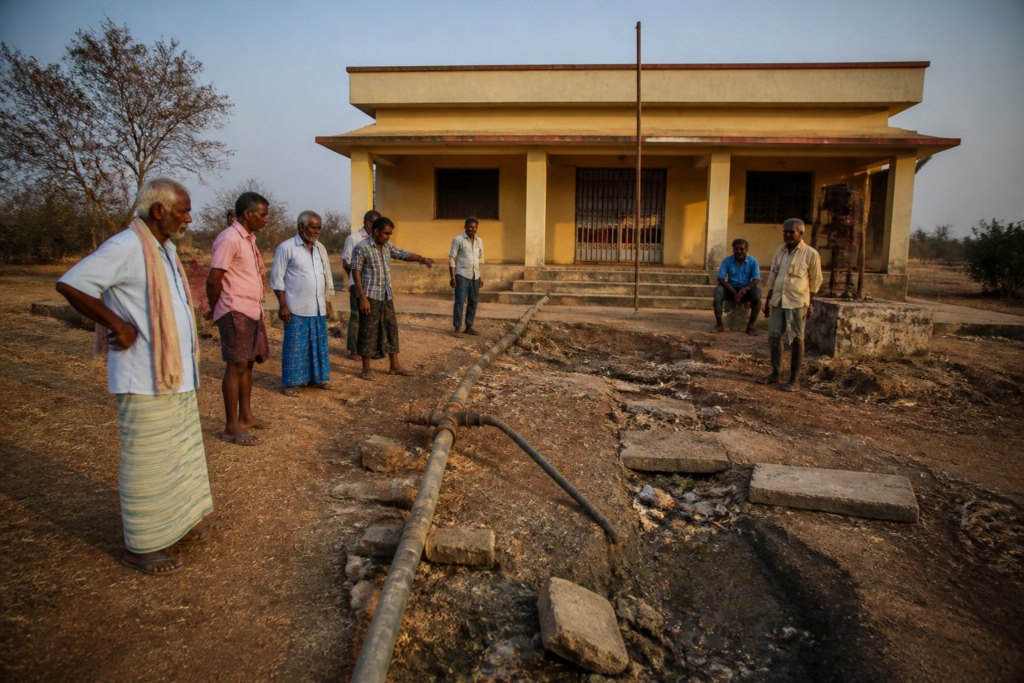
The report describes arguments between contractors and Panchayat Development Officers as increasingly common because payments for works have remained pending. It also says that, in drought conditions, contractors and suppliers are reluctant to undertake repairs to drinking-water pipelines and motors when earlier dues have not been cleared. In some places, sanitation activities have been affected, while some village panchayat offices have reportedly been locked.
These consequences show how a transfer delay can become a service-delivery problem. Rural infrastructure is often treated as a collection of small works: a borewell repair, a pipeline replacement, drain cleaning or waste collection. Yet these systems depend on regular maintenance and quick procurement. Their failure is visible at the level of households and neighbourhoods, even when the originating problem lies in intergovernmental finance.
The pressure has also exposed a conflict over the use of local funds. The report says the state government created a Prajaseva Department to hear and resolve public grievances and made weekly public grievance meetings on Saturdays mandatory. A government order allows resources from village panchayats and other local bodies to be used for the Prajaseva campaign.
Village panchayat employees and members have objected to using panchayat resources for these activities while Finance Commission grants remain delayed and drought conditions continue. Their position, as reported by Prajavani, is that funds meant for local public services should not be diverted or committed to additional administrative programmes when basic infrastructure maintenance is already under financial strain.
This dispute raises a question about the meaning of decentralisation. Assigning functions to panchayats without ensuring predictable and adequate finances leaves local governments responsible in practice but dependent in operation. Residents approach the panchayat when water supply fails, sanitation deteriorates or a drain remains blocked. They do not experience the distinction between a delayed central transfer, a state-level rejection or a local revenue shortfall. The service failure is simply located in their village.
The Panchayat Development Officers’ Welfare Association has sought emergency assistance of ₹10 lakh for every village panchayat until the pending Finance Commission grants are released. According to the report, the association has also asked that the emergency amount be recovered after the grants recommended by the 15th Finance Commission are disbursed. It has called for panchayats to receive a larger share of the tax revenue collected by the Centre and the state, along with stricter implementation of the devolution of powers.
The request for emergency support reflects the difference between planned funding and operational liquidity. Even if a panchayat is ultimately entitled to a grant, a long delay can make it impossible to meet immediate obligations. Contractors need payment when work is completed, and water or sanitation failures cannot always wait for the next release cycle. The proposed ₹10 lakh assistance is therefore framed as a bridge until the larger transfer is received, not as a replacement for the Finance Commission allocation.
The institutional design also places importance on the timing of releases. Panchayats prepare action plans in advance and undertake works on that basis. If funds are released only after a long interval, the original plan may no longer match local needs or seasonal conditions. Water repairs become more urgent during drought, while delayed drain or waste-management work can create public-health and environmental problems. The supplied report does not establish the precise administrative reason for the delay, but it records its financial and operational consequences.
The episode also demonstrates why rural local bodies should be read as part of India’s wider built environment. Village panchayats manage public systems that are smaller than city infrastructure but no less essential: water points, local roads and drains, sanitation facilities, waste systems and community assets. Their budgets may be modest, but their responsibilities are immediate and geographically dispersed.
The evidence in the report points to three connected weaknesses. First, panchayats have limited own-source revenue and cannot independently sustain essential services for an extended period. Second, the transfer system is vulnerable to delays even after works have been planned and undertaken. Third, local resources are being asked to support additional public-facing programmes while the underlying service budget remains under pressure.
What remains unresolved is the release schedule for the ₹2,186 crore, the number of panchayats affected and the extent of unpaid contractor and supplier dues. The report also does not provide a district-wise assessment of water, sanitation or waste-management disruptions. Those details would be necessary to measure the full scale of the crisis. The immediate institutional milestones are the state’s response to the demand for emergency assistance and the release of the pending 15th Finance Commission grants.