

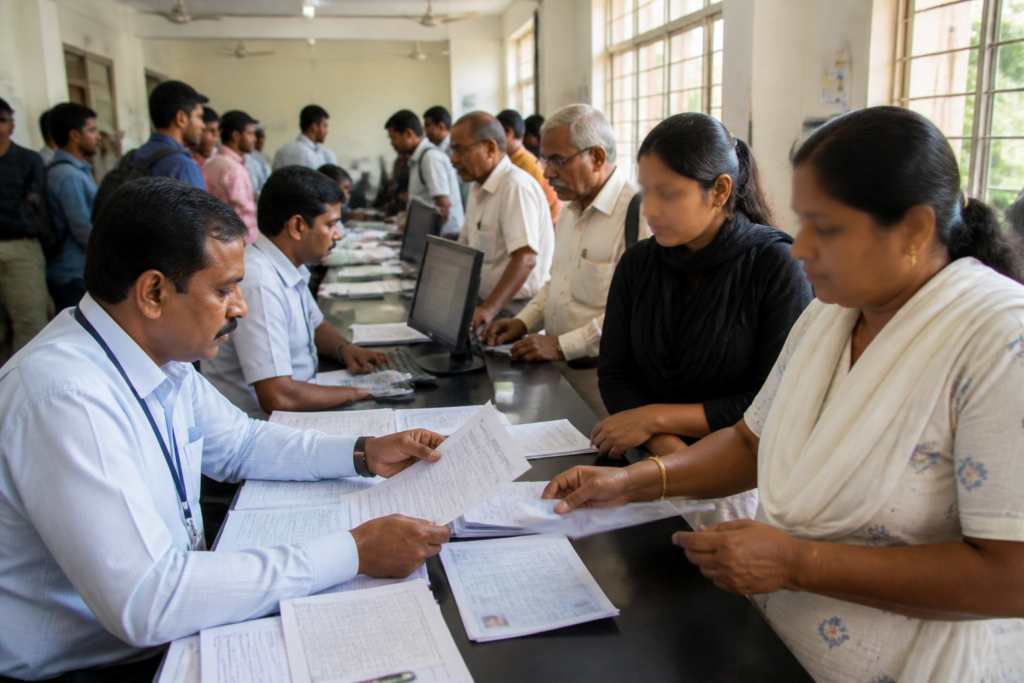
Karnataka’s electoral rolls have crossed a historic threshold: women now outnumber men among registered electors for the first time in the state’s electoral history. The provisional figures, released during the final stage of the Special Intensive Revision (SIR), list 2.28 crore women and 2.25 crore men as of October 16, giving women a lead of nearly 3.7 lakh.
The headline number is significant, but it is not yet the final picture of Karnataka’s electorate. The Chief Electoral Officer’s office is still processing claims, objections, corrections and new enrolment applications. The final electoral roll is scheduled to be published on October 27, after the disposal of claims and objections by October 22.
That makes the current gender balance both a demographic milestone and an administrative snapshot. It reflects who is currently present in the rolls during an intensive revision process, rather than offering a complete explanation of why women have overtaken men or whether the lead will remain unchanged after all pending applications are decided.
## What the Karnataka electoral rolls show
The state has 4.5 crore electors, including 2,860 third-gender voters. Women account for approximately half of the electorate and, in the October 16 figures, exceed the number of male electors by nearly 3.7 lakh. The source report says this is the first time in Karnataka’s electoral history that the female electorate has moved ahead of the male electorate.
An analysis of historical Election Commission of India data for Karnataka Assembly election years found that men outnumbered women in every year from 1962 through 2023 for which a separate gender-wise breakdown was available. The 1957 report gave the total electorate but did not provide separate male and female figures, making 1962 the earliest comparable year in the available series.
The change therefore marks a break from the recorded pattern, but the available figures do not by themselves establish a single cause. The latest roll has been assembled during a process that has generated a large volume of applications and hearings, and the electoral authorities have not yet completed every case.
The district-level distribution is also uneven. Women outnumber men in 25 of the 34 districts listed in the release, while men remain ahead in nine. Mysuru has the largest female lead, at 49,416 electors, followed by BBMP North, where women lead by 48,394. The strongest male leads are recorded in Bidar, where men outnumber women by 42,269, and Vijayapura, where the male lead is 30,353.
This spread matters because the statewide result is not being produced uniformly across Karnataka. It combines districts where women already have a substantial lead with others where men remain significantly ahead. The figures point to a geographically differentiated electorate, although the supplied data does not provide the social, demographic or administrative reasons behind those district-level differences.
## The revision process behind the milestone
The Special Intensive Revision is central to understanding the numbers. According to Chief Electoral Officer Anbu Kumar V, the office received 10 lakh new Form 6 applications, of which more than 7.8 lakh were submitted before September 23. Form 6 is used for new voter enrolment. The officer said all the applications needed to be cleared before a clear picture could emerge.
The office also reported that 43,82,824 notices had been generated and delivered across Karnataka by October 16. Hearings had been completed in 43,63,459 cases, or 99.6% of the total, leaving 19,365 pending. Gulbarga had the highest number of pending hearings, at 8,224, with 92.21% completed. Bengaluru Urban had 1,016 pending hearings and Belgaum had 1,495.
These figures show the administrative scale of the exercise. The gender balance is not an isolated statistic released outside the roll-maintenance system; it is emerging from a process involving notices, hearings, enrolment forms, objections and corrections. Until the process closes, the numbers can still move.
Between June 16 and October 15, the Chief Electoral Officer’s office received 24,46,803 forms connected with claims, objections and updates. These included 10,07,392 Form 6 applications, 4,777 Form 6A applications, 1,55,109 Form 7 applications and 12,79,525 Form 8 applications.
The distribution of these forms illustrates why the final roll is important. Form 6 applications can add new electors, while other forms relate to claims, objections and updates. The supplied report does not provide a final outcome for each category, so it is not possible to calculate from the current figures how many names will be added, removed or altered before publication.
## Why the numbers require administrative context
Voter rolls are built through an institutional process rather than through a single population count. The Chief Electoral Officer’s office receives applications, issues notices where required, conducts hearings and decides claims and objections before publishing the final roll. Each stage can affect the composition of the electorate recorded in a district.
That distinction is important in interpreting the female lead. Professor CM Lakshmana of the Population Research Centre at the Institute for Social and Economic Change described the trend as surprising. He noted that recent Census-based adult male-female ratios were nearly equal but that men outnumbered women, and said granular data would be needed to make assessments.
His observation places a clear limit on what can be concluded from the roll alone. The electoral data shows a registered-voter balance; it does not, by itself, explain the relationship between the registered electorate and the wider adult population. Nor does the supplied material establish whether the shift is driven primarily by new female enrolment, changes in older records, migration, corrections, deletions or a combination of factors.
The figures nevertheless provide a useful governance signal. They show how a revision exercise can reveal changes in participation and registration patterns at a scale visible across an entire state. They also show why electoral administration is closely linked to urban governance: the process must manage large volumes of applications and hearings across districts with very different levels of pending work.
## Bengaluru’s place in the changing electorate
Bengaluru appears in the district-level figures through BBMP North, where women outnumber men by 48,394. Bengaluru Urban has 1,016 pending hearings as of October 16. These figures do not provide a complete citywide gender profile, but they place the metropolitan region within the wider administrative picture.
For a city that receives migrants, adds new households and experiences frequent changes of address, the accuracy and timeliness of electoral records are particularly consequential. However, the supplied report does not provide migration data, ward-level numbers or a breakdown of applications by gender for Bengaluru. Any more detailed conclusion about the city would therefore require additional evidence.
The available figures do show that the metropolitan electorate is being processed alongside the rest of the state through the same revision framework. Bengaluru’s pending cases are much lower than Gulbarga’s in absolute terms, but the report does not provide comparable district totals for every area, so the relative completion rate cannot be assessed from the supplied information.
## What the final roll will clarify
The October 27 final roll is the next decisive administrative milestone. It will show the electorate after the claims-and-objections process and the clearance of pending applications. Until then, the October 16 figures should be read as an important but provisional stage in the revision.
The final publication will help establish whether women continue to outnumber men, how much the district-level leads change and how the large volume of Form 6, Form 7 and Form 8 applications affects the overall count. It may also provide a firmer basis for examining why Karnataka has moved away from the gender pattern recorded in the available election data from 1962 to 2023.
What the current evidence confirms is narrower but still consequential: Karnataka’s electoral rolls have, for the first time in the available state history, recorded more women than men; the lead is nearly 3.7 lakh; women are ahead in 25 of 34 listed districts; and the figures have emerged while a major revision process remains unfinished. The next test is whether the final roll published on October 27 preserves that historic balance.


