

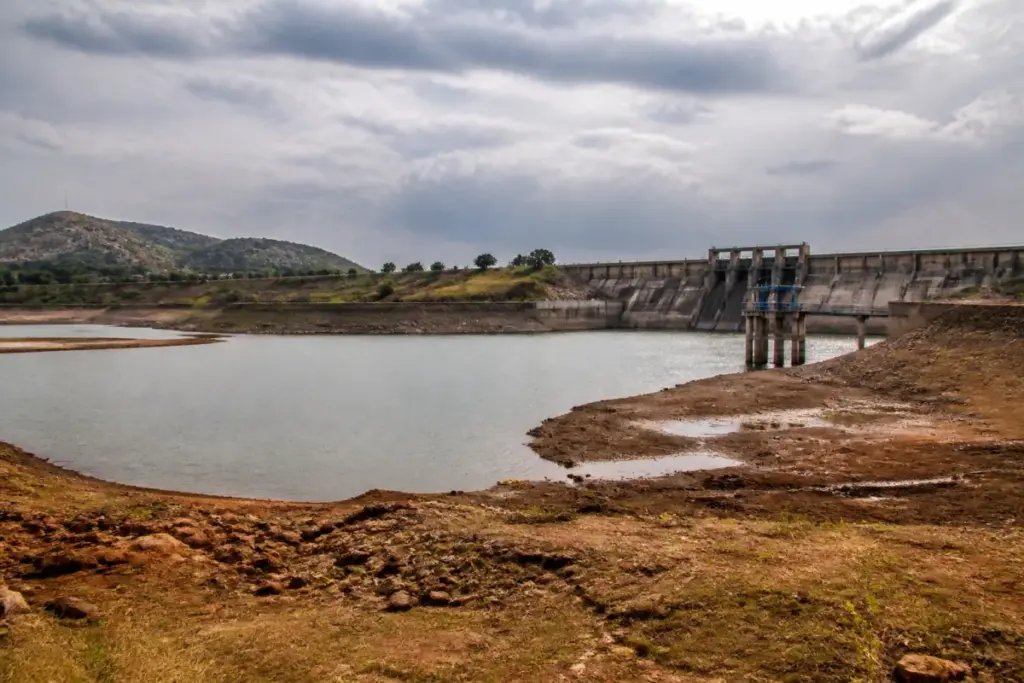
Karnataka dam water levels have fallen sharply after a deficient southwest monsoon, with the state’s 14 major reservoirs holding 540.94 TMC feet of water, or about 60% of their combined capacity, according to a report by Prajavani published on October 18. The storage was 824.56 TMC feet during the same period last year, the report said.
The decline has been recorded even as Karnataka continues releasing water to Tamil Nadu, Telangana and Andhra Pradesh. Unlike previous years, when most reservoirs were generally close to full by October before storage began falling during the irrigation and drinking-water season, several reservoirs did not fill adequately this year, according to the report.
The state’s reservoirs together have a storage capacity of 895.65 TMC feet. The Cauvery basin reservoirs are under particular pressure, with storage reported at 54.74 TMC feet, or 48% of their 114 TMC feet capacity. At the same time last year, the basin held 108.82 TMC feet, the report said.
The Krishna basin has comparatively higher storage at 296 TMC feet, representing about 70% of its 422 TMC feet capacity. However, this is still below last year’s level of 393 TMC feet. Three reservoirs in the Malnad region together hold 170 TMC feet, or 52% of their 328 TMC feet capacity, compared with 294 TMC feet during the same period last year.
Among individual reservoirs, the report said Linganamakki held 78 TMC feet, or 51% of capacity, against 140.25 TMC feet last year. Its inflow was 1,329 cusecs while the outflow was 6,179 cusecs. Supa held 76.77 TMC feet, or 53% of capacity, compared with 124.09 TMC feet last year; inflow stood at 510 cusecs and outflow at 5,658 cusecs.
The Harangi reservoir held 4.76 TMC feet, or 56% of capacity, compared with 8 TMC feet last year. Its inflow was 669 cusecs and outflow 1,200 cusecs. Hemavathi held 15.76 TMC feet, or 42% of capacity, against 32.43 TMC feet last year, with inflow of 996 cusecs and outflow of 300 cusecs.
Bhadra was among the better-performing reservoirs, holding 56.22 TMC feet, or 79% of capacity, although this was below last year’s 69.22 TMC feet. Its inflow was 339 cusecs and outflow 617 cusecs. The report said the Tungabhadra reservoir held 55.64 TMC feet, or 53% of capacity, compared with 69.22 TMC feet last year. Its inflow was zero, while outflow stood at 12,277 cusecs.
The Ghataprabha reservoir remained full, with 50.77 TMC feet and an outflow of 164 cusecs. Malaprabha held 21.10 TMC feet, or 56% of capacity, compared with 37.73 TMC feet last year. Vanivilas Sagar held 19.84 TMC feet, or 65% of capacity, against 28.34 TMC feet last year, with no reported inflow or outflow. The figures underline the pressure on Karnataka’s water-storage system before the winter irrigation and drinking-water demand period begins.


