

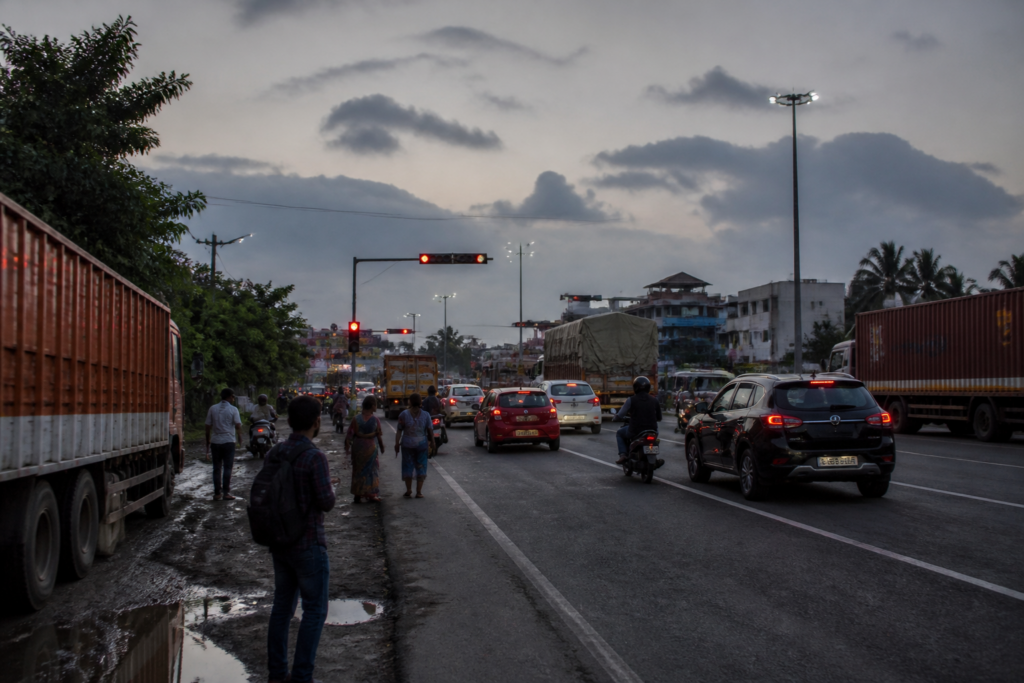
A recent fatal crash at Karayamparambu in Angamaly has again drawn attention to a dangerous stretch of National Highway between Karukutty and the Angamaly TELK junction, where repeated collisions are raising questions about road design, traffic management and the absence of sustained safety action. The central issue is not only the latest death, but why a junction described as a regular accident location continues to expose pedestrians, motorists and roadside communities to preventable risks.
According to a report by Mathrubhumi, a man identified as Gopalakrishnan, from Karaikkattuparambil in Mangattukara, Angamaly, was killed on Thursday after being struck by a tipper lorry while walking home after buying rice from a ration shop. The lorry was carrying granite stones. The fatality occurred at or near the Karayamparambu signal junction, which the report identifies as one of the most accident-prone points along the highway stretch.
The report describes crashes as a frequent occurrence at the junction and its surrounding area. Vehicles stopping at the signal are routinely hit from behind, while pedestrians are said to cross the road in fear. Residents have submitted several petitions seeking stronger road-safety measures, but Mathrubhumi reports that no effective action has followed those representations.
The pattern outlined in the report points to a road environment where several risks overlap. Excessive speed is identified as a major cause of crashes. The highway is also carrying heavier traffic, visibility is limited at night, vehicles are parked along the roadside and traffic arrangements at junctions are considered inadequate. Together, these conditions can turn a signalised intersection into a conflict zone for through traffic, turning vehicles, parked heavy vehicles and people attempting to cross the road.
The danger is particularly severe for pedestrians. The report says that areas with a high volume of pedestrian movement lack adequate facilities for safe road crossings. It also identifies insufficient street lighting, warning boards and road markings as weaknesses. These are not minor roadside conveniences. They determine whether a driver can identify a crossing, whether a pedestrian is visible in time and whether vehicles approaching a junction receive clear instructions about speed, lanes and stopping.
The recent death follows other fatal crashes mentioned in the report. On February 28, a student named Jasliya was killed in a road accident near Morning Star College. The report says an allegedly speeding car struck her. On June 29, a motorcyclist named Sharath died after his bike collided with the rear of a lorry parked on the roadside near TELK. These incidents occurred at different points on the same broader highway corridor, but together they underline the range of risks present: speeding traffic, roadside parking and exposure of pedestrians and two-wheeler users.
The presence of parked heavy vehicles is especially important in understanding the corridor’s safety problem. Mathrubhumi reports that lorries parked beside the road at night create a hazard for other road users. It also points to unauthorised parking along the side of the approach road to the Karayamparambu bridge. A parked vehicle can reduce visibility, narrow the usable carriageway and create a sudden obstacle for a motorcyclist or car driver. When lighting is poor, the hazard becomes harder to detect until the distance available for braking has already reduced.
The signal junction itself appears to be functioning as more than a point where vehicles stop and start. It is also a meeting point for local trips, walking routes, highway traffic and access to nearby institutions and shops. The report’s reference to a ration shop, Morning Star College, TELK and the bridge approach shows that the corridor serves everyday local movement as well as longer-distance traffic. This mixed use makes speed management and pedestrian protection central to the junction’s operation.
A signal alone does not guarantee safety. Its effectiveness depends on the approach speed of vehicles, the visibility of the signal, the length of stopping space, the clarity of lane markings and the ability of pedestrians to cross without entering unpredictable traffic movements. The repeated rear-end collisions described at Karayamparambu suggest that stopping behaviour and approach conditions require closer examination. The report, however, does not provide an engineering audit, crash map or official findings identifying which specific design intervention would be appropriate.
That limitation matters because road-safety action needs to distinguish between different kinds of failure. If speeding is the main problem, enforcement and traffic-calming measures may be required. If poor visibility is contributing to crashes, lighting, signage and junction illumination become important. If parked lorries are obstructing sightlines or lanes, parking enforcement and designated freight-management arrangements would be necessary. If pedestrians lack a safe crossing, the junction may need a formally designed crossing facility rather than informal attempts to cross between traffic gaps.
The report records that residents have already submitted multiple petitions. This indicates that the risk has been visible to the local community for some time rather than emerging only after the latest fatality. Yet the material supplied does not identify which authority received the petitions, whether any site inspection was conducted, whether crash data were reviewed or whether a time-bound remedial plan was issued. Those institutional details are essential to understanding where responsibility for the continuing danger lies.
A highway junction can involve several agencies and responsibilities. Traffic police may oversee enforcement and traffic regulation. The road-owning agency may be responsible for carriageway design, signs, markings, lighting or safety upgrades. The local administration may influence parking control and access management. Nearby institutions, businesses and property users also shape pedestrian and vehicle movement. The supplied report does not establish how these responsibilities are divided at Karayamparambu, but the absence of a clearly visible response raises a governance question: when repeated crashes occur at one location, which institution is expected to lead the corrective action?
The corridor’s safety challenge is also connected to the changing role of national highways through built-up areas. Such roads are designed to move large volumes of traffic, but they often continue to function as local streets at the same time. People walk to shops, ration outlets, colleges and homes; two-wheelers enter and leave side roads; buses and goods vehicles stop; and residents cross the carriageway. When a high-speed corridor passes through this kind of urbanising environment without adequate separation between through movement and local access, the road can become dangerous even when traffic signals are present.
The available evidence does not establish the total number of crashes at Karayamparambu, the speed profile of vehicles, the road’s lighting levels or the exact traffic volume. It also does not state whether the junction has a pedestrian crossing, footpath, refuge island, speed camera, rumble strips or other safety infrastructure. These gaps should not obscure the evidence that is available: the report identifies repeated accidents, three named fatal incidents in the wider stretch, speeding, night-time visibility problems, roadside parking, inadequate junction management and unsafe pedestrian crossing conditions.
The distinction between a single crash and a recurring black spot is important for public administration. A single collision may require investigation of the immediate circumstances. Repeated collisions at the same location require a wider review of the road environment. That review would need to examine the junction, bridge approach, parking practices, visibility, signal operations, pedestrian movement and the location of earlier crashes. The report says residents are seeking such action through studies of accident-prone locations and measures to reduce crashes, but it does not record that such a study has been completed.
For people living and travelling along the Angamaly corridor, the result is an everyday safety burden. Pedestrians are reported to cross in fear, while motorists face queues, parked heavy vehicles and sudden stopping at signals. Families near the highway are exposed not only to the risk of a collision but also to the consequences of poor lighting and inadequate crossing infrastructure. The deaths of Gopalakrishnan, Jasliya and Sharath give the problem a human dimension, but the wider exposure includes everyone using the corridor each day.
Karayamparambu therefore represents a structural road-safety question rather than only an isolated accident story. The immediate facts are clear enough to justify attention: a recent death, earlier fatalities, recurring crashes and a series of environmental risks identified by residents and reported by Mathrubhumi. What remains unclear is whether the responsible agencies have formally assessed the location and what corrective measures, if any, have been scheduled. The next meaningful developments would be an official safety audit, a documented response to residents’ petitions, action on roadside parking and a publicly identified plan for pedestrian protection, lighting, signs, markings and junction traffic management.


