

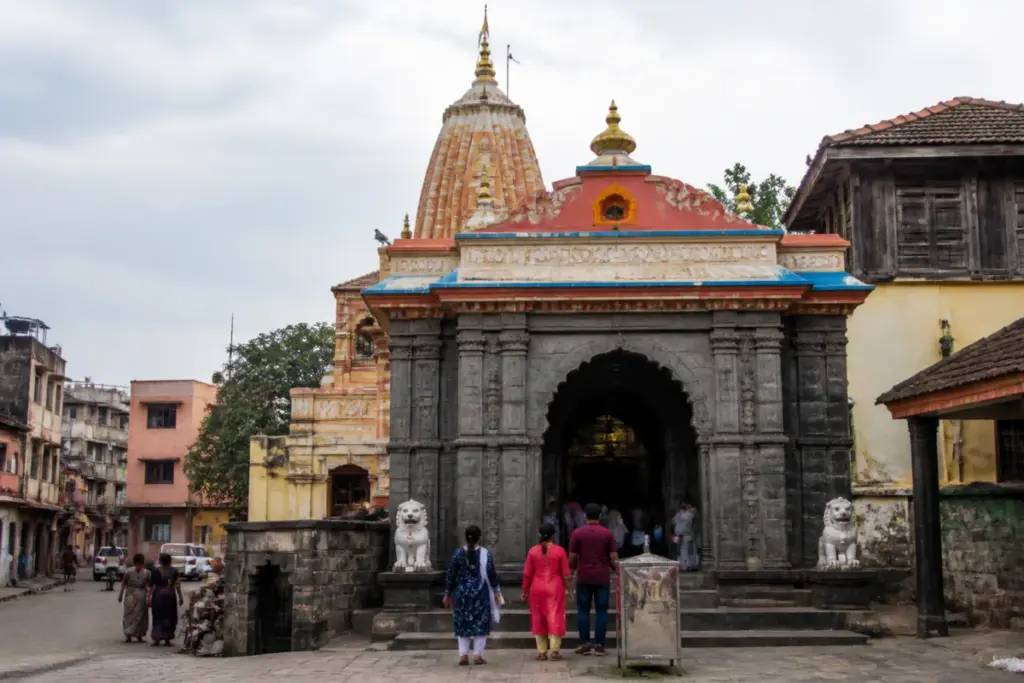
The Bombay High Court has stayed an order of the Joint Charity Commissioner concerning worship arrangements at Pune’s historic Kali Jogeshwari Temple, allowing the existing interim system to continue until a final decision in the appeal. The order gives the Bhide family temporary relief in its dispute with the Shri Devdeveshwar Sansthan over the right to conduct पूजा-related rituals at the temple.
Justice Aarti Sathe observed that there had been no change in circumstances since 2023 that required the existing arrangement to be altered. The court also noted that the first appeal raised issues requiring consideration. The challenged order will therefore remain stayed until the appeal is finally decided.
Under the arrangement continued by the court, the Shri Devdeveshwar Sansthan, based in Pune’s Parvati and Kothrud areas, may place a signboard and donation box within the temple premises. However, it cannot appoint any person to conduct पूजा or abhishek rituals. Trustees and devotees may enter the temple to offer prayers, while the religious ceremonies will continue according to the interim directions currently in force.
The court has not issued a final ruling on the competing claims over management of the temple or on the Bhide family’s alleged hereditary right to conduct religious rituals. The dispute therefore remains pending, with the interim order determining how the temple will function during the appeal.
According to submissions made on behalf of the Bhide family, its members have performed पूजा, worship, offerings and abhishek at the temple for about 120 years, across five generations. Their lawyer, Chaitanya B. Nikte, argued that the family’s traditional relationship with the temple predates the establishment of the institution that now claims authority over it. The family’s position is that such a traditional right cannot be ended without a proper judicial determination of the underlying evidence.
The family has also challenged the institution’s interpretation of a scheme prepared on 16 March 1971. Its written submissions state that the scheme distinguishes between properties owned by the institution, temples receiving financial grants and other listed religious sites. The family argues that Kali Jogeshwari Temple does not appear in Schedules A, B or C, which it says relate to the institution’s properties and specified temples. Instead, it is listed at number 20 in Schedule D, which records ancient temples receiving financial grants.
On that basis, the family has argued that inclusion in a schedule of grant-receiving temples does not by itself establish ownership or give the institution exclusive authority over religious rituals. It has cited municipal and property-tax records dating from 1937, along with other historical documents, to support its claim of a long-standing association with the temple.
The family further claims that the temple was established around 1825, while the Shri Devdeveshwar Sansthan was established in 1952. It has referred to historical records, including an Inam Commission report, to argue that financial grants to ancient temples should not automatically be treated as proof of ownership or exclusive control over worship.
The Shri Devdeveshwar Sansthan, according to the report, maintains that the temple belongs to it and that the Bhide family had been appointed to provide religious services. The institution had initiated proceedings under Section 41E of the Maharashtra Public Trusts Act, 1950, seeking directions against alleged interference in its administration, the appointment of priests and employees, the conduct of religious ceremonies and the collection of donations.
The High Court’s interim order keeps the existing arrangements in place while these questions are considered in the appeal. A final determination on ownership, management and hereditary worship rights is still pending.


