

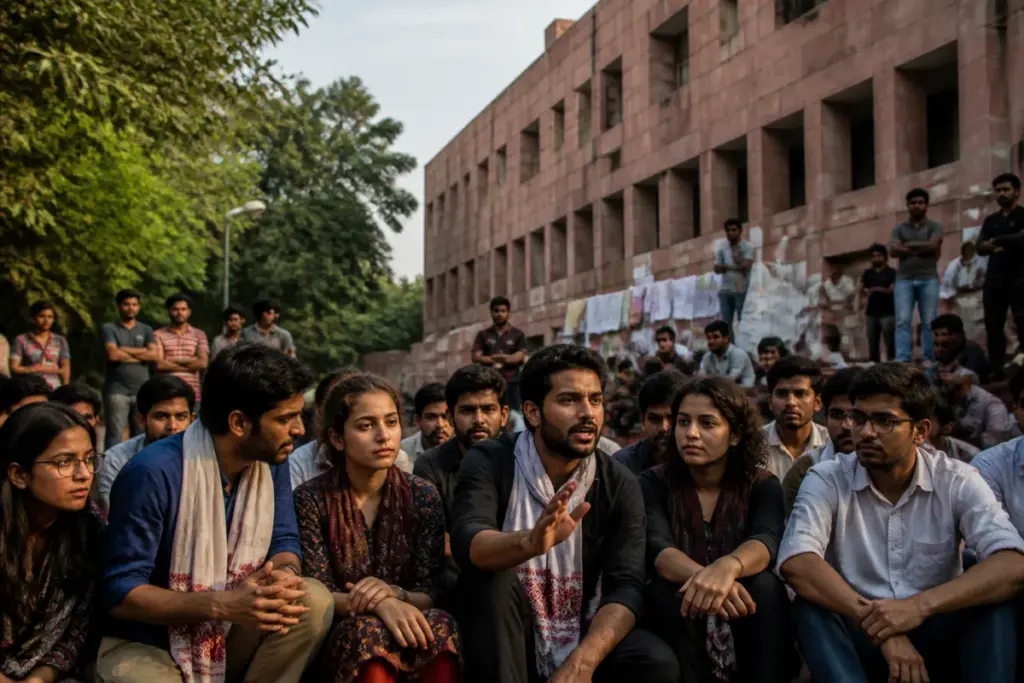
The JNU protest ended on Tuesday after Jawaharlal Nehru University revoked the rustication orders against five student leaders and agreed to several demands raised during a 17-day hunger strike. The decision covers JNUSU president Aditi Mishra, vice-president K. Gopika Babu, general secretary Sunil Yadav, joint secretary Danish Ali and former JNUSU president Nitish Kumar.
The five students had been rusticated and asked to pay a penalty of ₹20,000 each on February 8 over allegations of vandalism during a demonstration the previous year against the installation of a biometric entry system at the Dr. B.R. Ambedkar Central Library. The administration has asked them to clear the fines immediately.
The impasse ended after Vivek Kumar, Dean of the School of Social Sciences, met student representatives on Monday and agreed to withdraw the rustication orders. The decision was one of 13 demands submitted by the protesters. According to the minutes of the meeting, the university also agreed to withdraw all FIRs registered against students for protests that followed the rustication and review the 2023 Chief Proctor Office manual governing demonstrations.
The manual prescribes stringent fines for protesting students. The administration’s agreement to review it places the university’s rules on demonstrations at the centre of the dispute, alongside the immediate question of penalties against the five students.
The university also agreed to form a committee, including a JNUSU representative, to examine the possibility of restoring the JNU Entrance Examination in place of the present admission process based on examinations conducted by the National Testing Agency. Other commitments include an audit of the Equal Opportunity Office, a panel on hostel reservations, consideration of a 25% increase in merit-cum-means scholarships, and structural audits and renovation of all hostels.
Vice-Chancellor Shantishree Dhulipudi Pandit said the administration had never taken “extreme action” against the students, whom she accused of destroying public property worth ₹20 lakh. In a release, she said the students had violated prescribed restrictions, including remaining on campus and participating in protests that the university described as political, allegedly in violation of their bail conditions.
The JNUSU described the hunger strike as part of a wider struggle against what it called the “criminalisation of dissent”. The union said the administration had been forced to “bow down before the collective strength of the student community” and added that it would monitor the commitments to ensure they did not become “empty promises, indefinite consultations or bureaucratic delays”.


